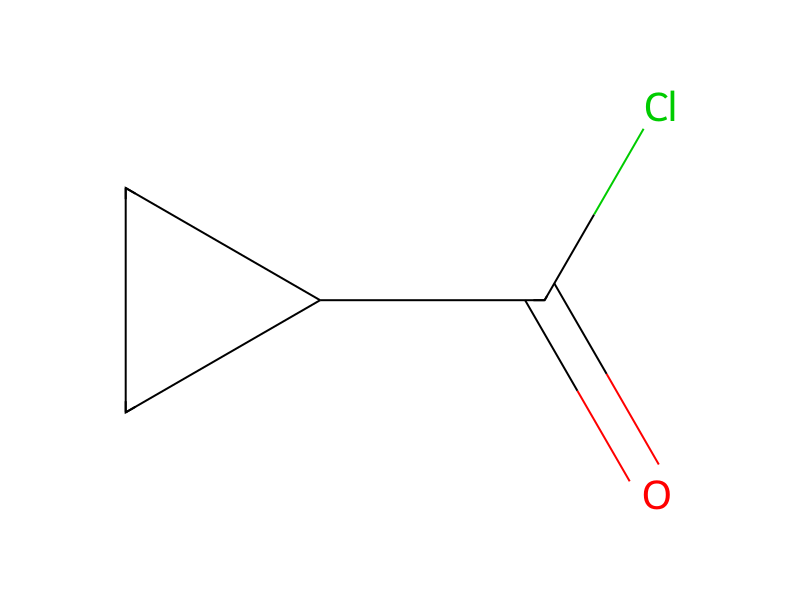
Cyclopropanecarbonyl chloride → 2-Cyclopropylcarbonyl-1-methyl-1H-imidazo[4,5-c]quinoline
Reaction equation

[CH3:1][N:2]1[C:14]2[C:13]3[CH:12]=[CH:11][CH:10]=[CH:9][C:8]=3[N:7]=[CH:6][C:5]=2[N:4]=[CH:3]1.C([Li])CCC.[CH:20]1([C:23](Cl)=[O:24])[CH2:22][CH2:21]1>C1COCC1.CCCCCC>[CH:20]1([C:23]([C:3]2[N:2]([CH3:1])[C:14]3[C:13]4[CH:12]=[CH:11][CH:10]=[CH:9][C:8]=4[N:7]=[CH:6][C:5]=3[N:4]=2)=[O:24])[CH2:22][CH2:21]1Participants
Reactant 3


Product 1

Reagents, catalysts & solvents 2


Procedure
In the same manner as in Ex. 1, to a solution containing 550 mg of 1-methyl-1H-imidazo[4,5-c]quinoline (II-2) in 25 ml of THF and a mixture of 2.2 ml of 1.6M solution of n-butyl lithium in hexane-2 ml of THF was added 0.75 g of cyclopropanecarbonyl chloride. The reaction mixture was gradually warmed to room temperature and concentrated under reduced pressure. The residue was partitioned between ethyl acetate and aqueous ammonia. The organic layer was washed with water and brine, and then dried. The ethyl acetate was removed by evaporation, and the residue was chromatographed on a column of silica gel for purification. The fraction eluted with ethyl acetate was concentrated and the residue was crystallized from n-hexane to give 275 mg (yield: 36%) of the titled compound (Ia-1). This was recrystallized from ethyl acetate n-hexane to give colorless crystals melting at 156°~158° C.
Workup
- concentrationconcentrated under reduced pressure
- customThe residue was partitioned between ethyl acetate and aqueous ammonia
- washThe organic layer was washed with water and brine
- customdried
- customThe ethyl acetate was removed by evaporation
- customthe residue was chromatographed on a column of silica gel for purification
- washThe fraction eluted with ethyl acetate
- concentrationwas concentrated
- customthe residue was crystallized from n-hexane
Sources & evidence
- ORD record
- ord-e1a5f66a1bc844b484a28695a3e487c6
- Source dataset
- uspto-grants-1990_07
- Patent number
- US04940714
Reaction notes
Loading…