Tetrahydrofuran → HCID 178420696, compound
Reaction equation

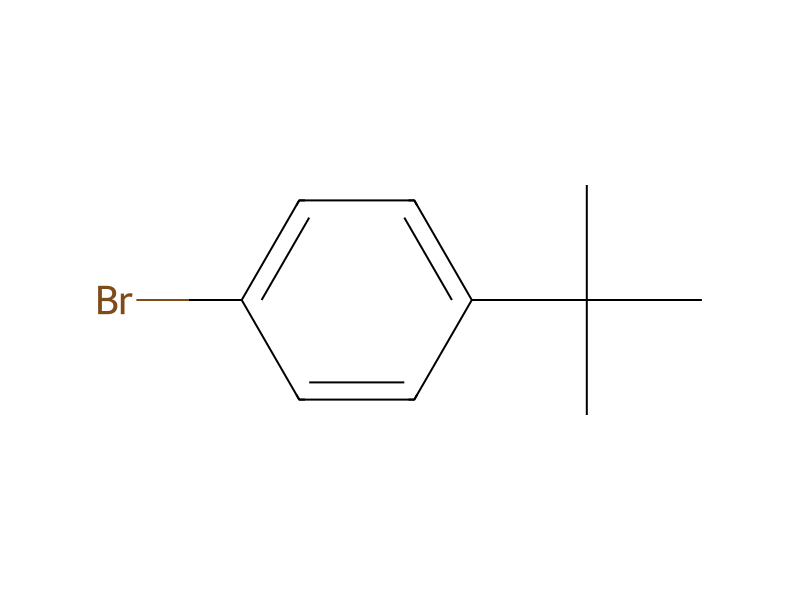
Br[C:2]1[CH:7]=[CH:6][C:5]([C:8]([CH3:11])([CH3:10])[CH3:9])=[CH:4][CH:3]=1.C([Li:16])CCC.CCCCCC.[O:23]1[CH2:27][CH2:26][CH2:25][CH2:24]1>>[C:8]([C:5]1[CH:6]=[CH:7][C:2]([Li:16])=[CH:3][CH:4]=1)([CH3:11])([CH3:10])[CH3:9].[CH2:26]1[CH2:27][O:23][CH2:24][CH2:25]1Participants



Conditions
- Temperature
- -70 °C
Procedure
Under an argon gas flow, a reaction container was charged with 1-bromo-4-tert-butylbenzene (125 g, 587 mmol) and tetrahydrofuran (470 mL) and cooled to −70° C. An n-butyllithium/hexane solution (1.6 M, 367 mL, 587 mmol) was dropped into the mixture at −70° C. over 90 minutes, and after the completion of the dropping, the mixture was stirred at −70° C. for 2 hours to obtain a 4-tert-butylphenyllithium/THF solution. Under an argon gas flow, another reaction container was charged with cyanuric chloride (50.8 g, 276 mmol) and tetrahydrofuran (463 mL) and cooled to −70° C. The 4-tert-butylphenyllithium/THF solution previously prepared was slowly dropped into the mixture, with cooling so that the reaction temperature was −60° C. or less. After the completion of the dropping, the reaction solution was stirred at −40° C. for 4 hours and at room temperature for 4 hours. Water (50 mL) was added to this reaction mixture to complete the reaction, and the tetrahydrofuran was distilled off. Water (1 L) and chloroform (2 L) were added to the residue to extract the organic layer. Further, the organic layer was washed with water (1 L), and then, the solvent was distilled off. The residue was dissolved in acetonitrile (600 mL), and the insoluble solid was removed by hot filtration. The obtained filtrate was concentrated to about 100 mL and cooled to −70° C. The precipitated solid was recovered by filtration. The recovered solid was dissolved in a chloroform (200 mL)/hexane (600 mL) mixed solvent and purified by silica gel column chromatography (developing solvent: chloroform/hexane). The solvent was distilled off, and the residue was recrystallized from acetonitrile to obtain 2,4-di(4′-tert-butylphenyl)-6-chloro-1,3,5-triazine (41.3 g, 109 mmol).
Sources & evidence
- ORD record
- ord-4b472e5b4ba544dabf746368c9b9e7f1
- Source dataset
- uspto-grants-2015_06
- Patent number
- US09048442B2
Reaction notes
Loading…