Trifluoroacetic acid → 4-Chloro-6,7-difluoro-1H-pyrrolo[3,4-c]pyridin-3(2H)-one
Reaction equation

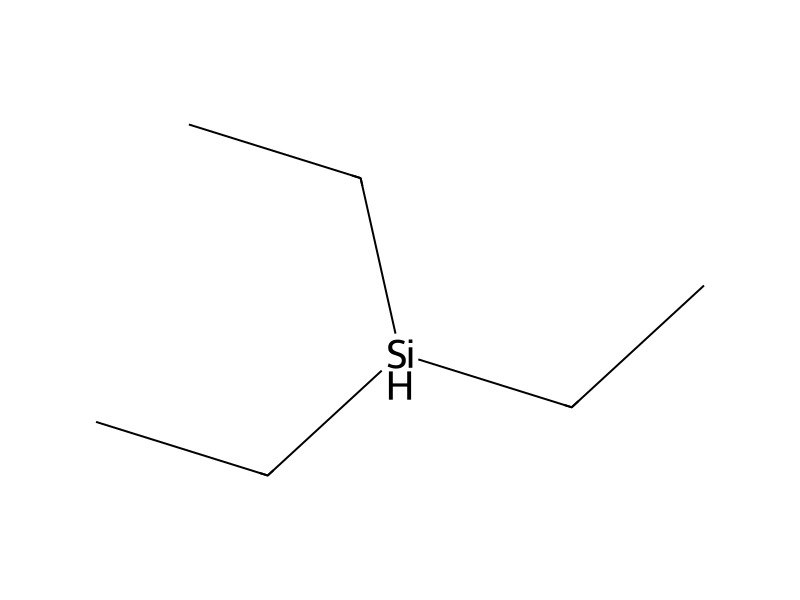
[Cl:1][C:2]1[C:7]2[C:8](=[O:12])[NH:9][CH:10](O)[C:6]=2[C:5]([F:13])=[C:4]([F:14])[N:3]=1.FC(F)(F)C(O)=O.C([SiH](CC)CC)C>CC(OC)(C)C>[Cl:1][C:2]1[C:7]2[C:8](=[O:12])[NH:9][CH2:10][C:6]=2[C:5]([F:13])=[C:4]([F:14])[N:3]=1Participants
Reactant 3


Product 1

Reagents, catalysts & solvents 1

Conditions
- Temperature
- 60 °C
Procedure
To an inert 50 mL round bottom flask with magnetic stirring was added 4-chloro-6,7-difluoro-1-hydroxy-1H-pyrrolo[3,4-c]pyridin-3(2H)-one (4.39 g, 19.90 mmol) and trifluoroacetic acid (18.40 mL, 239 mmol). The solids were suspended with stirring and triethylsilane (7.95 mL, 49.8 mmol) was added. The reaction mixture was heated to 60° C. and stirred for 30 minutes at that temperature. The reaction mixture was subsequently cooled to room temperature and added dropwise to MTBE (88 mL) to produce a white precipitate. The suspension was cooled to 5° C. for 45 minutes. The solids were filtered, washed with MTBE (20 mL) and air dried on the filter to afford the title compound (3.336 g, 82%). 1H NMR (400 MHz, DMSO-d6) δ ppm 4.58 (s, 2H), 9.13 (s br, 1H).
Workup
- stirringwith stirring
- stirringstirred for 30 minutes at that temperature
- temperatureThe reaction mixture was subsequently cooled to room temperature
- customto produce a white precipitate
- temperatureThe suspension was cooled to 5° C. for 45 minutes
- filtrationThe solids were filtered
- washwashed with MTBE (20 mL) and air
- customdried on the
- filtrationfilter
Sources & evidence
- ORD record
- ord-ae7a6c7c50ad4df1b6b1577d342e8b20
- Source dataset
- uspto-grants-2015_06
- Patent number
- US09056873B2
Reaction notes
Loading…