Acetic Anhydride → 5-Methylene-tetrahydro-cyclopenta[c]furan-1,3-dione
Reaction equation

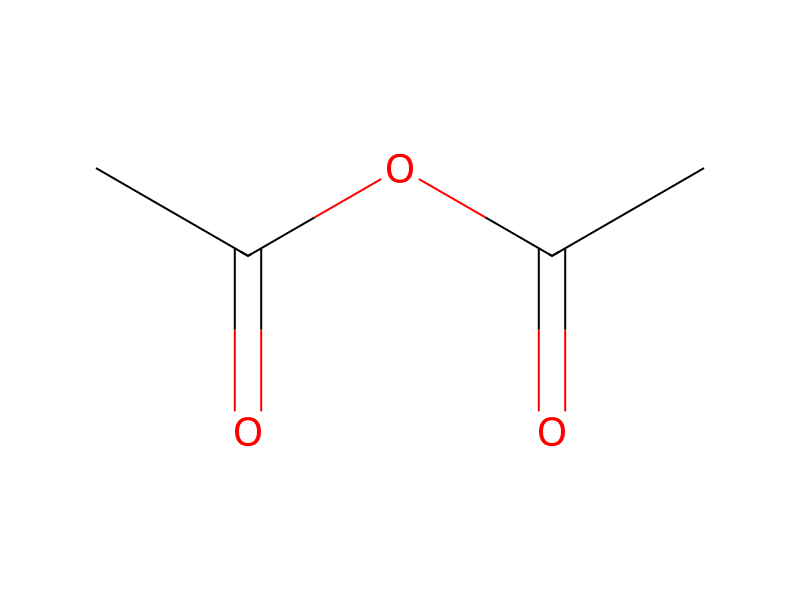
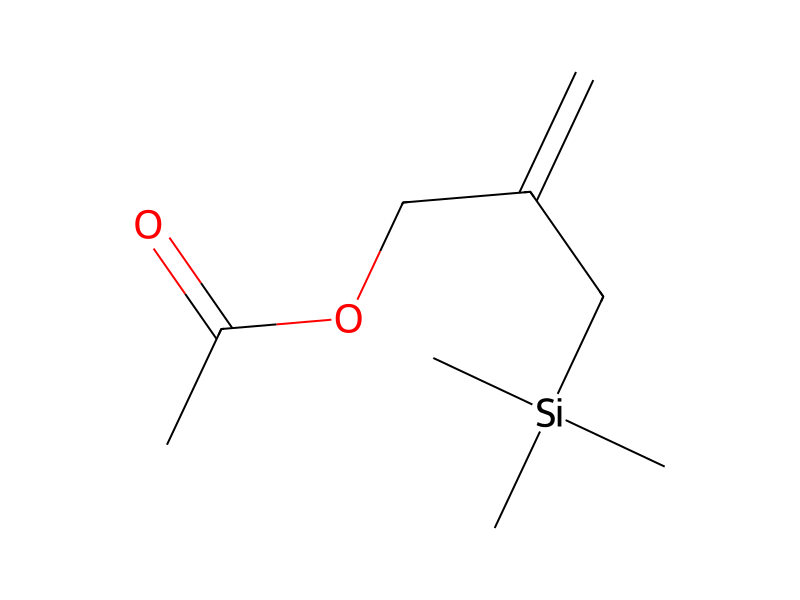
C(O[CH2:5][C:6]([CH2:8][Si](C)(C)C)=[CH2:7])(=O)C.C(OC)(=O)/C=C\C(OC)=O.[C:23]([O:26][C:27](=[O:29])[CH3:28])(=[O:25])[CH3:24]>[Pd]>[CH2:5]=[C:6]1[CH2:8][CH:24]2[C:23](=[O:25])[O:26][C:27](=[O:29])[CH:28]2[CH2:7]1Participants
Reactant 3

Product 1

Reagents, catalysts & solvents 1

Procedure
Methods for the synthesis of suitable 3-azabicyclo[3.3.0]octane intermediates vary. For instance, Flynn et al., Tetrahedron 53(1): 1-20 (1996), provides two approaches to suitably functionalized 3-azabicyclo[3.3.0]octanes. Such reference is herein incorporated by reference with regard to such synthetic teaching. The first approach involves the palladium-catalyzed [3+2] cycloaddition reaction of 2-trimethylsilylmethyl-2-propen-1-yl acetate with dimethyl maleate. The resulting diester is saponified, treated with acetic anhydride, and pyrolyzed to give the fused cyclic anhydride, tetrahydro-5-methylene-1H-cyclopenta[c]furan-1,3(3aH)-dione. Treatment with ammonia followed by cyclization with acetyl chloride gives the imide, tetrahydro-5-methylene-1H-cyclopenta[c]pyrrole-1,3(2H,2aH)-dione. Reduction with lithium aluminum hydride and protection of the free amine with di-tert-butyl dicarbonate gives 7-methylene-3-(tert-butoxycarbonyl)-3-azabicyclo[3.3.0]octane. Subsequent transformations, using this methylene compound, are possible. For instance, ozonolysis of 7-methylene-3-(tert-butoxycarbonyl)-3-azabicyclo[3.3.0]octane will give 3-(tert-butoxycarbonyl)-3-azabicyclo[3.3.0]octan-7-one. Alternately, treatment of 7-methylene-3-(tert-butoxycarbonyl)-3-azabicyclo[3.3.0]octane with borane, followed by aqueous basic hydrogen peroxide, will produce 7-(hydroxymethyl)-3-(tert-butoxycarbonyl)-3-azabicyclo[3.3.0]octane. Oxidation of this alcohol by any number of methods, known to those of skill in the art of organic synthesis, will generate 3-(tert-butoxycarbonyl)-3-azabicyclo[3.3.0]octane-7-carboxylic acid, a key intermediate for the synthesis of compounds of the present invention.
Sources & evidence
- ORD record
- ord-d6e35733c73949c78ca98720fff8148f
- Source dataset
- uspto-grants-2012_06
- Patent number
- US08198296B2
Reaction notes
Loading…