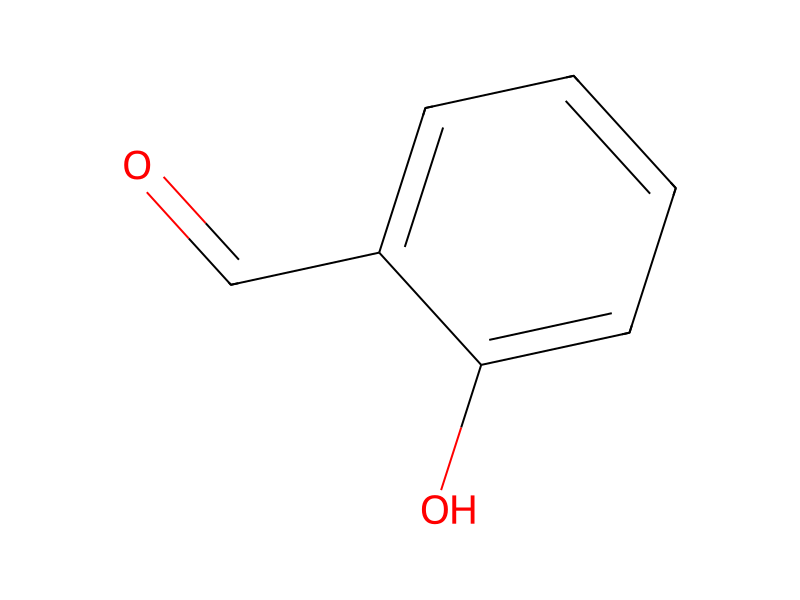
Salicylaldehyde → 1,3-Cycloheptadiene
Reaction equation

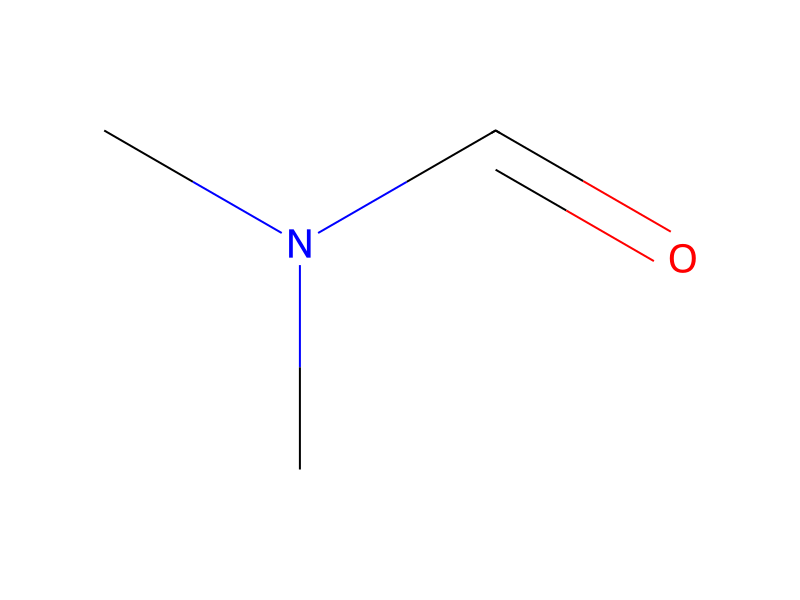
[O:1]1[C:10]2[C:5](=[CH:6][CH:7]=[CH:8][CH:9]=2)[CH2:4]CC1.[CH:11]1[CH:16]=[C:15]([CH:17]=O)[C:14](O)=[CH:13][CH:12]=1>CN(C=O)C>[CH2:6]1[CH2:4][CH2:5][CH:10]2[O:1][CH:9]2[CH2:8][CH2:7]1.[CH:15]1[CH2:17][CH2:14][CH2:13][CH:12]=[CH:11][CH:16]=1Participants
Reactant 2

Product 2


Reagents, catalysts & solvents 1
Procedure
According to the first pathway, the starting material for the preparation of chromane fragment d12 was the salicylic aldehyde d3, which was synthesized either by formylation of compound d1 or by reaction of the lithiated compound d2 at −60° C. with DMF. The allylic cycloheptene epoxide which could be obtained by epoxidation of cycloheptadiene was then reacted with aldehyde d4 to give the racemic compound d7 by a regioselective and stereoselective nucleophilic opening of epoxide d8. Protection of the hydroxyl group of d7 using TBSOT followed by treatment with 5 equiv EtMgCl and 10 mol % (R)-(EBTHI)Zr-binol delivered d8 in 44% yield and >98% ee. The Mo-catalyzed metathesis reaction under an ethylene atmosphere, followed by Wacker oxidation ofthe terminal double bond and subsequent catalytic hydrogenation, gave d10 in 83% overall yield. To synthesize d11 from d10, a photochemical Norrish type II cleavage was necessary. The following three-step sequence of ozonolytic cleavage, Mitsunobu reaction using tributylphosphine and phthalide followed by hydrazinolysis to remove the phthalimidyl group gave intermediate d12. The second pathway started with the synthesis of cis configured racemate d16, which was then resolved in the presence of the Zirconium catalyst (S)-(EBTHI)Zr-biphenol. The compound d17 was converted into compound d18 by Mo-catalyzed metathesis reaction. Wacker oxidation of the terminal double bond and subsequent catalytic hydrogenation delivered intermediate d19, which was further converted by a photochemical Norrish type II cleavage and ozonolysis into the aldehyde d21. D-Nebivolol was then obtained by reductive amination of compounds d12 and d21 followed by removal of the silyl ether protection groups.
Sources & evidence
- ORD record
- ord-5bae8ccb710f4857a4d3b1b70fa178af
- Source dataset
- uspto-grants-2009_07
- Patent number
- US07560575B2
Reaction notes
Loading…