Hydrochloric Acid → ethyl 4-(N-methyl-N-(tert-butoxycarbonyl)amino)pentanoate
Reaction equation

[CH3:1][N:2]([CH:10]([CH3:15])[CH2:11][CH2:12][CH:13]=[O:14])[C:3]([O:5][C:6]([CH3:9])([CH3:8])[CH3:7])=[O:4].CN1C(C)C[CH2:19][C:18]1=[O:23].Cl.CNC(C)CCC(O)=O.CNC(C)CCC(OCC)=O.C(OC(OC(C)(C)C)=O)(OC(C)(C)C)=O>>[CH3:1][N:2]([CH:10]([CH3:15])[CH2:11][CH2:12][C:13]([O:23][CH2:18][CH3:19])=[O:14])[C:3]([O:5][C:6]([CH3:9])([CH3:7])[CH3:8])=[O:4]Participants
Reactant 6

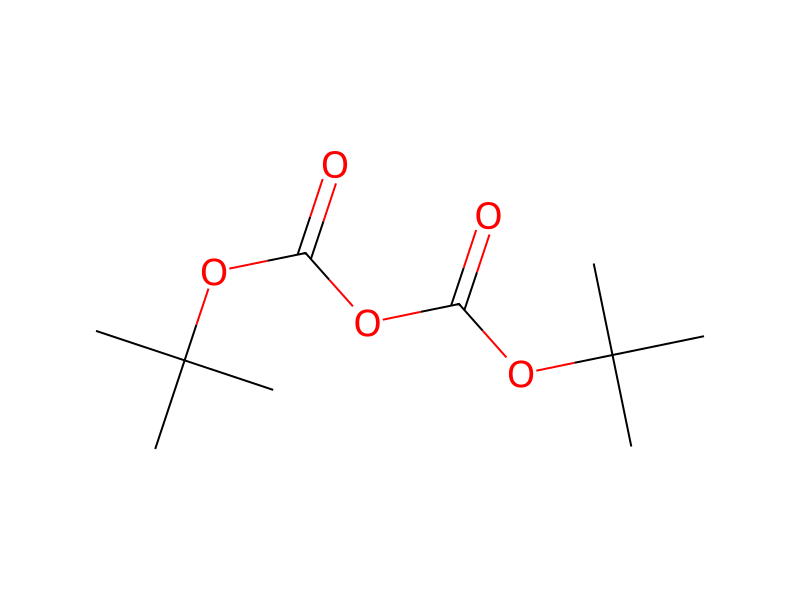


Product 1

Procedure
Alternatively, the aryl substituted olefinic amine compounds of the present invention can be prepared by coupling an N-protected aminoaldehyde, such as 4-(N-methyl-N-(tert-butoxycarbonyl)amino)pentanal with an aryllithium. The required aldehyde can be prepared according to methodology described by Otsuka et al., J. Am Chem. Soc. 112: 838-845 (1990), starting from commercially available 1,5-dimethyl-2-pyrrolidinone (Aldrich Chemical Company). Thus, heating 1,5-dimethyl-2-pyrrolidinone with 6N hydrochloric acid forms 4-(methylamino)pentanoic acid, which can be readily esterified to ethyl 4-(methylamino)pentanoate. The latter compound can be treated with one equivalent of di-tert-butyl dicarbonate to give ethyl 4-(N-methyl-N-(tert-butoxycarbonyl)amino)pentanoate which is then reduced with DIBAL-H to give 4-(N-methyl-N-(tert-butoxycarbonyl)amino)pentanal. Reaction of this aldehyde with an aryllithium generates an alcohol, which can subsequently be converted to the N-protected olefinic amine by conversion of the alcohol to the alkyl halide (with, for instance, carbon tetrachloride and triphenylphosphine) and subsequent dehydrohalogenation (with 1,8-diazabicyclo[5.4.0]undec-7-ene). Removal of the tert-butoxycarbonyl protecting group, with trifluoroacetic acid, affords the desired (E)-5-aryl-4-penten-2-amine. Thus, 3-lithio-5-isopropoxypyridine (from 3-bromo-5-isopropoxypyridine and n-butyllithium) can be condensed with 4-(N-methyl-N-(tert-butoxycarbonyl)amino)pentanal to give 1-(3-(5-isopropoxypyridin)yl)-4-(N-methyl-N-(tert-butoxycarbonyl)amino)-1-pentanol, which can subsequently be converted into (4E)-N-methyl-5-(3-(5-isopropoxypyridin)yl)-4-penten-2-amine.
Sources & evidence
- ORD record
- ord-1556c785379b439ab55a8edd4f14365e
- Source dataset
- uspto-grants-2002_12
- Patent number
- US06492399B1
Reaction notes
Loading…