Thionyl Chloride → HCID 18460994, compound
Reaction equation

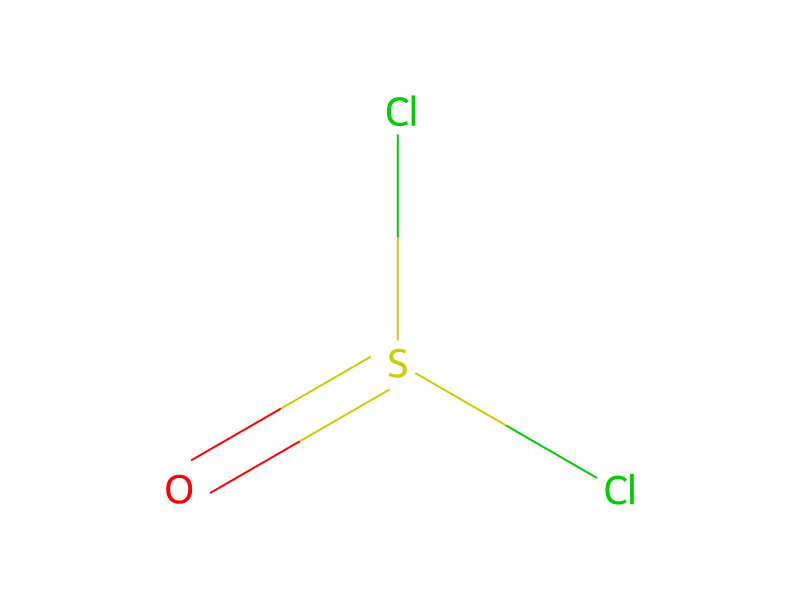
Cl.Cl.Cl[CH:4]1[CH:9]2[CH2:10][CH2:11][N:6]([CH2:7][CH2:8]2)[C:5]1=[CH:12][C:13]1[CH:18]=[CH:17][CH:16]=[C:15]([N+:19]([O-])=O)[CH:14]=1.S(Cl)(Cl)=O.[C].[C]>[Ni].[Pd]>[NH2:19][C:15]1[CH:14]=[C:13]([CH2:12][CH:5]2[CH2:4][CH:9]3[CH2:10][CH2:11][N:6]2[CH2:7][CH2:8]3)[CH:18]=[CH:17][CH:16]=1Participants
Reactant 3


Product 1

Reagents, catalysts & solvents 2
Procedure
The manner in which 2-[(3-aminophenyl)methyl]-1-azabicyclo[2.2.2]octane is synthesized can vary. For example, in one method, 3-nitrobenzaldehyde can be condensed with 3-quinuclidinone in an aldol reaction using potassium hydroxide and ethanol to yield 2-[(3-nitrophenyl)methylene]-1-azabicyclo[2.2.2]octan-3-one. The latter compound can be converted to the corresponding dithioketal by treatment with 1,2-ethanedithiol and boron triflouride etherate. Reduction and desulfurization can be effected by hydrogenation using Raney nickel to yield 2-[(3-aminophenyl)methyl]-1-azabicyclo[2.2.2]octane. Alternatively, in another method, the aldol product, 2-[(3-nitrophenyl)methylene]-1-azabicyclo[2.2.2]octan-3-one can be reduced by treatment with sodium borohydride in methanol to give the alcohol, 2-[(3-nitrophenyl)methylene]-1-azabicyclo[2.2.2]octan-3-ol. The latter compound can be converted to the chloro intermediate, 3-chloro-2-[(3-nitrophenyl)methylene]-1-azabicyclo[2.2.2]octane dihydrochloride upon treatment with thionyl chloride. Dechlorination by hydrogenation with Raney nickel and carbon-carbon double bond reduction by hydrogenation over 10% palladium on carbon can then be effected to yield 2-[(3-aminophenyl)methyl]-1-azabicyclo[2.2.2]octane. Replacement of 3-nitrobenzaldehyde with 2-nitrobenzaldehyde or 4-nitrobenzaldehyde in the above synthetic approach affords the isomeric compounds, 2-[(2-aminophenyl)methyl]-1-azabicyclo[2.2.2]octane and 2-[(4-aminophenyl)methyl]-1-azabicyclo[2.2.2]octane, respectively.
Sources & evidence
- ORD record
- ord-ab62b40e8c344292a86e80dac6d344d7
- Source dataset
- uspto-grants-2002_08
- Patent number
- US06432975B1
Reaction notes
Loading…