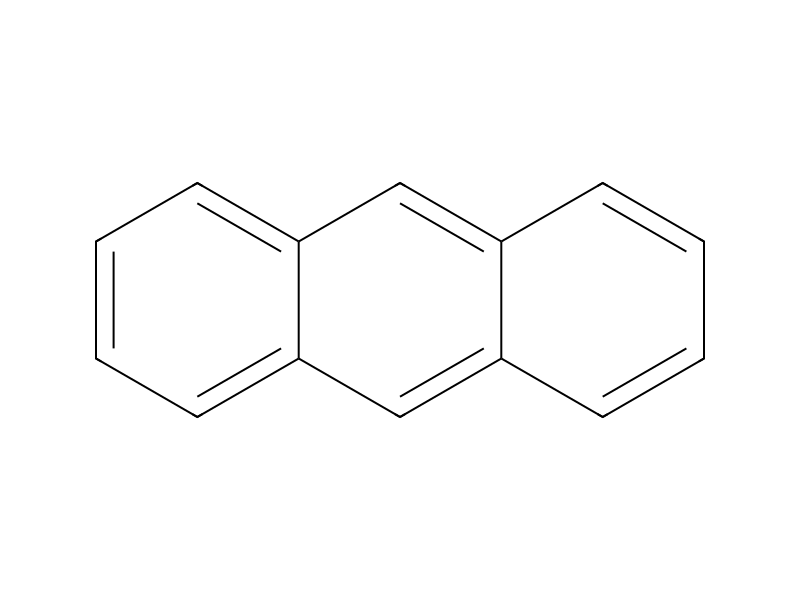
Anthracene → Anthracene-1,4-diol
Reaction equation

CO[C:3]1[CH:9]=[C:8]([OH:10])[CH:7]=[CH:6][C:4]=1[OH:5].COC1C(=O)C=CC(=O)C=1.[CH:21]1[C:34]2[C:25](=[CH:26]C3C([CH:33]=2)=CC=CC=3)[CH:24]=[CH:23][CH:22]=1>[Ag]=O>[OH:5][C:4]1[C:3]2[C:9](=[CH:26][C:25]3[C:34]([CH:33]=2)=[CH:21][CH:22]=[CH:23][CH:24]=3)[C:8]([OH:10])=[CH:7][CH:6]=1Participants
Reactant 3


Product 1

Reagents, catalysts & solvents 1
Procedure
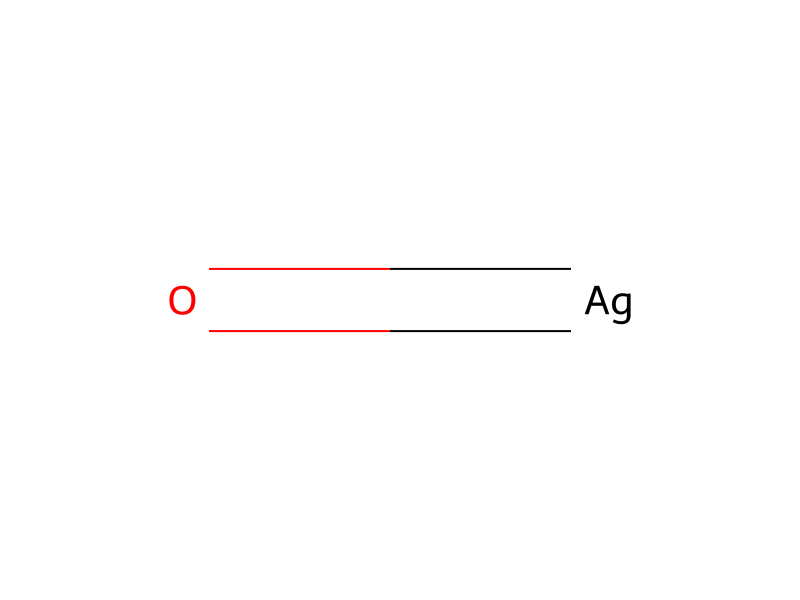
In the reported synthesis of 5,8-disubstituted triptycene monoquinones, (Bartlett, P. D.; Ryan, M. J.; Cohen, S. G. J. Am. Chem. Soc. 1942, 64, 2649; Skvarehenko, V. R.; Shalaev, V. K.; Klabunovskii, E. I. Russ. Chem. Rev. 1974, 43, 951; Iwamura, H.; Maino, K. An intramolecular triptycene quinhydrone. J. Chem. Soc. Chem. Commun. 1978, 720.; Quast, H.; Fuchsbauer, H. -L. Chem. Ber. 1986, 119, 1016-1038; Quast, H.; Fuchsbauer, H. -L. Chem. Ber. 1986, 119, 2414; Patney, H. K. Synthesis 1991, 694. Charge-transfer complexes; Lipczynska-Kochany, E.; Iwamura, H. Chem. Lett. 1982, 1075; Daub, J.; Jakob, L.; Salbeck, J. Chem. Ber. 1988, 121, 2187. Radical Anions: Russell, G. A.; Suleman, N. K. J. Am. Chem. Soc. 1981, 103, 1560-1561. Liquid Crystals; Norvez, S. J. Org. Chem. 1993, 58, 2414) a sequence of three reactions was carried out: Diels-Alder reaction of 1,4-dimethoxyanthracene (Criswell, T. R.; Klanderman, B. H. J. Org. Chem. 1974, 39, 770) and p-benzoquinone followed by isomerization of the adducts (endo- and exo-adducts) with potassium hydroxide and then oxidation with silver oxide. These three reactions have been successfully combined into one simple operation. Hence, heating of anthracene 2 (derived from the reduction of 1,4-anthracenedione (Perchellet, E. M.; Magill, M. J.; Huang, X.; Brantis, C. E.; Hua, D. H.; Perchellet, J. P. Anti-cancer Drugs, 1999, 10, 749) with sodium hydrosulfite followed by sodium hydride and iodomethane), 1.4 equiv of methoxyhydroquinone (3), 2.7 equiv of silver oxide, and 0.2 equiv of zinc iodide in toluene under reflux for 4 days gave a 70% yield of triptycene monoquinone 4 (Scheme 14). Presumably, silver oxide oxidizes methoxyhydroquinone to methoxy-p-benzoquinone which undergoes Diels-Alder reaction with anthracene 2 to give adducts 5 (endo- and exo-isomers). Compound 5 then undergoes oxidation with silver oxide to give quinone 4. A catalytic amount of zinc iodide was added to facilitate the Diels-Alder reaction. No other regioisomers (such as isomers with methoxy substituent attached at C4a) were detected. To verify the reaction sequence, methoxyquinone 6, obtained from the oxidation of 3 with silver oxide and potassium carbonate in benzene (98% yield), was treated with anthracene 2 in toluene at 150° C. in a sealed tube to give adducts 5 (48% yield). Isomerization of ketones 5 with KOH in p-dioxane and water followed by oxidation with silver oxide gave monoquinone 4 (95% overall yield). Oxidation of monoquinone 4 with ceric ammonium nitrate afforded a 94% yield of triptycene bisquinone 7. Regioselective bromination of 7 was achieved by the treatment with N-bromosuccinimide (NBS) in DMF at 25° C. for 10 h to give bromoquinone 1 (45% yield). Alternatively, compound 1 can also be obtained from the bromination of monoquinone 4 with NBS in DMF at 40° C. followed by oxidation with ceric ammonium nitrate (59% overall yield). The bromination of quinones with NBS has not been reported previously, and apparently, reactivity of the methoxyquinone moiety towards NBS is greater than that of quinone and 1,4-dimethoxyphenyl moieties. Likely, the methoxy substituent of 7 or 4 (at C2) enhances nucleophilicity of adjacent double bond carbon resulting the bromination.
Sources & evidence
- ORD record
- ord-6126891bf582446dbd3ec702d5a0b303
- Source dataset
- uspto-grants-2004_12
- Patent number
- US06828450B2
Reaction notes
Loading…