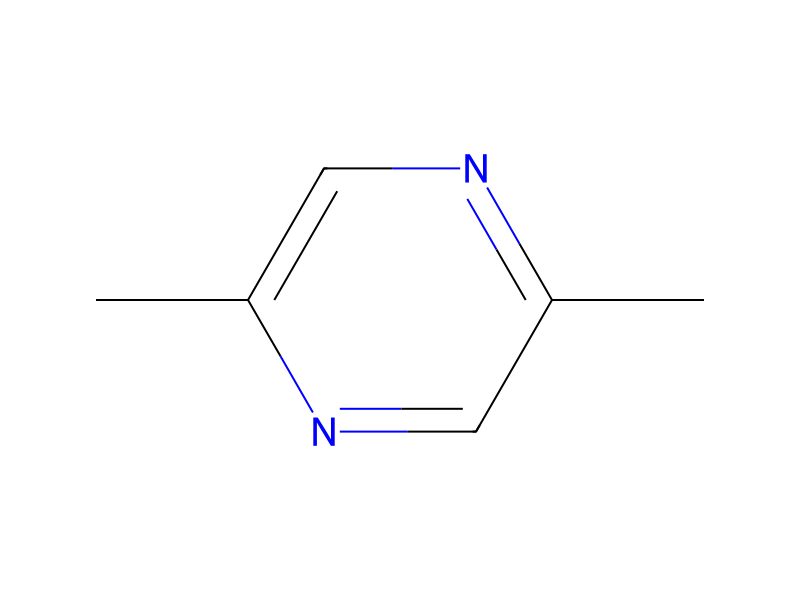
Pyrazine → 2,5-Dimethylpyrazine
Reaction equation

N1C=CN=CC=1.[NH:7]1[CH2:12][CH:11]([C:13]([OH:15])=[O:14])[NH:10][CH2:9][CH:8]1[C:16]([OH:18])=[O:17].[N:19]1[CH:24]=[C:23]([C:25]([OH:27])=[O:26])[N:22]=[CH:21][C:20]=1[C:28]([OH:30])=[O:29].N1C=CC=CC=1.O>>[NH:7]1[CH2:12][CH:11]([C:13]([OH:15])=[O:14])[NH:10][CH2:9][CH:8]1[C:16]([OH:18])=[O:17].[N:19]1[CH:24]=[C:23]([C:25]([OH:27])=[O:26])[N:22]=[CH:21][C:20]=1[C:28]([OH:30])=[O:29].[CH3:16][C:8]1[CH:9]=[N:10][C:11]([CH3:13])=[CH:12][N:7]=1Participants


Procedure
An alternate pathway for the synthesis of piperazine-2,5-dicarboxylates 64-66 involved reduction of the corresponding pyrazine precursors. Preparation of piperazine-2,5-dicarboxylic acid 64 had been reported in Felder, Von E., Maffei, S., Peitra, S. and Pitre, D., Helv. Chim. Acta. 1960, 43, 888-896, from pyrazine diester 83. Hydrolsis of 83 followed by hydrogenation of the alkaline solution at room temperature was reported to afford trans-64, but no evidence for the geometric assignment was provided. Diacid 64 was prepared from the corresponding pyrazine 82. Synthesis of pyrazine-2,5-dicarboxylic acid 82 had been reported by several authors. See Krems, I. J., and Spoerri, P. E., J. Amer. Chem. Soc. 1946, 68, 527-528; Mager, H. I. X. and Berends, W., Rec. Trav. Chim. 1958, 77, 827-841; Kimura, T., Yamada, S., Kanzahi, K. and Kato, K., Jpn. Patent 1960, 10,510 through Chem. ABs. 1961, 55, 9439; Schut, W. J., Mager, H. I. X., and Berends, W., Rec Trav. Chim. 1961, 80, 391-398 and Fujii, S., Kikucki, R. and Kushida, H., J. Org. Chem. 1966, 31, 2239-2241. Oxidation using SeO2 in refluxing pyridine-water afforded 82 in 65-71% yield from commercially available 2,5-dimethylpyrazine. An alkaline solution of diacid 82 at 50°-60° C. and 40-42 psi H2 pressure using Pd/C catalyst over a period of 12 h afforded an isomeric mixture of 64 in 98% yield. The isomers were separated by crystallization from water under controlled pH. The trans isomer crystallized at pH 5.5-6.5. Further acidification to pH 4.0-5.0 resulted in crystallization of cis-64. Geometric configurations were assigned by [1H]--NMR analysis. ##STR27##
Workup
- customfollowed by hydrogenation of the alkaline solution at room temperature
- customto afford trans-64
- customno evidence for the geometric assignment was provided
Sources & evidence
- ORD record
- ord-96f6bf71601c4212b9fa32a67afaf3e6
- Source dataset
- uspto-grants-1989_10
- Patent number
- US04871736
Reaction notes
Loading…