Sodium Carbonate → 2,5,6-Trichloro-1-(5-deoxy-beta-D-ribofuranosyl)benzimidazole
Reaction equation

ClC1NC2C=C(Cl)C(Cl)=CC=2N=1.[Si](S(C(F)(F)F)(=O)=O)(C)(C)C.[Cl:24][C:25]1[N:29]([C@@H:30]2[O:42][C@H:41]([CH3:43])[C@@H:36]([O:37]C(=O)C)[C@H:31]2[O:32]C(=O)C)[C:28]2[CH:44]=[C:45]([Cl:49])[C:46]([Cl:48])=[CH:47][C:27]=2[N:26]=1.C([O-])([O-])=O.[Na+].[Na+].CC(OCC1C2C(=CC=CC=2)C(COC(C)=O)=C2C=1C=CC=C2)=O>C(#N)C.CO.CCO.O.CO.C(Cl)(Cl)Cl>[Cl:24][C:25]1[N:29]([C@@H:30]2[O:42][C@H:41]([CH3:43])[C@@H:36]([OH:37])[C@H:31]2[OH:32])[C:28]2[CH:44]=[C:45]([Cl:49])[C:46]([Cl:48])=[CH:47][C:27]=2[N:26]=1Participants
Reactant 5


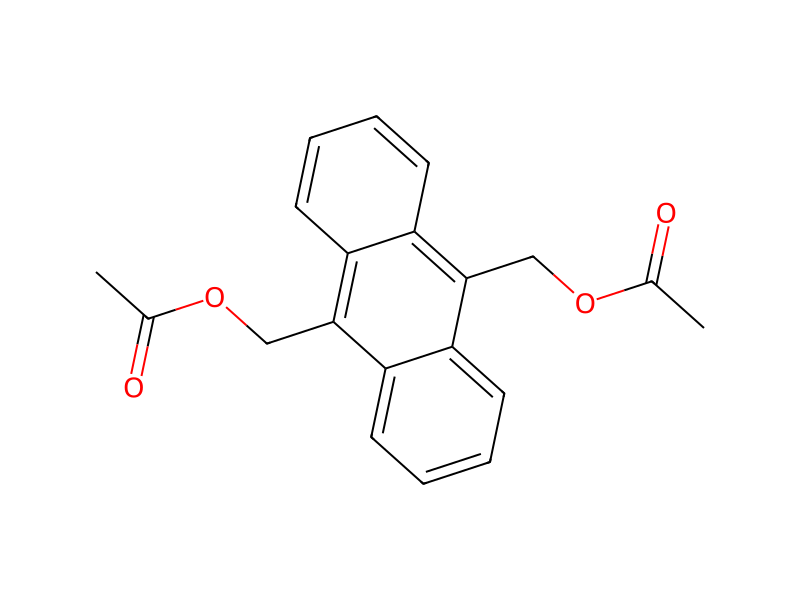


Product 1

Reagents, catalysts & solvents 3



Procedure
2,5,6-Trichlorobenzimidazole (500 mg, 2.26 mmol) was suspended in dry acetonitrile (90 mL) and treated with BSA (0.56 mL, 2.26 mmol). After 15 minutes, 1,2,3-tri-O-acetyl-5-deoxyribose (621 mg, 2.26 mmol) was added along with TMSTf (0.45 mL, 2.26 mmol). The mixture was allowed to stir at room temperature overnight. The mixture was concentrated under reduced pressure and applied to a silica gel column (3.5×9 cm) and eluted with dichloromethane, isolating 490 mg (64%) of the β anomer independent of the α anomer; the rest of the material isolated was an inseparable α, β mixture. For the β anomer (209): 1H NMR(CDCl3): δ 7.64 (s, 1H, C7 -H), 7.48 (s, 1H, C4 -H), 6.02 (d, 1H,1'-H, 6.66 Hz), 5.46 (dd, 1H, 2'-H), 5.12 (dd, 1H, 3' -H), 4.20 (m, 1H, 4'-H), 2.08 (s, 3H), 1.97 (s, 3H), 1.52 (d, 3H, 5'-H). 13C NMR (CDCl3): δ 169.42, 169.01, 141.32, 141.08, 131.98, 127.75, 127.75, 120.80, 112.37, 87.35, 78.63, 73.46, 71.40, 20.32, 20.02, 18.61. 2,5,6-Trichloro-1-(2,3-di-O-acetyl-5-deoxy-β-D-ribofuranosyl)benzimidazole (209), (460 mg., 0.001 moles) was dissolved in a MeOH/EtOH/H2O mixture (45 mL, 45 mL, 10 mL, respectively) and stirred for 2 hours at room temperature in the presence of Na2CO3 (112 mg, 0.001 moles). TLC analysis 2% of MeOH/CHCl3 indicated the disappearance of the protected nucleoside and complete formation of a more polar compound. The aqueous alcoholic solution was neutralized with the addition of glacial acetic and then concentrated under reduced pressure to about 10 mL. The yellow, oily residue was triturated with the addition of 10 mL H2O and the yellow precipitate that formed was collected by vacuum filtration. The isolated material was dissolved in EtOH, treated with charcoal, filtered, concentrated to dryness, and recrystallized from H2O/EtOH/dioxane. The compound was re-crystallized from H2O. mp: 85°-86° C. 1H NMR (DMSO-d6): δ 7.97 (s, 1H, C7 -H), 7.86 (s, 1H, C4 -H), 5.86 (d, 1H, 1'-H, 6.42 Hz), 5.53 (d, 1H, 2'-OH), 5.27 (d, 1H, 3'-OH), 4.48 (q, 1H, 2'-H), 4.00 (m, 1H, 3'-H), 3.88 (m, 1H, 4'-H), 1.40 (d, 3H, 5'-H). 13C NMR (DMSO-d6): δ 142.09, 141.03, 132.68, 126.14, 125.93, 120.40, 113.42, 90.02, 80.97, 73.80, 71.71, 18.88. MS (EI 70 EV with DCI probe): 336/338. Anal. Calcd for C12H11Cl3N2O3 : 42.69, 3.28, 8.30. Found 42.80, 3.49, 8.12.
Workup
- additiontreated with BSA (0.56 mL, 2.26 mmol)
- concentrationThe mixture was concentrated under reduced pressure
- washeluted with dichloromethane
- customisolating 490 mg (64%) of the β anomer independent of the α anomer
- customthe rest of the material isolated
- concentrationconcentrated under reduced pressure to about 10 mL
- customThe yellow, oily residue was triturated with the addition of 10 mL H2O
- customthe yellow precipitate that formed
- filtrationwas collected by vacuum filtration
- dissolutionThe isolated material was dissolved in EtOH
- additiontreated with charcoal
- filtrationfiltered
- concentrationconcentrated to dryness
- customrecrystallized from H2O/EtOH/dioxane
- customThe compound was re-crystallized from H2O
Sources & evidence
- ORD record
- ord-6169cae3a09543d4a13ceee48a8e4a00
- Source dataset
- uspto-grants-1994_11
- Patent number
- US05360795
Reaction notes
Loading…