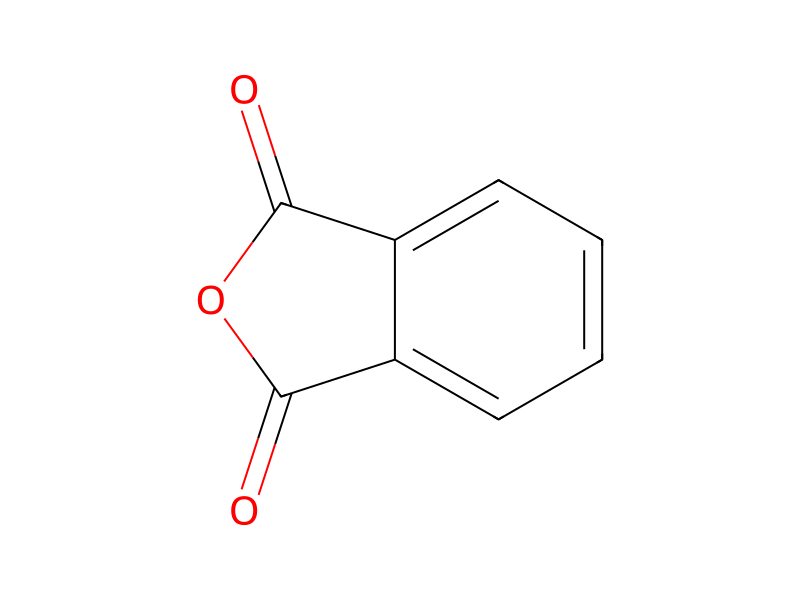
Phthalic Anhydride → 2-[[(3-Methyl-1H-indol-1-yl)amino]carbonyl]benzoic acid
Reaction equation

[NH2:1][N:2]1[C:10]2[C:5](=[CH:6][CH:7]=[CH:8][CH:9]=2)[C:4]([CH3:11])=[CH:3]1.[C:12]1(=[O:22])[O:17][C:15](=[O:16])[C:14]2=[CH:18][CH:19]=[CH:20][CH:21]=[C:13]12>C(Cl)(Cl)Cl>[CH3:11][C:4]1[C:5]2[C:10](=[CH:9][CH:8]=[CH:7][CH:6]=2)[N:2]([NH:1][C:12]([C:13]2[CH:21]=[CH:20][CH:19]=[CH:18][C:14]=2[C:15]([OH:17])=[O:16])=[O:22])[CH:3]=1Participants
4
Reactant 2

Product 1

Reagents, catalysts & solvents 1

Procedure
A suspension of 2.0 g of N-amino-3-methylindole, 140 ml of dry chloroform and 2.74 g of phthalic anhydride was stirred at reflux for 4 hours. The suspension was allowed to cool to room temperature, concentrated to approximately 50 ml, filtered and the residue washed with chloroform to provide 4.25 g of a white solid. Recrystallization from ethyl acetate provided 3.18 g (79.0%) of 2-[[(3-methyl(indol-1-yl)amino]carbonyl]benzoic acid, m.p. 191°-193° C.
Workup
- temperatureat reflux for 4 hours
- concentrationconcentrated to approximately 50 ml
- filtrationfiltered
- washthe residue washed with chloroform
Sources & evidence
- ORD record
- ord-bfb55e164261414b8f12184990495e32
- Source dataset
- uspto-grants-1997_07
- Patent number
- US05646300
Reaction notes
Loading…