N-bromobutanimide → Methyl 2-(bromomethyl)-3-nitrobenzoate
Reaction equation

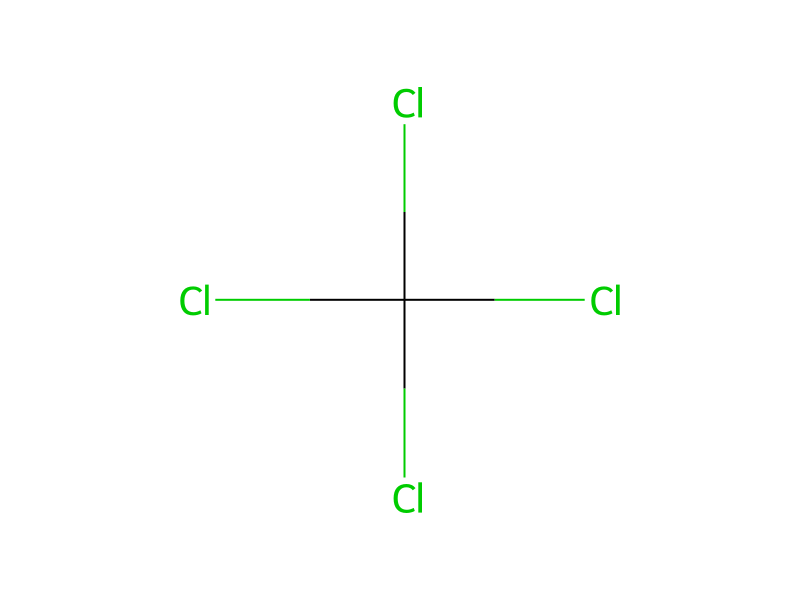
[CH3:1][O:2][C:3](=[O:14])[C:4]1[CH:9]=[CH:8][CH:7]=[C:6]([N+:10]([O-:12])=[O:11])[C:5]=1[CH3:13].[Br:15]N1C(=O)CCC1=O>C(Cl)(Cl)(Cl)Cl>[CH3:1][O:2][C:3](=[O:14])[C:4]1[CH:9]=[CH:8][CH:7]=[C:6]([N+:10]([O-:12])=[O:11])[C:5]=1[CH2:13][Br:15]Participants
Reactant 2


Product 1

Reagents, catalysts & solvents 1
Procedure
2-Methyl-3-nitrobenzoic acid methyl ester (commercially available) is treated in a solvent such as carbon tetrachloride with N-bromosuccinimide under light to produce 2-bromomethyl-3-nitrobenzoic acid methyl ester. This benzylic bromide is treated in a solvent such as dimethylformamide with [2-(3-amino-2,6-dioxo-piperidin-1-yl)-ethyl]-phosphonic acid diethyl ester (for the preparation of this compound, see below) in the presence of a base such as triethylamine. The coupled product is then reduced by hydrogenation (Bioorg. Med. Chem. Lett., (1999), 9, 1625) to afford the desired analog. [2-(3-amino-2,6-dioxo-piperidin-1-yl)-ethyl]-phosphonic acid diethyl ester is obtained according to a procedure such as that reported in J. Med. Chem., (2003) 46, 3793. Accordingly, benzyloxycarbonyl-protected glutaric acid is treated in a solvent such as acetonitrile with triethylamine, 1-hydroxybenzotriazole, diethyl 2-aminoethylphosphonate and 1,3-dicyclohexylcarbodiimide. After the reaction is complete, the solvent is removed and the residue is purified by chromatography to generate the cyclic product, which is subjected to hydrogen in the presence of palladium catalysis to afford the desired intermediate.
Sources & evidence
- ORD record
- ord-1e58ac76dd8c44cb974697e82c5bb90d
- Source dataset
- uspto-grants-2008_11
- Patent number
- US07452901B2
Reaction notes
Loading…