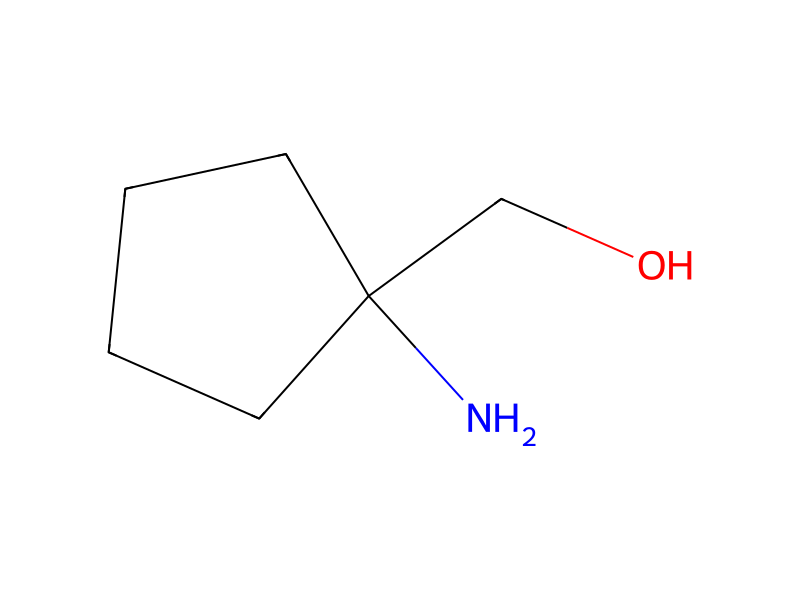
Ethanolamine → 1-Aminocyclopentanemethanol
Reaction equation

C([C:3]1[CH:9]=[C:8]([N+]([O-])=O)[CH:7]=[CH:6][C:4]=1[NH2:5])C.C([C:15]1[CH:20]=[C:19]([N+]([O-])=[O:22])[CH:18]=[CH:17][C:16]=1[N:24]=C=S)C.OCCN.O=S(Cl)[Cl:33]>>[NH2:5][C:4]1([CH2:3][OH:22])[CH2:6][CH2:7][CH2:8][CH2:9]1.[ClH:33].[NH2:24][C:16]1([CH2:15][Cl:33])[CH2:17][CH2:18][CH2:19][CH2:20]1Participants





Procedure
2- Ethylaniline was converted to 2-ethylacetanilide according to Method A2a, Step 1. The acetanilide was converted to 2-ethyl-4-nitroacetanilide according to Method A2a, Step 2. The acetanilide was deprotected according to Method A2a, Step 3 to give 2-ethyl-4-nitroaniline. The aniline was converted to 2-ethyl-4-nitrophenyl isothiocyanate according to Method A2a, Step 3. 1-Amino-1-(hydroxymethyl)cyclopentane was synthesized as described in Method B1c. The 2-hydroxyethylamine was reacted with with SOCl2 according to Method B7a to give 1-amino-1-(chloromethyl)cyclopentane HCl salt. The 2-chloroethylamine was reacted with 2-ethyl-4-nitrophenyl isothiocyanate according to Method C1a to give 2-(2-ethyl-4-nitrophenylimino)-1-thia-3-azaspiro[4.4]nonane. The thiazolidine was reacted with cyclopentyl bromide according to Method D2b to afford 3-cyclopentyl-2-(2-ethyl-4-nitrophenylimino)-1-thia-3-azaspiro[4.4]nonane.
Sources & evidence
- ORD record
- ord-f046bd167c9b439386eca458a8fcada7
- Source dataset
- uspto-grants-2002_03
- Patent number
- US06353006B1
Reaction notes
Loading…