Benzoyl Peroxide → 3-Chloro-4-(4-chlorobenzoyl)-5-methylbenzyl azide
Reaction equation

[Cl:1][C:2]1[CH:18]=[CH:17][C:5]([C:6]([C:8]2[C:13]([CH3:14])=[CH:12][C:11]([CH3:15])=[CH:10][C:9]=2[Cl:16])=[O:7])=[CH:4][CH:3]=1.BrN1C(=O)CCC1=O.C(OOC(=O)C1C=CC=CC=1)(=O)C1C=CC=CC=1.[N-:45]=[N+:46]=[N-:47].CN(C)C(=[NH2+])N(C)C>C(Cl)(Cl)(Cl)Cl>[Cl:16][C:9]1[CH:10]=[C:11]([CH:12]=[C:13]([CH3:14])[C:8]=1[C:6](=[O:7])[C:5]1[CH:17]=[CH:18][C:2]([Cl:1])=[CH:3][CH:4]=1)[CH2:15][N:45]=[N+:46]=[N-:47]Participants
Reactant 4


Product 1

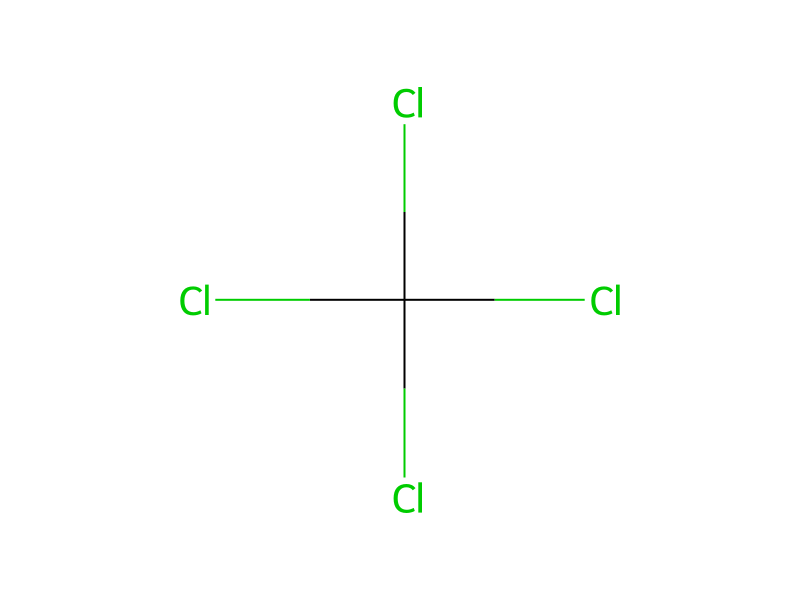
Reagents, catalysts & solvents 1
Conditions
- Temperature
- 0 °C
Procedure
A stirred, ambient temperature solution of 1-(4-chlorobenzoyl)-2-chloro-4,6-dimethylbenzene (6.90 g, 24.7 mmol) in dry carbontetrachloride (200 ml) was treated with N-bromosuccinimide (4.40 g, 24.7 mmol) and benzoylperoxide (250 mg, 1.03 mmol). The mixture was refluxed 4 hours, cooled to 0° C., and filtered. The precipitate was washed with carbon tetrachloride and the combined filtrate and wash were evaporated to dryness at 40° C. under vacuum. The oily residue was dissolved in dichloromethane (150 ml) treated with tetramethylguanidinium azide (8.1 g, 51.2 mmol), and stirred 20 minutes at ambient temperature. The solvent was evaporated under vacuum and the semisolid residue was triturated with diethyl ether (200 ml) and filtered. The solid was washed well with diethyl ether, and the combined filtrates and washes were extracted with water (2×150 ml) and brine (200 ml), dried over anhydrous magnesium sulfate, and evaporated to dryness under vacuum. The residue was triturated with hexane (400 ml), decanted, and evaporated under vacuum at 30° C. The residual oil was chromatographed on silica gel (500 g) eluted with 93:7 (v/v) hexane-ethyl acetate using a preparative high performance liquid chromatograph to provide 2.2 g (28%) oily 3-chloro-4-(4-chlorobenzoyl)-5-methylbenzyl azide [I.R. (neat): 2110, 1680 cm-1 ; 60 MHz 'H NMR (CDCl3): 2.17 (3H), 4.33 s (2H), 7.14 m (1H), 7.23 m (1H), 7.41 dm (J=9 Hz, 2H), 7.74 dm (J=9 Hz, 2H)] and 2.4 g (30%) oily 3-chloro-2-(4-chlorobenzoyl)-5-methylbenzyl azide [IR (neat): 2105, 1670 cm-1 ; 60 MHz 'H NMR (CDCl3): 2.39 s (3H), 4.23 s (2H), 7.17 s (1H), 7.21 s (1H), 7.40 dm (J=9 Hz, 2H), 7.75 dm (J=9Hz, 2 H)].
Workup
- temperatureThe mixture was refluxed 4 hours
- filtrationfiltered
- washThe precipitate was washed with carbon tetrachloride
- washthe combined filtrate and wash
- customwere evaporated to dryness at 40° C. under vacuum
- dissolutionThe oily residue was dissolved in dichloromethane (150 ml)
- customThe solvent was evaporated under vacuum
- customthe semisolid residue was triturated with diethyl ether (200 ml)
- filtrationfiltered
- washThe solid was washed well with diethyl ether
- extractionthe combined filtrates and washes were extracted with water (2×150 ml) and brine (200 ml)
- dry with materialdried over anhydrous magnesium sulfate
- customevaporated to dryness under vacuum
- customThe residue was triturated with hexane (400 ml)
- customdecanted
- customevaporated under vacuum at 30° C
- customThe residual oil was chromatographed on silica gel (500 g)
- washeluted with 93:7 (v/v) hexane-ethyl acetate using a preparative high performance liquid chromatograph
Sources & evidence
- ORD record
- ord-eea875b8bb0844e48f7b8333eabbc831
- Source dataset
- uspto-grants-1986_05
- Patent number
- US04590201
Reaction notes
Loading…