Pivaloyl chloride → N-(4-Chloropyridin-2-yl)pivalamide
Reaction equation

[NH2:1][C:2]1[CH:7]=[C:6]([Cl:8])[CH:5]=[CH:4][N:3]=1.[CH3:9][C:10]([CH3:15])([CH3:14])[C:11](Cl)=[O:12]>>[CH3:9][C:10]([CH3:15])([CH3:14])[C:11]([NH:1][C:2]1[CH:7]=[C:6]([Cl:8])[CH:5]=[CH:4][N:3]=1)=[O:12]Participants
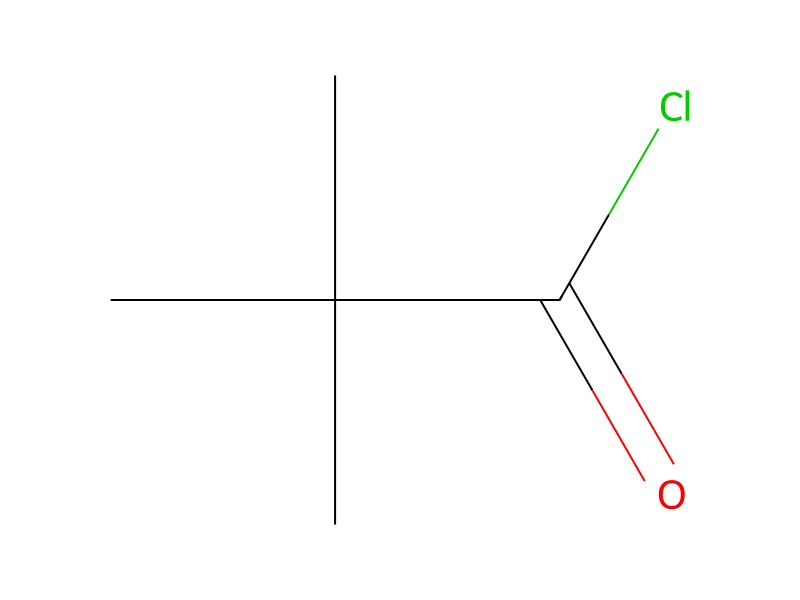


Procedure
The synthetic strategy used in the preparation of compounds 4, 5, 6, 7, and 8 is illustrated in FIG. 2. Polychlorinated pyridines were synthesized from the 2-amino-4-chloro-pyridine (compound 3). For example, compound 3 was dissolved in concentrated hydrochloric acid (HCl), reacted at 0° C. with hydrogen peroxide (H2O2), and allowed to warm to room temperature yielding a mixture of 2-amnino-4,5-dichloro-pyridine (compound 4), 2-amino-3,4-dichloro-pyridine (compound 5), and 2-amino-3,4,5-trichloro-pyridine (compound 6). In another method, compound 3 was dissolved in concentrated hydrochloric acid (HCl) and heated at reflux temperature to yield 2-amino-4,5-dichloro-pyridine (compound 4) in 97% yield. In another method, compound 3 was dissolved in concentrated hydrochloric acid (HCl), reacted at 0° C. with hydrogen peroxide (H2O2), and allowed to warm to room temperature yielding 2-amino-3,4,5-dichloro-pyridine (compound 6) in 80% yield. In still another method, compound 3 was reacted with trimethylacetyl chloride ((CH3)3COCl) to yield 2-trimethylacetamido-4-chloro-pyridine (compound 7). Compound 7 was then reacted with N-chlorosuccinimide (NCS) to yield 2-trimethylacetamido-4,5-chloro-pyridine (compound 8). Compound 8 was then reacted with hydrochloric acid (HCl) to yield 2-amino-4,5-chloro-pyridine (compound 4).
Sources & evidence
- ORD record
- ord-bdb16c0f728140dba28cf0d3c90b9405
- Source dataset
- uspto-grants-2001_04
- Patent number
- US06214801B1
Reaction notes
Loading…