5-Bromonicotinamide → N-(5-bromopyridin-3-yl)acetamide
Reaction equation

[Br:1][C:2]1[CH:3]=[N:4][CH:5]=[C:6]([CH:10]=1)C(O)=O.BrC1C=NC=[C:16](C=1)[C:17]([NH2:19])=[O:18].NC1C=NC=C(Br)C=1.C(OC(=O)C)(=O)C>>[C:17]([NH:19][C:6]1[CH:5]=[N:4][CH:3]=[C:2]([Br:1])[CH:10]=1)(=[O:18])[CH3:16]Participants

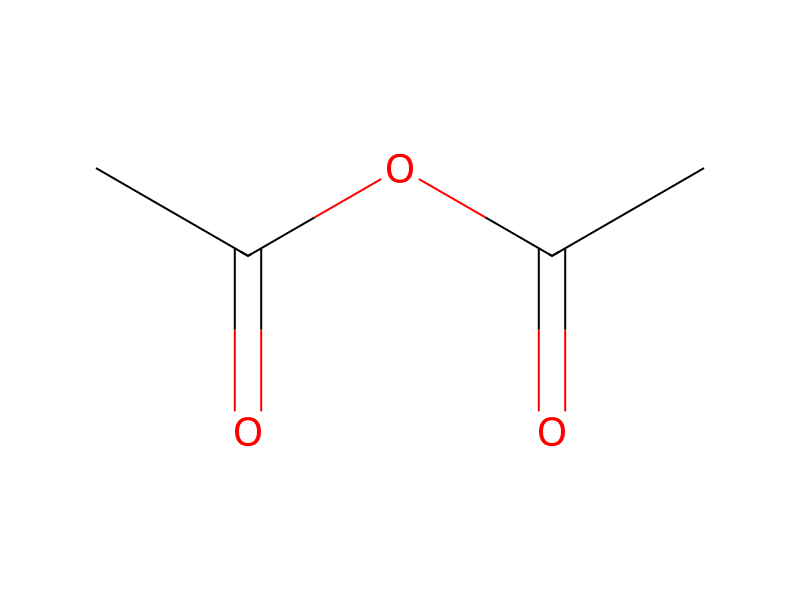


Procedure
Other representative compounds include (E)-N-methyl-4-[3-(5-acetamidopyridinyl)]-3-buten-1-amine and (E)-N-methyl-4-[3-(5-carbamoylpyridinyl)]-3-buten-1-amine. These compounds may be produced according to the techniques set forth in C. V. Greco et al., J. Heterocyclic Chem. 7 (4): 761 (1970). More specifically, the commercially available starting material, 5-bromonicotinic acid is converted to both 5-bromonicotinamide and 3-amino-5-bromopyridine. The 3-amino-5-bromopyridine can be acylated with acetic anhydride to give 3-acetamido-5-bromopyridine. 3-Acetamido-5-bromopyridine may then be reacted with N-methyl-N-(tert-butoxycarbonyl)-3-buten-1-amine (prepared according to the preceeding techniques) using the Heck reaction described hereinabove and set forth in W. C. Frank et al., J. Org. Chem. 43 (15): 2947 (1978). The reaction gives (E)-N-methyl-N-(tert-butoxycarbonyl)-4-[3-(5-acetamidopyridinyl)]-3-buten-1-amine. The Heck reaction of 5-bromonicotinic acid with N-methyl-N-(tert-butoxycarbonyl)-3-buten-1-amine gives (E)-N-methyl-N-(tert-butoxycarbonyl)-4-[3-(5-carbamoylpyridinyl)]-3-buten-1-amine. The treatment of either product with aqueous acid effects the removal of the tert-butoxycarbonyl groups from these compounds, giving the 5-acetamido and 5-carbamoyl substituted metanicotinic compounds respectively.
Workup
- customThese compounds may be produced
Sources & evidence
- ORD record
- ord-ff2e64db2d66477291d11c07eb951353
- Source dataset
- uspto-grants-1999_01
- Patent number
- US05861423
Reaction notes
Loading…