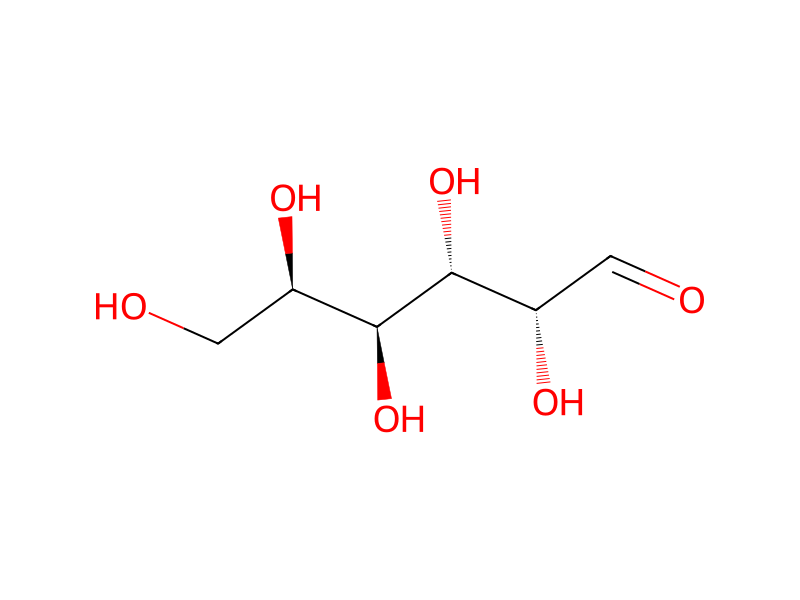
(3S,4S,5R)-1,3,4,5,6-pentahydroxyhexan-2-one → (2R,3S,4S,5R)-2,3,4,5,6-pentahydroxyhexanal
Reaction equation

[OH:1][CH2:2][C:3]([C@H:5]([C@H:7]([C@@H:9]([CH2:11][OH:12])[OH:10])[OH:8])[OH:6])=[O:4].OCC([C@@H]([C@H]([C@@H](CO)O)O)O)=O>>[O:1]=[CH:2][C@@H:3]([C@H:5]([C@H:7]([C@@H:9]([CH2:11][OH:12])[OH:10])[OH:8])[OH:6])[OH:4]Participants


Procedure
A Ca(OH)2 slurry was prepared in a small bucket by carefully mixing 4.66 kg CaO with 14 1 water in an exothermic reaction. A 230 1 capacity stainless steel kettle, equipped with a strong agitator, was charged with 15.0 kg D-galactose and 135 1 deionized water and stirred until the sugar dissolved. With the solution stirring at 20° C., the Ca(OH)2 slurry weighing 18.7 kg was gradually added to the kettle. Addition was complete in hour. The progress of the reaction was monitored by HPLC analysis each 0.5 hour, as described below. After 2 hours the mixture had turned to a thick gel; vigorous stirring was continued. After approximately 4 hours, galactose conversion reached greater than 85% and the reaction was stopped by slowly adding 50% by weight phosphoric acid until the pH was 5.8. In this process, the gel dissolved and calcium phosphate precipitated. The calcium phosphate solids were separated from the reaction mixture by centrifugation. The hydrated calcium salts were then rewashed by stirring them with 25 1 water in the kettle for an additional hour. Using the centrifuge, the washings were separated and combined with the reaction mixture. The reaction mixture of 150 1 was deionized by passing it through columns of AMBERLITE IR-120 (H+ form, 7 1) and then AMBERLITE IRA-68 (free base form, 9 1). AMBERLITE IR-120 is a trademark for a cationic ion exchange resin sold by Rohm and Haas, Philadelphia, PA. AMBERLITE IRA-68 is a trademark for an anionic ion exchange resin sold by Rohm and Haas, Philadelphia, PA. The contact time for each resin was at least 20 minutes. The colorless 200 1 of eluant was analyzed by HPLC, which showed that the dissolved solids contained 72% D-tagatose based on the amount of D-galactose charged. Because of the large volume of solution, the solution was split into several portions for crystallization. Concentration in vacuo of the first portion of deionized solution gave a thick syrup of 5862 g to which 5871 g of 95% EtOH was added. The stirred mixture was heated to dissolve the syrup, then it was cooled and seeded with a few D-tagatose crystals. After stirring 24 hours, crystalline D-tagatose weighing 2390 g, 93% pure by HPLC, was isolated by vacuum filtration. Recrystallization from 95% EtOH gave 1386 g D-tagatose which had a melting point of 127° C.-130° C. and the following composition by HPLC: D-tagatose, 97.5%; D-sorbose, 1.00%; unknown No. 1, 0 65%; and unknown No. 2, 1.00% (estimate, unknown No. 2 not well resolved). The remaining portions of deionized solution were concentrated and crystallized in the same way. Two crops of crystals were obtained from each portion. Syrup containing less than 60% D-tagatose would not yield any more crystals.
Workup
- concentrationThe remaining portions of deionized solution were concentrated
- customcrystallized in the same way
- customTwo crops of crystals were obtained from each portion
- customyield any more crystals
Sources & evidence
- ORD record
- ord-f1f386dffce74928888126b7db7fc4f6
- Source dataset
- uspto-grants-1991_03
- Patent number
- US05002612
Reaction notes
Loading…