1,1,1-Trifluoro-2-isothiocyanatoethane → HCID 20240509, compound
Reaction equation

[F:1][C:2]([F:8])([F:7])[CH2:3][N:4]=[C:5]=[S:6].[F:9][C:10]([F:27])([F:26])[CH2:11][N:12]=[C:13]([NH2:25])[NH:14][C:15]1[S:16][CH:17]=[C:18]([CH2:20][CH2:21][CH2:22][CH2:23][NH2:24])[N:19]=1.C(Cl)(Cl)Cl.CO.N>C(#N)C>[F:27][C:10]([F:9])([F:26])[CH2:11][N:12]=[C:13]([NH2:25])[NH:14][C:15]1[S:16][CH:17]=[C:18]([CH2:20][CH2:21][CH2:22][CH2:23][NH:24][C:5]([NH:4][CH2:3][C:2]([F:8])([F:7])[F:1])=[S:6])[N:19]=1Participants
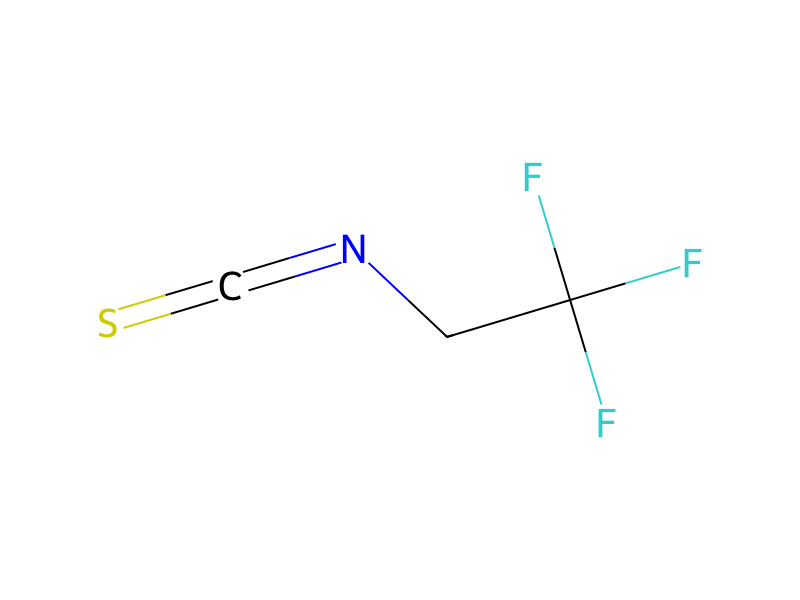



Procedure
Trifluoroethylisothiocyanate (0.2 g.) in acetonitrile (6 ml.) was added to a solution of 2-[2-(2,2,2-trifluoroethyl)guanidino]-4-(4-aminobutyl)thiazole (0.5 g.) in acetonitrile (10 ml.), and the mixture was allowed to stand at room temperature for 2 hours. The residue obtained on evaporation of the solvent was subjected to preparative thin layer chromatography using chloroform/methanol/ammonia 85:15:0.5 v/v/v for development. The appropriate zone of the chromatogram was isolated and extracted with hot ethanol/chloroform 50:50 v/v (200 ml.). The residue was crystallised from ethyl acetate/light petroleum ether (b.p. 60°-80°) to give 2-[2-(2,2,2-trifluoroethyl)-guanidino]-4-(4-[3-(2,2,2-trifluoroethyl)thioureido]butyl)-thiazole. The n.m.r. spectrum in d6 dimethylsulphoxide using tetramethylsilane as internal standard (δ=0) included the following resonances (δ):4.05 (2H, multiplet); 4.35 (2H, multiplet); 6.36 (1H, singlet).
Workup
- customThe residue obtained on evaporation of the solvent
- customThe appropriate zone of the chromatogram was isolated
- extractionextracted with hot ethanol/chloroform 50:50 v/v (200 ml.)
- customThe residue was crystallised from ethyl acetate/light petroleum ether (b.p. 60°-80°)
Sources & evidence
- ORD record
- ord-2428455db0f849428d59f5a5e5125763
- Source dataset
- uspto-grants-1986_08
- Patent number
- US04604465
Reaction notes
Loading…