2-Bromo-4'-nitroacetophenone → Ethyl 2-amino-5-(4-nitrophenyl)-1H-pyrrole-3-carboxylate
Reaction equation
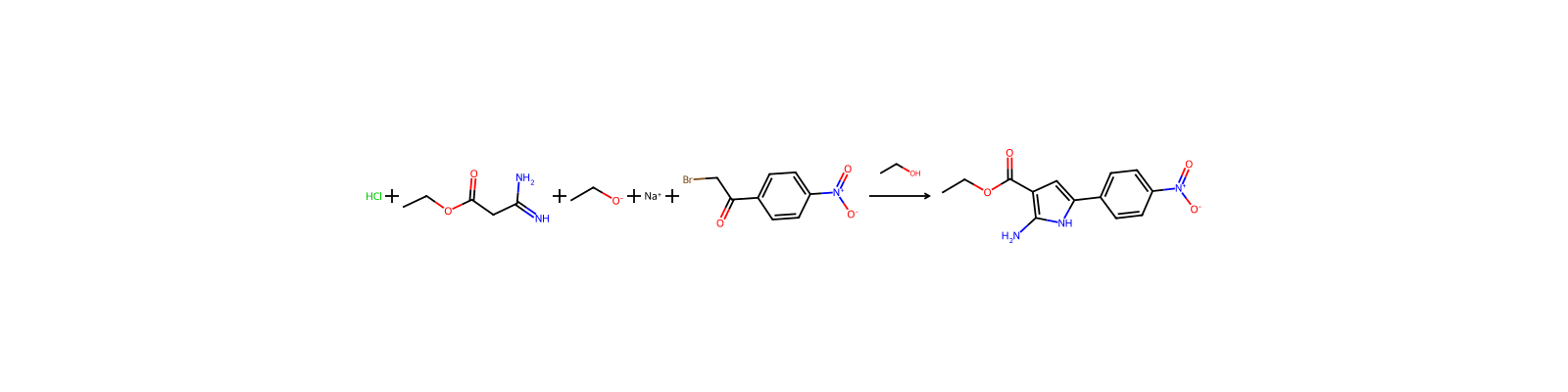
Cl.[CH2:2]([O:4][C:5](=[O:10])[CH2:6][C:7](=[NH:9])[NH2:8])[CH3:3].C([O-])C.[Na+].Br[CH2:16][C:17]([C:19]1[CH:24]=[CH:23][C:22]([N+:25]([O-:27])=[O:26])=[CH:21][CH:20]=1)=O>C(O)C>[NH2:9][C:7]1[NH:8][C:17]([C:19]2[CH:20]=[CH:21][C:22]([N+:25]([O-:27])=[O:26])=[CH:23][CH:24]=2)=[CH:16][C:6]=1[C:5]([O:4][CH2:2][CH3:3])=[O:10]Participants





Procedure
In a dry three-necked flask, under argon, 75 ml of abs. ethanol and 6.5 g (390 mmol) of 2-amidino-acetic acid ethyl ester hydrochloride [preparation see: Liebigs Ann. Chem., 1895 (1977)] are cooled to 0-5° C. and 2.65 g (390 mmol) of sodium ethanolate are added. 5 g (195 mmol) of 2-bromo-1-(4-nitro-phenyl)-ethan-1-one are then added and the mixture is allowed to rise to room temperature and is stirred for a further 48 hours. The reaction mixture is then partitioned between water and ethyl acetate. The ethyl acetate phase is washed three times with water and once with sat. NaCl solution, dried and filtered, and the filtrate is concentrated by evaporation. The reddish-brown residue is made into a slurry in hexane, the title compound precipitating in the form of a crude product (purity 93%) which is used for the next step without further purification; MS: (M)+ =275.
Workup
- customto rise to room temperature
- customThe reaction mixture is then partitioned between water and ethyl acetate
- washThe ethyl acetate phase is washed three times with water
- dry with materialonce with sat. NaCl solution, dried
- filtrationfiltered
- concentrationthe filtrate is concentrated by evaporation
- customthe title compound precipitating in the form of a crude product (purity 93%) which
- customis used for the next step without further purification
Sources & evidence
- ORD record
- ord-3277198f8d4641eaa571e274b09fce9e
- Source dataset
- uspto-grants-2000_10
- Patent number
- US06140317
Reaction notes
Loading…