3-Chloro-4-fluoroaniline → 4-(3-Chloro-4-fluoro-anilino)-6-(pyrid-2-yl)-7H-pyrrolo[2,3-d]pyrimidine
Reaction equation

[N:1]1[CH:6]=[CH:5][CH:4]=[CH:3][C:2]=1[C:7]1[NH:16][C:10]2[N:11]=[CH:12][N:13]=[C:14](O)[C:9]=2[CH:8]=1.P(Cl)(Cl)(Cl)=O.[Cl:22][C:23]1[CH:24]=[C:25]([CH:27]=[CH:28][C:29]=1[F:30])[NH2:26]>>[Cl:22][C:23]1[CH:24]=[C:25]([CH:27]=[CH:28][C:29]=1[F:30])[NH:26][C:14]1[C:9]2[CH:8]=[C:7]([C:2]3[CH:3]=[CH:4][CH:5]=[CH:6][N:1]=3)[NH:16][C:10]=2[N:11]=[CH:12][N:13]=1Participants
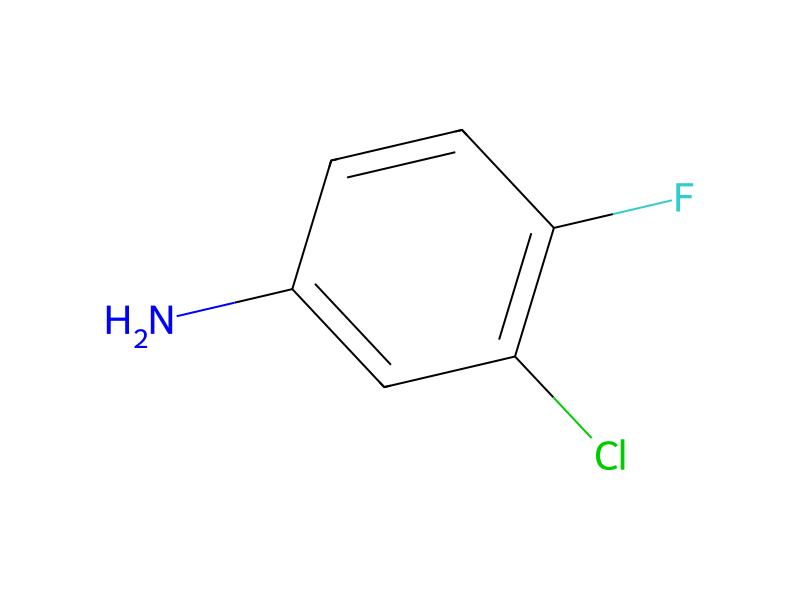



Procedure
Under a protective gas, 20 mg (0.09 mmol) of 6-(pyrid-2-yl)-7H-pyrrolo[2,3-d]pyrimidin-4-ol (see Step 1.2) are heated at boiling with 1 ml of phosphorus oxychloride for 30 min. The reaction mixture is concentrated to dryness by evaporation and made into a suspension in 1 ml of n-butanol. 16.4 mg (0.108 mmol) of 3-chloro-4-fluoro-aniline are added and the suspension is boiled under reflux for 2 hours. The dark-brown suspension is then concentrated by evaporation and the residue is dissolved in methanol. Silica gel is added and drying is carried out. The powder is applied to a silica gel column and elution is carried out with ethyl acetate, yielding the title compound; 1H-NMR (400 MHz, DMSO-d6): 12.5 (sb, HN), 9.64 (s, HN), 8.64 (d, J=5, 1H), 8.38 (s, 1H), 8.35 (dd, J1 =7, J2 =3, 1H), 7.92 (m, 2H), 7.83 (m, 1H), 7.53 (s, 1H), 7.41 (t, J=9, 1H), 7.33 (m, 1H); HPLC: tRet (Grad20)=10.4 min; MS: (M)+ =339.
Workup
- concentrationThe reaction mixture is concentrated to dryness by evaporation
- temperatureunder reflux for 2 hours
- concentrationThe dark-brown suspension is then concentrated by evaporation
- dissolutionthe residue is dissolved in methanol
- additionSilica gel is added
- customdrying
- washThe powder is applied to a silica gel column and elution
Sources & evidence
- ORD record
- ord-15b1702fbf2942d89bcd0a818d72a147
- Source dataset
- uspto-grants-2000_10
- Patent number
- US06140332
Reaction notes
Loading…