Sorbitol → Sorbitol glycidyl ether
Reaction equation

[CH2:1]([CH:3]1[O:5][CH2:4]1)Cl.[OH:6][CH2:7][C@@H:8]([C@H:10]([C@@H:12]([C@@H:14]([CH2:16][OH:17])[OH:15])[OH:13])[OH:11])[OH:9]>[Sn](F)F>[CH2:1]([O:17][CH2:16][C@@H:14]([C@H:12]([C@@H:10]([C@@H:8]([CH2:7][OH:6])[OH:9])[OH:11])[OH:13])[OH:15])[CH:3]1[O:5][CH2:4]1Participants
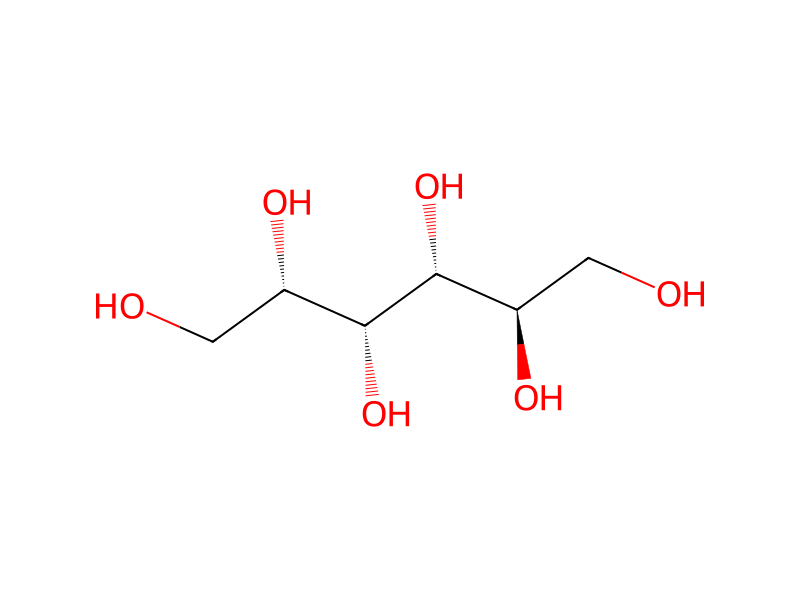


Reagents, catalysts & solvents 1

Conditions
- Temperature
- 110 °C
Procedure
A 750 ml reactor equipped with reflux condenser, thermometer, stirrer and metering device for epichlorohydrin is charged with 72.9 g (0.4 mol) of sorbitol and 1.25 g (0.008 mol) of tin difluoride in 88.5 g (0.957 mol) of epichlorohydrin, and the charge is heated to 110° C. Then, with stirring, 132.1 g (1.429 mol) of epichlorohydrin are added at a rate of 1.5 ml/min, while keeping the temperature at 110°-115° C. Stirring is continued for a further 8 hours at 125°-130° C. Excess epichlorohydrin is removed by distillation under a water jet vacuum and the residue is diluted with 441 g of methyl isobutyl ketone. With efficient stirring, 142.4 g (1.78 mol) of a 50% solution of sodium hydroxide are added dropwise over 1 hour and the reaction mixture is kept for another 2 hours at this temperature. The reaction mixture is neutralised by addition of dry ice and filtered, and the organic phase is dried over magnesium sulfate. The solvent is removed on a rotary evaporator and the residue is dried under vacuum (2 hours/60° C.), giving 155.2 g of sorbitol glycidyl ether for which the following analytical values are obtained: epoxy value: 5.5 eq/kg; total chlorine content 15.56%; hydrolysable chlorine content 1.09%; viscosity at 40° C.: 2460 mPa.s; average molecular weight Mn (GPC): 658.
Workup
- customA 750 ml reactor equipped
- temperaturewith reflux condenser
- customat 110°-115° C
- stirringStirring
- customExcess epichlorohydrin is removed by distillation under a water jet vacuum
- additionthe residue is diluted with 441 g of methyl isobutyl ketone
- additionWith efficient stirring, 142.4 g (1.78 mol) of a 50% solution of sodium hydroxide are added dropwise over 1 hour
- waitthe reaction mixture is kept for another 2 hours at this temperature
- additionThe reaction mixture is neutralised by addition of dry ice
- filtrationfiltered
- dry with materialthe organic phase is dried over magnesium sulfate
- customThe solvent is removed on a rotary evaporator
- customthe residue is dried under vacuum (2 hours/60° C.)
Sources & evidence
- ORD record
- ord-b3e233332f48425ea55d66e8103dd3ca
- Source dataset
- uspto-grants-1992_11
- Patent number
- US05162547
Reaction notes
Loading…