2,8-Dibromo-3,7-dinitrodibenzothiophene-5-oxide → 3,7-Dinitrodibenzothiophene-2,8-dicarbonitrile
Reaction equation

BrC1[C:16]([N+:17]([O-])=O)=CC2S(=O)C3C=CC(Br)=CC=3C=2C=1.Br[C:21]1[C:38]([N+:39]([O-:41])=[O:40])=[CH:37][C:24]2[S:25](=O)[C:26]3[CH:31]=[C:30]([N+:32]([O-:34])=[O:33])[C:29](Br)=[CH:28][C:27]=3[C:23]=2[CH:22]=1.[Cu][C:43]#[N:44]>CC(N(C)C)=O.O1CCOCC1>[N+:39]([C:38]1[C:21]([C:16]#[N:17])=[CH:22][C:23]2[C:27]3[CH:28]=[C:29]([C:43]#[N:44])[C:30]([N+:32]([O-:34])=[O:33])=[CH:31][C:26]=3[S:25][C:24]=2[CH:37]=1)([O-:41])=[O:40]Participants
Reactant 3


Product 1

Reagents, catalysts & solvents 1

Procedure
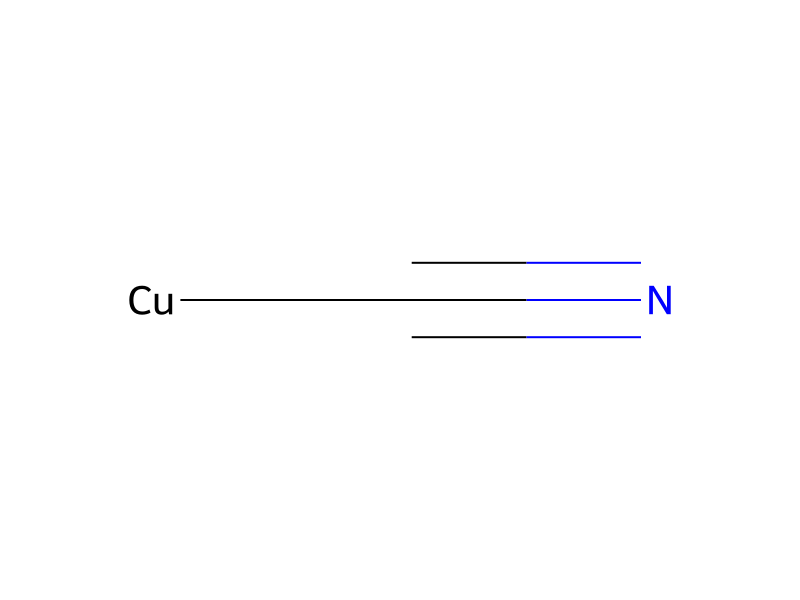
While not wishing to be bound by theory and once again referring to Scheme I, it is contemplated that 3-amino-7-chlorodibenzothiophene-2,8-dicarboxylic acid diester 8 where R3 is hereinbefore defined is also formed during the process of Scheme I through the sequence of steps starting with reaction of 2,8-dibromodibenzothiophene 2 with >90% nitric acid at 50-60° C. which gave 2,8-dibromo-3,7-dinitrodibenzothiophene-5-oxide 3a as the primary product and which also contains a minor product 2,8-dibromo-3-nitrodibenzothiophene-5-oxide 3b. A mixture of 2,8-dibromo-3,7-dinitrodibenzothiophen-5-oxide 3a containing minor product 2,8-dibromo-3-nitrodibenzothiophene-5-oxide 3b in 1:1 DMAC/dioxane was treated with copper (I) cyanide (Cu(I)CN) for about 10 hours at 50-150° C. followed by further treatment with ferric chloride/concentrated hydrochloric acid to yield 3,7-dinitrodibenzothiophene-2,8-dicarbonitrile 4a as the primary product containing a minor product 3-chloro-7-nitrodibenzothiophene-2,8-dicarbonitrile 4b. Further treatment of 3,7-dinitrodibenzothiophene-2,8-dicarbonitrile 4a containing minor product 3-chloro-7-nitrodibenzothiophene-2,8-dicarbonitrile 4b with glacial acetic acid, hydrobromic acid and water at 50-100° C. followed by treatment with sodium hydroxide at 50-100° C. for 0.5 to 3 hours followed by acidification to a pH of 1 to 5 affords 3,7-dinitrodibenzothiophene-2,8-dicarboxylic acid 5a as the primary product containing minor product 3-chloro-7-nitrodibenzothiophene-2,8-dicarboxylic acid 5b. Reaction of 3,7-dinitrodibenzothiophene-2,8-dicarboxylic acid 5a containing minor product 3-chloro-7-nitrodibenzothiophen-2,8-dicarboxylic acid 5b with an excess of an acid chloride producing agent which include but are not limited to thionyl chloride, oxalyl chloride, selenium tetrafluoride, phosphorus trichloride, phosphorus tribromide or pentabromide and the like; at reflux temperature of the reaction mixture, under anhydrous conditions, in the presence of an anhydrous polar organic solvent which include but are not limited to p-dioxane, tetrahydrofuran, methyl alcohol, chloroform and the like; followed by further treatment with 1-100 equivalents of an alkylamine base which include but are not limited to triethylamine, N,N-diethylmethylamine, N,N-diethyl-aniline, N,N-diethylethylenediamine, N,N-diisopropyl-ethylamine, or pyridine and the like; in an alcohol, R3OH, where R3 is a straight chain alkyl of 1 to carbon atoms, branched chain alkyl of 3 to 5 carbon atoms or benzyl which include but are not limited to methyl, ethyl, propyl, isopropyl, butyl or benzyl alcohol; stirred at a temperature range from 0-75° C. for about 1 to 100 hours to give the major product 3,7-dinitrodibenzothiophene-2,8-dicarboxylic acid diester 6a and a minor product 3-chloro-7-nitrodibenzothiophene-2,8-dicarboxylic acid diester 6b where R3 is hereinbefore defined. A heterogeneous mixture of 3,7-dinitrodibenzothiophen-2,8-dicarboxylic acid diester 6a containing minor product 3-chloro-7-nitrodibenzo-thiophene-2,8-dicarboxylic acid diester 6b was treated with a reducing agent which include but are not limited to powdered iron, tin(II) chloride, zinc metal or palladium on charcoal with hydrogen in alcoholic solvents which include but are not limited to methyl alcohol, ethyl alcohol, propyl alcohol or 2-methoxy-ethanol and the like; and an organic acid which include but are not limited to acetic acid; at a temperature range from 50-120° C. for about 2 hours or until completion as indicated by TLC. Chromatographic purification of the reaction mixture on silica gel affords 3,7-diaminodibenzothiophene-2,8-dicarboxylic acid diester 7 as the major product where R3 is hereinbefore defined and 3-amino-7-chlorodibenzothiophene-2,8-dicarboxylic acid diester 8 as the minor product where R3 is hereinbefore defined.
Sources & evidence
- ORD record
- ord-e7d22145a80641f3bc04624f43927922
- Source dataset
- uspto-grants-2000_02
- Patent number
- US06022307
Reaction notes
Loading…