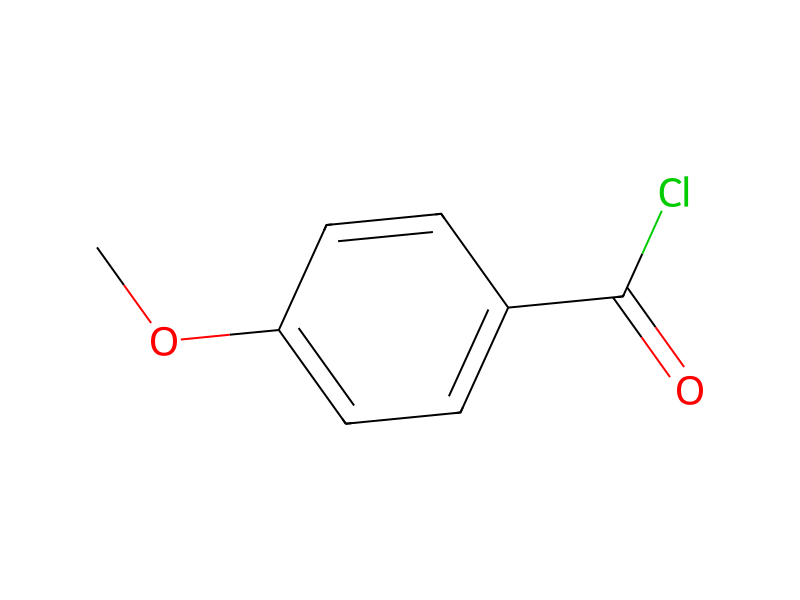
p-Anisoyl chloride → [6-Hydroxy-2-(4-hydroxyphenyl)-1-benzothiophen-3-YL](4-methoxyphenyl)methanone
Reaction equation

C(Cl)(=O)C1C=CC(OC)=CC=1.C[O:13][C:14]1[CH:19]=[CH:18][C:17]([C:20]2[S:24][C:23]3[CH:25]=[C:26]([O:29]C)[CH:27]=[CH:28][C:22]=3[C:21]=2[C:31](=[O:40])[C:32]2[CH:37]=[CH:36][C:35]([O:38][CH3:39])=[CH:34][CH:33]=2)=[CH:16][CH:15]=1.B(Cl)(Cl)Cl>ClCCCl>[OH:13][C:14]1[CH:15]=[CH:16][C:17]([C:20]2[S:24][C:23]3[CH:25]=[C:26]([OH:29])[CH:27]=[CH:28][C:22]=3[C:21]=2[C:31](=[O:40])[C:32]2[CH:37]=[CH:36][C:35]([O:38][CH3:39])=[CH:34][CH:33]=2)=[CH:18][CH:19]=1Participants



Conditions
- Temperature
- 2.5 °C
Procedure
A 100 mL, 3 neck, round bottom flask fitted with a mechanical agitator, glass stopper, and outlet to a caustic scrubber is charged with p-anisoyl chloride (3.47 g, 20.34 mmol), 2-(4-methoxyphenyl)-3-(4-methoxybenzoyl)-6-methoxybenzo[b]thiophene (5.0 g, 18.49 mmol) and 30 mL 1,2-dichloroethane. The mixture is cooled to 0-5° C. and previously condensed boron trichloride (4.7 mL, 55.0 mmol) is added in one portion. The mixture is stirred at 0-50° C. for 7.5 hours then more boron trichloride (4.7 mL, 55.0 mmol) is added. The cooling bath is removed and the reaction mixture is stirred at ambient temperature for 16 hours. After the overnight stir, the mixture is poured into 500 mL of agitated ice/water which caused precipitation of the monomethoxy product. The reaction vessel is rinsed in with 1,2-dichloroethane and the slurry is stirred for 1 hour. Then, 200 mL of methylene chloride is added and the mixture is vacuum filtered washing with methylene chloride. The solid is dried overnight in a vacuum oven at 40° C. to afford 6.3 g (82.4%) of monomethoxy product as a yellow solid. An analytical sample is obtained by chromatography on silica gel (20:1 methylene chloride/methanol). mp 127-128° C. (dec); 1H NMR (300.1 MHz, DMSO-d6) δ 3.76 (s, 3H), 6.66 (d, 2H), 6.85 (dd, 1H), 6.87 (d, 2H), 7.16 (d, 2H), 7.25 (d, 1H), 7.33 (s, 1H), 7.66 (d, 2H), 9.76 (br s, 2H); 13C NMR (75.5 MHz, DMSO-d6) d 55.5, 107.1, 114.0, 115.2, 115.7, 123.3, 123.8, 129.7, 131.8, 132.3, 139.2, 140.4, 155.4, 157.8, 163.5, 192.6; MS (FD+) m/e 376(100), 377(25), 378(7); Analysis calc'd for C22H16O4S: C, 70.20; H, 4.28; S, 8.52; found: C, 70.09; H, 4.27; S, 8.45.
Workup
- customA 100 mL, 3 neck, round bottom flask fitted with a mechanical agitator, glass stopper, and outlet to a caustic scrubber
- additionis added in one portion
- customThe cooling bath is removed
- stirringthe reaction mixture is stirred at ambient temperature for 16 hours
- stirringAfter the overnight stir
- additionthe mixture is poured into 500 mL of agitated ice/water which
- customprecipitation of the monomethoxy product
- washThe reaction vessel is rinsed in with 1,2-dichloroethane
- stirringthe slurry is stirred for 1 hour
- additionThen, 200 mL of methylene chloride is added
- filtrationfiltered
- washwashing with methylene chloride
- customThe solid is dried overnight in a vacuum oven at 40° C.
- customto afford 6.3 g (82.4%) of monomethoxy product as a yellow solid
- customAn analytical sample is obtained by chromatography on silica gel (20:1 methylene chloride/methanol)
Sources & evidence
- ORD record
- ord-716159df2e55440c8f3e8ae113ed6081
- Source dataset
- uspto-grants-2000_02
- Patent number
- US06025495
Reaction notes
Loading…