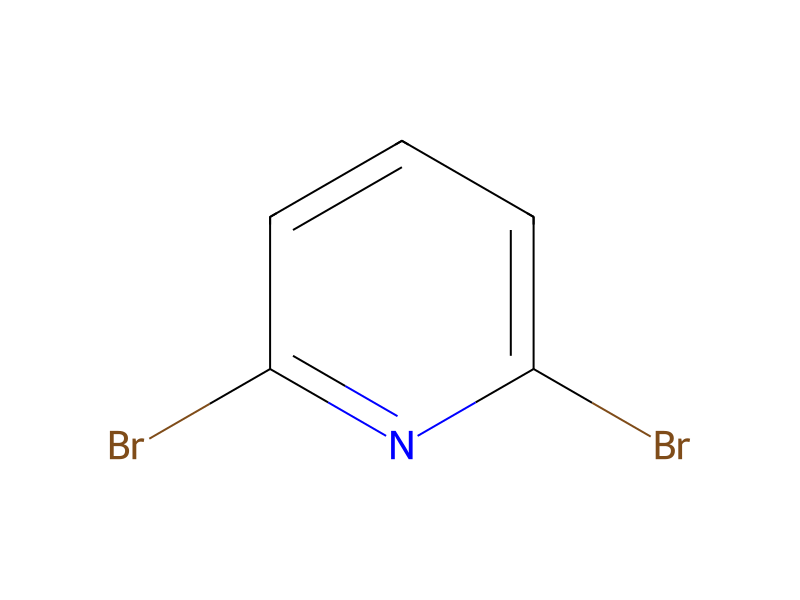
2,6-Dibromopyridine → tert-Butyl 4-[(6-bromopyridin-2-yl)(hydroxy)methyl]piperazine-1-carboxylate
Reaction equation

Br[C:2]1[CH:7]=[CH:6][CH:5]=[C:4]([Br:8])[N:3]=1.C([Li])CCC.[CH:14]([N:16]1[CH2:21][CH2:20][N:19]([C:22]([O:24][C:25]([CH3:28])([CH3:27])[CH3:26])=[O:23])[CH2:18][CH2:17]1)=[O:15]>O1CCCC1>[Br:8][C:4]1[N:3]=[C:2]([CH:14]([OH:15])[N:16]2[CH2:17][CH2:18][N:19]([C:22]([O:24][C:25]([CH3:27])([CH3:26])[CH3:28])=[O:23])[CH2:20][CH2:21]2)[CH:7]=[CH:6][CH:5]=1Participants
5
Reactant 3


Product 1

Reagents, catalysts & solvents 1

Procedure
2,6-Dibromopyridine (5.45 g, 23.01 mmol) was dissolved in tetrahydrofuran (27.3 mL) and cooled to −78° C. under argon after which n-butyllithium (10.40 mL, 26.0 mmol) was added and the solution was stirred for thirty minutes. A solution of tert-butyl 4-formylpiperazine-1-carboxylate (5.00 g, 23.47 mmol) in tetrahydrofuran (8 mL) was added and the solution was stirred at −78° C. for one hour and then for one hour at ambient temperature. The reaction was quenched with saturated sodium bicarbonate (10 mL) and stirred for ten minutes. The product was extracted with ether, dried over magnesium sulfate, filtered and concentrated. The crude material was purified by silica gel chromatography to give the title compound.
Workup
- additionwas added
- stirringthe solution was stirred at −78° C. for one hour
- customThe reaction was quenched with saturated sodium bicarbonate (10 mL)
- stirringstirred for ten minutes
- extractionThe product was extracted with ether
- dry with materialdried over magnesium sulfate
- filtrationfiltered
- concentrationconcentrated
- customThe crude material was purified by silica gel chromatography
Sources & evidence
- ORD record
- ord-9bfe0fc00e724814a8966c53875d08af
- Source dataset
- uspto-grants-2013_02
- Patent number
- US08367706B2
Reaction notes
Loading…