反应详情
EQUATION
反应方程式

REACTANTS
反应物
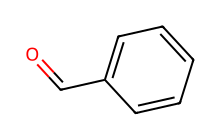

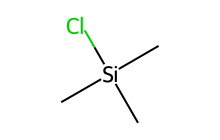

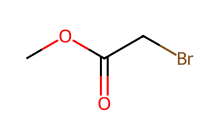


PRODUCTS
产物

AUXILIARIES
试剂、催化剂与溶剂
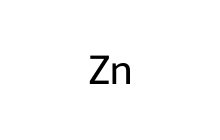
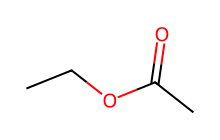
CONDITIONS
反应条件
- 温度
- 65 °C
PROCEDURE
实验过程
At room temperature, a three-necked flask fitted with reflux condenser, internal thermometer, dropping funnel and stirrer was charged, under nitrogen protective gas, with 5.6 g of zinc powder (85 mmol) in 35 ml of ethyl acetate. After 1.61 ml of trimethylchlorosilane (12.6 mmol) had been added, the mixture was heated at 65° C. for 30 min, then left to cool to 60° C., following which 10 g of neat 1-phenylhexan-3-one prepared by base-catalyzed aldol condensation of benzaldehyde and pentan-2-one and subsequent hydrogenation of the resulting 1-phenylhex-1-en-3-one were added. Subsequently, over the course of 5 min, 10.4 g of methyl bromoacetate (68 mmol) were added dropwise, the temperature being maintained at 65° C. by external cooling. The mixture was stirred for 30 min at 60° C., and following cooling to 0° C., acidified with 35 ml of 2 N hydrochloric acid to a pH of 1 and stirred for 30 min. Excess zinc was removed by filtration and the organic phase separated. The organic phase was then stirred at 0° C. with 30 ml of 0.5 N hydrochloric acid and finally washed with 20 ml of saturated sodium hydrogen carbonate solution. Following phase separation and drying over sodium sulfate, the solvent was removed by distillation under reduced pressure. Methyl 3-hydroxy-3-(2′-phenylethyl)caproate was obtained in a yield of 13.5 g (95% of theory) and a purity of greater than 97% (HPLC).
WORKUP
后处理
- customAt room temperature, a three-necked flask fitted
- temperaturewith reflux condenser
- waitleft
- temperatureto cool to 60° C.
- additionwere added
- temperaturethe temperature being maintained at 65° C. by external cooling
- temperaturefollowing cooling to 0° C.
- stirringstirred for 30 min
- customExcess zinc was removed by filtration
- customthe organic phase separated
- stirringThe organic phase was then stirred at 0° C. with 30 ml of 0.5 N hydrochloric acid
- washfinally washed with 20 ml of saturated sodium hydrogen carbonate solution
- customFollowing phase separation
- dry with materialdrying over sodium sulfate
- customthe solvent was removed by distillation under reduced pressure