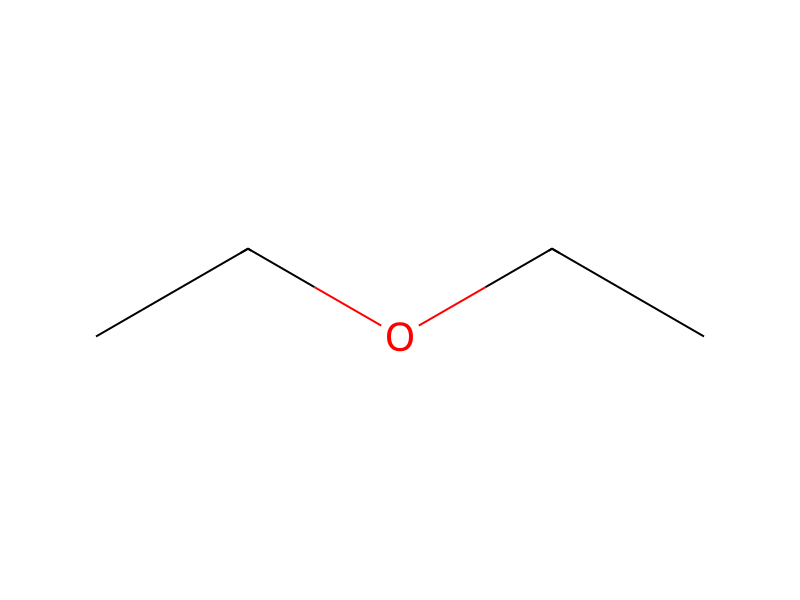
Diethyl Ether → HCID 178419178, 화합물
반응식

[BH3:1].[PH3:2].[CH2:3]1[CH2:12][C@H:11]2N(C[C@H:8]3[C@@H:15]4[CH2:16][CH2:17][CH2:18][CH2:19]N4C[C@@H:10]2[CH2:9]3)CC1.[Li][CH:21]([CH2:23]C)[CH3:22].[Li]C(CC)C.C1[CH2:39][C@H:38]2N(C[C@@H]3[C@@H]4CCCCN4[CH2:40][C@H:37]2[CH2:36]3)CC1.C(Br)C1C=CC=CC=1.CC[O:57][CH2:58][CH3:59]>>[BH3:1].[CH2:15]([C@H:16]1[CH2:17][CH2:18][CH2:19][P:2]1[O:57][CH:58]1[CH:59]([CH:21]([CH3:23])[CH3:22])[CH2:39][CH2:38][C@H:37]([CH3:36])[CH2:40]1)[C:8]1[CH:9]=[CH:10][CH:11]=[CH:12][CH:3]=1참가 물질



실험 절차
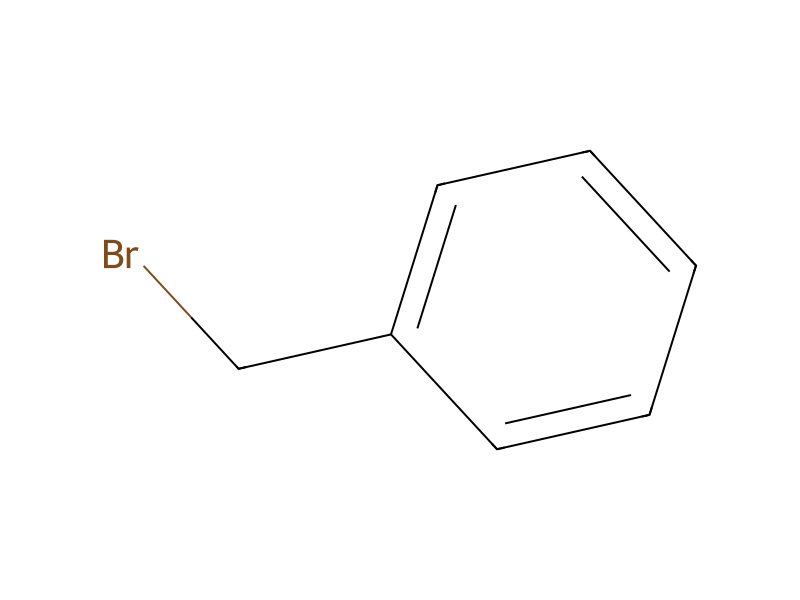
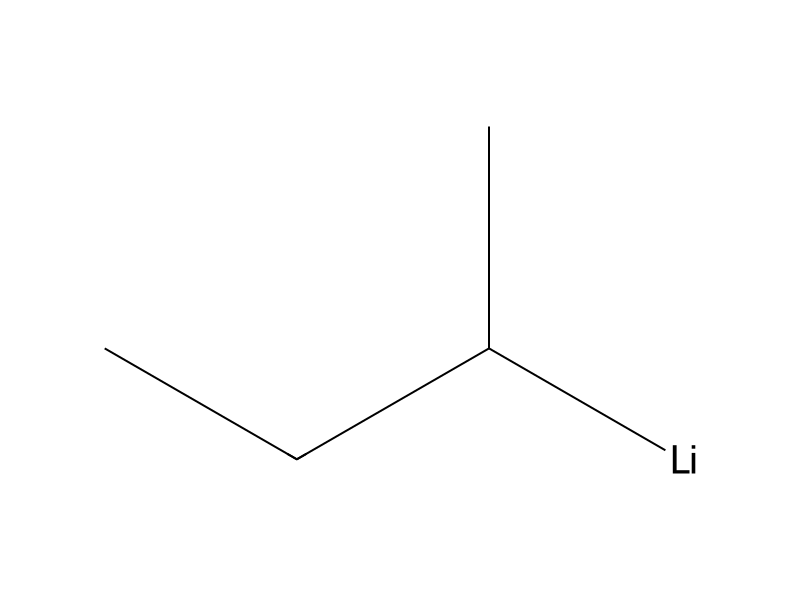
The phosphine-borane compound of Example 2 (8.83 g, 0.0345 mole) was placed in a 500 mL round bottom flask and dissolved in 150 mL Et2O at −78° C. under N2. In a separate flask, (−)-sparteine (9.9 mL, 0.043 mole) was placed in a 250 mL flask and dissolved in 100 mL of Et2O under N2. The (−)-sparteine solution was cooled to −78° C. and then s-BuLi (33.2 mL of 1.3 M in cyclohexane solution reagent, 0.043 mole) was added via syringe. The s-BuLi/sparteine solution was then delivered to the flask containing the phosphine-borane compound via cannula at −78° C. over 30 minutes. After addition, the reaction was stirred for 2 hours. In a separate 100 mL flask was dissolved benzyl bromide (5.3 mL, 0.0449 mole), an electrophile, in 50 mL Et2O under N2. The benzyl bromide solution was then delivered quickly to the anion solution via cannula. The cold bath was removed and the reaction was allowed to warm slowly to room temperature. The reaction was then quenched with 500 ML 1N HCl. The organic layer was separated, and then the aqueous layer was extracted with 2×75 mL Et2O. The combined organic layers were dried over MgSO4, and then the solvent was removed on a rotary evaporator. The crude product was chromatographed over silica gel (1.5% EtOAc/hexane) to yield 9.14 g/77% of (1S,2R)-2-benzyl-1-(−)-menthoxy-phospholane borane. Determination of the d.e. of the product was not possible at this stage. 1H NMR (400 MHz, CDCl3) δ 0.2-1.1 (m, 14 H), 1.2-1.4 (m, 3 H), 1.3-1.5 (m, 1 H), 1.7-2.0 (m, 8 H), 2.18-2.30 (m, 1 H), 2.20-2.25 (m, 1 H), 2.55-2.61 (m, 1 H), 3.15-3.21 (m, 1 H), 3.96-4.02 (m, 1 H), 7.15 (m, 3 H), 7.24-7.29 (m, 2 H); 13C NMR (100 MHz, CDCl3) δ 16.2, 20.9, 22.1, 23.1, 23.7, 26.0, 30.3, 31.2, 31.3, 34.2, 34.9, 43.4, 44.3, 48.7, 79.0 (d, JC-P=4.6 Hz), 126.2, 128.5, 128.7, 140.7 (d, 14.5 Hz); 31P NMR (162 MHz, CDCl3) dd 143.5 (m).
후처리
- additionAfter addition
- customThe cold bath was removed
- customThe reaction was then quenched with 500 ML 1N HCl
- customThe organic layer was separated
- extractionthe aqueous layer was extracted with 2×75 mL Et2O
- dry with materialThe combined organic layers were dried over MgSO4
- customthe solvent was removed on a rotary evaporator
- customThe crude product was chromatographed over silica gel (1.5% EtOAc/hexane)
출처 및 근거
- ORD 기록
- ord-8155da24517a4c5cab5e276534da334d
- 출처 데이터셋
- uspto-grants-2003_08
- 특허 번호
- US06605745B2
반응 노트
불러오는 중…