Acetic Anhydride → 9-Acetyl-3-bromocarbazole
Reaction equation
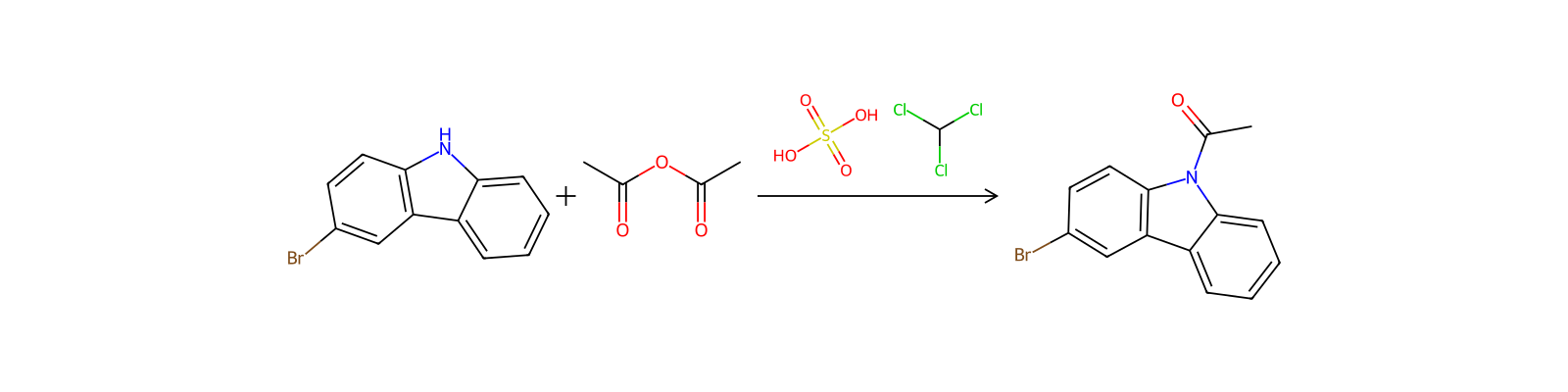
[Br:1][C:2]1[CH:3]=[CH:4][C:5]2[NH:6][C:7]3[C:12]([C:13]=2[CH:14]=1)=[CH:11][CH:10]=[CH:9][CH:8]=3.[C:15](OC(=O)C)(=[O:17])[CH3:16]>OS(O)(=O)=O.C(Cl)(Cl)Cl>[Br:1][C:2]1[CH:3]=[CH:4][C:5]2[N:6]([C:15](=[O:17])[CH3:16])[C:7]3[C:12]([C:13]=2[CH:14]=1)=[CH:11][CH:10]=[CH:9][CH:8]=3Participants
5
Reactant 2


Product 1

Reagents, catalysts & solvents 2


Procedure
A solution of 3-bromo-9H-carbazole (10.00 g, 40.6 mmol), acetic anhydride (8.30 g, 81 mmol) together with 2 drops of H2SO4 in chloroform (150 mL) was refluxed overnight. After cooling to room temperature, the solution was washed with water. Upon evaporation of the solvent, the crude product was purified by crystallization from hexane/DCM and hexane/EtOAc to yield 1-(3-bromo-9H-carbazol-9-yl)ethanone (6.1 g, 51% yield) as a light yellow solid.
Workup
- washthe solution was washed with water
- customUpon evaporation of the solvent
- customthe crude product was purified by crystallization from hexane/DCM and hexane/EtOAc
Sources & evidence
- ORD record
- ord-448e779b27c0471baaa8051f1674588c
- Source dataset
- uspto-grants-2014_06
- Patent number
- US08748012B2
Reaction notes
Loading…