Ammonium bisulfate → 1,1-Dimethoxy-3-methyl-2-butene
Reaction equation

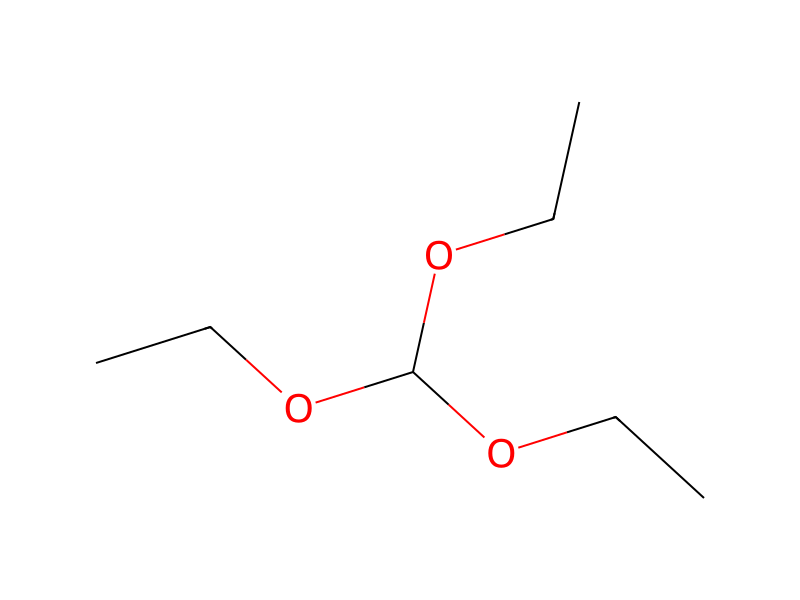
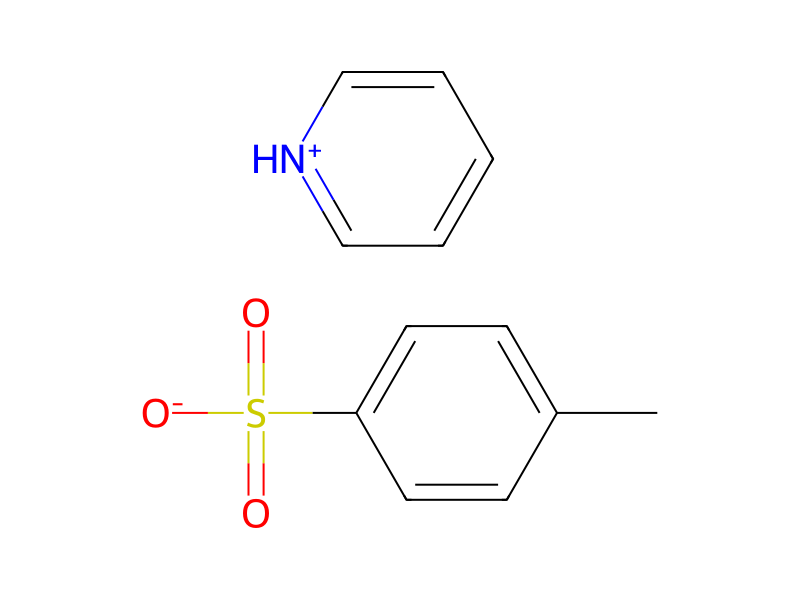
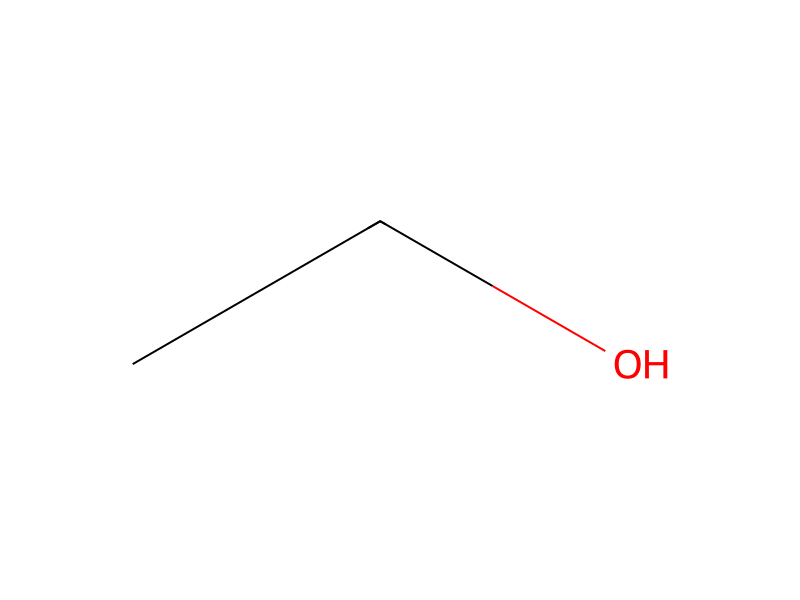
[Cl-].C([NH+](CC)CC)C.[C:9]1([CH3:19])[CH:14]=CC(S([O-])(=O)=O)=C[CH:10]=1.[NH+]1C=CC=CC=1.S(=O)(=O)(O)[O-].[NH4+].S(=O)(=O)(O)[O-].[K+].[CH:38]([O:45][CH2:46]C)([O:42][CH2:43]C)OCC.CC(C)=CC=O>S(=O)(=O)(O)[O-].C([N+](CCCC)(CCCC)CCCC)CCC.C(O)C>[CH3:46][O:45][CH:38]([O:42][CH3:43])[CH:10]=[C:9]([CH3:19])[CH3:14]Participants
Reactant 6




Product 1

Reagents, catalysts & solvents 2

Conditions
- Temperature
- 2 °C
Procedure
Various acidic catalysts were tested in J. Org. Chem. 1995, 60, 1995, 3397-3400. Use of p-toluenesulfonic acid resulted in polymerization of the 3-methyl-2-butenal. Triethylammonium chloride, pyridinium p-toluenesulfonate, tetrabutylammonium bisulfate and ammonium bisulfate likewise gave unsatisfactory results. Potassium bisulfate proved to be more suitable. The reaction conditions are likewise described in the Patent Application EP 0629619. Triethyl orthoformate and 3-methyl-2-butenal are added to abs. ethanol at 4° C. The clear solution is cooled to 2° C., and potassium bisulfate is added. The heterogeneous reaction mixture warms to 10° C. owing to the exothermic reaction. The mixture is then allowed to warm to 21° C. over the course of 45 minutes and is then stirred at this temperature for 15 minutes. The catalyst is then filtered off and washed with ethanol. The filtrate is mixed with potassium carbonate and stirred at room temperature for one hour. The potassium carbonate is then likewise filtered off and washed with ethanol. Distillation affords 3-methyl-2-butenal dimethyl acetal in a yield of 85%. The disadvantages of this process are that elaborate temperature control is required and the alternating cooling and warming steps require increased energy consumption and elaborate apparatus.
Workup
- customThe reaction conditions
- customat 4° C
- customwarms to 10° C.
- customowing to the exothermic reaction
- temperatureto warm to 21° C. over the course of 45 minutes
- filtrationThe catalyst is then filtered off
- washwashed with ethanol
- additionThe filtrate is mixed with potassium carbonate
- stirringstirred at room temperature for one hour
- filtrationThe potassium carbonate is then likewise filtered off
- washwashed with ethanol
- distillationDistillation
Sources & evidence
- ORD record
- ord-aef827e49b1848f49d055e3970894285
- Source dataset
- uspto-grants-2001_11
- Patent number
- US06313322B1
Reaction notes
Loading…