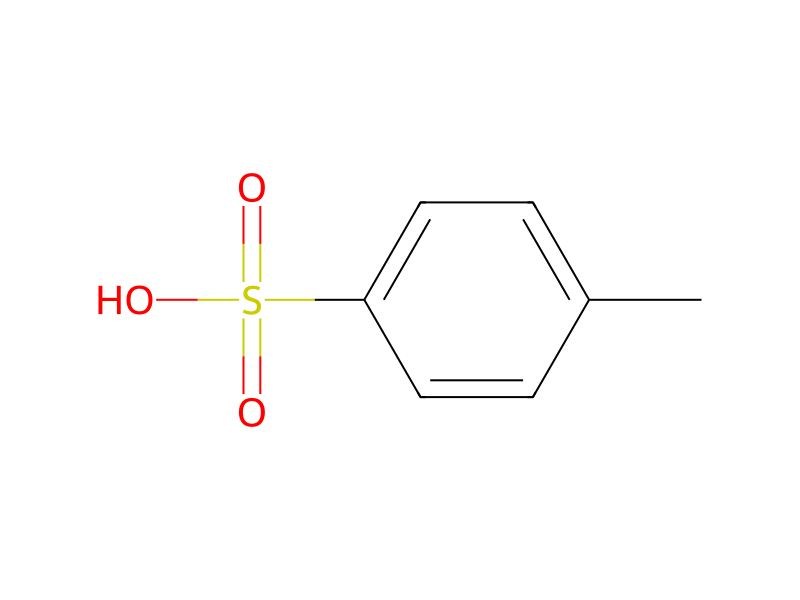
p-Toluenesulfonic acid → 7-Nitrobenzofuran
Reaction equation

Cl[C:2]1[C:3]([CH2:12][C:13](C)=C)=[C:4]([OH:11])[C:5]([N+:8]([O-:10])=[O:9])=[CH:6][CH:7]=1.C1(C)C=CC(S(O)(=O)=O)=CC=1>>[N+:8]([C:5]1[C:4]2[O:11][CH:13]=[CH:12][C:3]=2[CH:2]=[CH:7][CH:6]=1)([O-:10])=[O:9]Participants


Procedure
In Schema 1, a 3,5-optionally substituted-2-nitrophenol is reacted with a 2-alkenyl chloride, such as 2-methallyl chloride, to form the corresponding 2-(2-alken-1-yloxy)-4,6-optionally substituted-nitrobenzene (I), for example, 4-chloro-2-(2-methyl-2-propen-1-yloxy)nitrobenzene. This product is rear-ranged by heating to 180° C. to give the corresponding 2-(2-alken-1-yl)-6-nitrophenol (II), for example, 3-chloro-2-(2-methyl-2-propen-1-yl)-6-nitrophenol. This compound is then heated in the presence of p-toluenesulfonic acid to give the corresponding 7-nitrobenzofuran (III), for example 4-chloro-2,3-dihydro-2,2-dimethyl-7-nitrobenzofuran. Compound III is then converted to the corresponding amine(IV) by reduction of the nitro group using powdered iron, acetic acid, and water, after which the amine is heated at reflux with trichloromethyl chloroformate to form the corresponding isocyanate(V). The isocyanate is then treated with a 3-amino-3-fluoroalkylacrylate, for example, ethyl 3-amino-4,4,4-trifluorocrotonate, to give the corresponding 3-(2,3-dihydrobenzofuran-7-yl)-6-haloalkyl uracil, for example, 3-(4-chloro-2,3-dihydro-2,2-dimethylbenzofuran-7-yl)-6-trifluoromethyluracil. This uracil which represents certain compounds of this invention may be isolated, or without isolation, may be alkylated with an alkyl iodide, such as methyl iodide, in the presence of anhydrous potassium carbonate to produce the corresponding 3-(2,3-dihydrobenzofuran-7-yl)-1-alkyl-6-haloalkyluracil (VI), for example 3-(4-chloro-2,3-dihydro-2,2-dimethylbenzofuran-7-yl)-1-methyl-6-trifluoromethyluracil.
Sources & evidence
- ORD record
- ord-ec1c7e04a0b445759f198a8133730b21
- Source dataset
- uspto-grants-1996_05
- Patent number
- US05521147
Reaction notes
Loading…