Hydrochloric Acid → (6-Chloro-2-oxohexyl) triphenylphosphonium chloride
Reaction equation

C1(=O)OCCCC1.S(Cl)([Cl:10])=O.ClCCCCC(Cl)=O.[N+](=C)=[N-].[N+](=CC(C=[N+]=[N-])=O)=[N-].Cl.Cl[CH2:33][C:34](=[O:40])[CH2:35][CH2:36][CH2:37][CH2:38][Cl:39].[C:41]1([P:47]([C:54]2[CH:59]=[CH:58][CH:57]=[CH:56][CH:55]=2)[C:48]2[CH:53]=[CH:52][CH:51]=[CH:50][CH:49]=2)[CH:46]=[CH:45][CH:44]=[CH:43][CH:42]=1>[Cl-].[Zn+2].[Cl-]>[Cl-:10].[Cl:39][CH2:38][CH2:37][CH2:36][CH2:35][C:34](=[O:40])[CH2:33][P+:47]([C:48]1[CH:49]=[CH:50][CH:51]=[CH:52][CH:53]=1)([C:54]1[CH:59]=[CH:58][CH:57]=[CH:56][CH:55]=1)[C:41]1[CH:42]=[CH:43][CH:44]=[CH:45][CH:46]=1Participants
Reactant 8







Product 1

Reagents, catalysts & solvents 1

Procedure
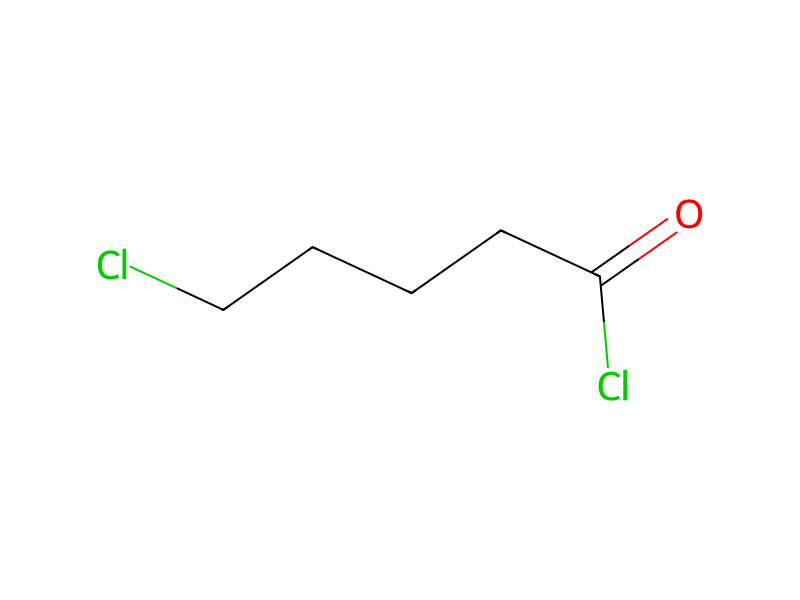
The latter reactions are exemplified by the cleavage of δ-valerolactone with zinc chloride and thionyl chloride to produce 5-chlorovaleryl chloride, reaction of that acid chloride with diazomethane, followed by treatment of the resulting diazomethyl ketone with hydrochloric acid to yield 1,6-dichloro-2-hexanone, and reaction of that ketone with triphenylphosphine to afford (6-chloro-2-oxohexyl)triphenylphosphonium chloride. This product is converted to (5-chloropentanoylmethylene)triphenyl phosphorane by reaction with aqueous sodium hydroxide. Condensation of that phosphorane with the aforementioned 3α-(tetrahydropyran-2-yloxy)-2β-formyl-5-oxocyclopentane-1α-heptanoic acid affords a mixture of stereoisomers, which are separated by chromatographic techniques to afford, as the major product, 3α-(tetrahydropyran-2-yloxy)-2β-(7-chloro-3-oxo-1-heptenyl)-5-oxocyclopentane-1α-heptanoic acid. Removal of the tetrahydropyran-2-yl group is effected by reaction with acetic acid in aqueous tetrahydrofuran, thus affording 3α-hydroxy-2β-(7-chloro-3-oxo-1-heptenyl)-5-oxocyclopentane-1α-heptanoic acid.
Workup
- customto produce
- customto yield
Sources & evidence
- ORD record
- ord-622bbc4844a74853910c999153656256
- Source dataset
- uspto-grants-1977_08
- Patent number
- US04041050
Reaction notes
Loading…