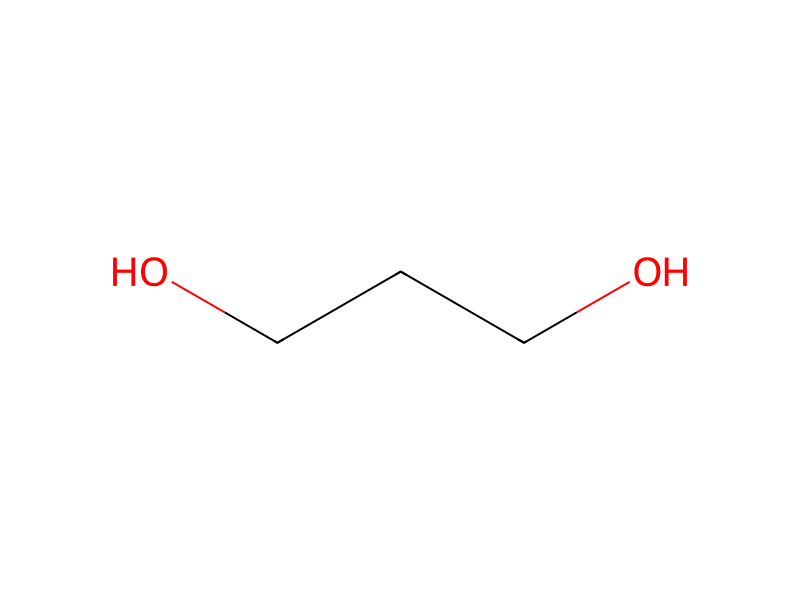
1,3-Propanediol → HCID 53942355, compound
Reaction equation

[Br:1][C:2]1[CH:3]=[CH:4][C:5]([O:20][CH3:21])=[C:6]([S:8]([O:11][C:12]2[CH:13]=[C:14]([OH:19])[CH:15]=[C:16]([CH3:18])[CH:17]=2)(=[O:10])=[O:9])[CH:7]=1.[CH2:22](O)[CH2:23][CH2:24][OH:25].C1(P(C2C=CC=CC=2)C2C=CC=CC=2)C=CC=CC=1.N(C(OCC)=O)=NC(OCC)=O.C1(P(=O)(C2C=CC=CC=2)C2C=CC=CC=2)C=CC=CC=1>O1CCCC1>[Br:1][C:2]1[CH:3]=[CH:4][C:5]([O:20][CH3:21])=[C:6]([S:8]([O:11][C:12]2[CH:13]=[C:14]([CH:15]=[C:16]([CH3:18])[CH:17]=2)[O:19][CH2:22][CH2:23][CH2:24][OH:25])(=[O:10])=[O:9])[CH:7]=1Participants






Procedure
To 1.39 g (3.72 mmol) 3-(5-bromo-2-methoxyphenylsulfonyloxy)-5-methylphenol, as prepared in the preceding step, 2.69 mL (37.2 mmol) of 1,3-propanediol and 1.95 g (7.44 mmol) of triphenylphosphine in 25 mL of anhydrous tetrahydrofuran was added 1.17 mL (7.44 mmol) of diethyl azodicarboxylate dropwise over 15 min. After stirring at ambient temperature for 2 h, the reaction mixture was concentrated to a semisolid. The resulting mixture was flash chromatographed on 250 g of silica gel with 60% ethyl acetate-hexane to give a mixture of desired product and triphenylphosphine oxide. A second chromatography on 120 g of silica gel with 8% acetone-dichloromethane afforded 1.43 g (89% yield) of the pure title compound as a colorless resin: 1H-NMR (300 MHz; CDCl3) δ 7.95 (d, 1 H, J=2.5 Hz), 7.70 (dd, 1 H, J=8.9, 2.5 Hz), 6.98 (d, 1 H, J=8.9 Hz), 6.62 (br s, 1 H), 6.52 (br s, 1 H), 6.46 (t, 1 H, J=2.0 Hz), 4.03 (t, 2 H, J=6.0 Hz), 4.00 (s, 3 H), 3.84 (q, 2 H, J=5.7 Hz), 2.26 (s, 3 H) and 2.00 (m, 2 H). Mass spectrum (MALDI-TOF, α-cyano-4-hydroxycinnamic acid matrix) calcd. for C17H1981BrO6S: 455.0 (M+Na). Found: 454.8.
Workup
- concentrationthe reaction mixture was concentrated to a semisolid
- customchromatographed on 250 g of silica gel with 60% ethyl acetate-hexane
- customto give
Sources & evidence
- ORD record
- ord-9d34583cc64a48f28f63a35a5d16755b
- Source dataset
- uspto-grants-1999_04
- Patent number
- US05891909
Reaction notes
Loading…