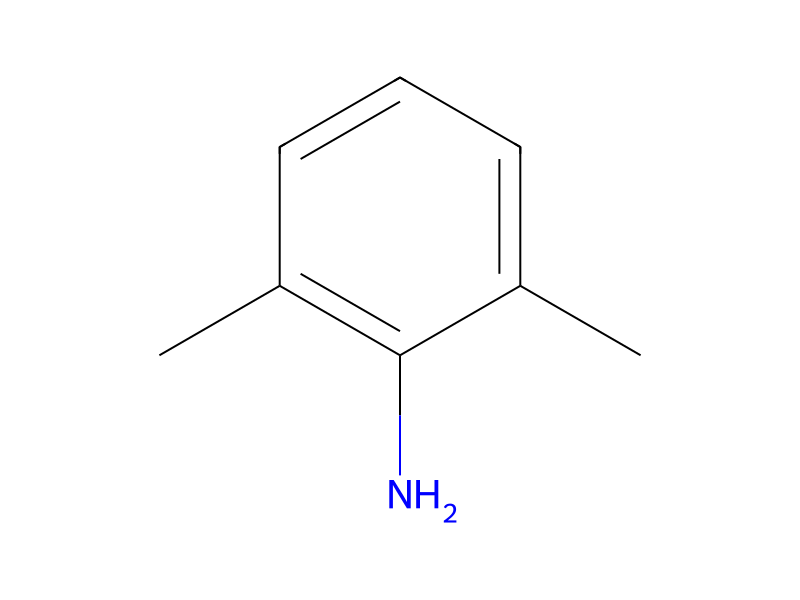
2,6-Dimethylaniline → Z-Dehydro-Ala-OMe
Reaction equation

CC1C=CC=C(C)C=1N.ICl.[CH3:12][O:13][C:14](=[O:29])[C@H:15]([CH2:27]O)[NH:16][C:17]([O:19][CH2:20][C:21]1[CH:26]=[CH:25][CH:24]=[CH:23][CH:22]=1)=[O:18]>>[CH3:12][O:13][C:14](=[O:29])[C:15](=[CH2:27])[NH:16][C:17]([O:19][CH2:20][C:21]1[CH:26]=[CH:25][CH:24]=[CH:23][CH:22]=1)=[O:18]Participants



Procedure
The synthesis of indazole amino acid B begins with the iodination of 2,6-dimethylaniline by the action of iodine monochloride (Scheme 3). This intermediate was temporarily set aside. N-CBZ-L-serine methyl ester undergoes a one-pot methanesulfonylation/elimination reaction to afford N-CBZ-dehydroalanine methyl ester. With the iodide and dehydroalanine in hand, they are efficiently coupled using palladium (II) acetate in a Heck coupling to afford the product in 65% yield. At this point, the chiral center is installed using a catalytic asymmetric hydrogenation utilizing (−)-1,2-bis((2R,5R)-2,5-diethylphospholano)benzene(cyclooctadiene)rhodium(I) tetrafluoroborate and hydrogen (60 psi) to give the chiral amino acid in ˜96% ee. The indazole ring is then formed by the action of iso-amyl nitrite. The resulting indazole is highly crystalline. One recrystallization from acetone/hexanes affords the indazole amino acid in excellent purity and with an improved 99.8% ee. Removal of the CBZ protecting group under hydrogenation conditions completes the preparation of fragment B. Indazole amino acid B can also be prepared using enzymatic resolution of the racemic amino acid or keto acid (Hanson, Ronald L.; Davis, Brian L.; Goldberg, Steven L.; Johnston, Robert M.; Parker, William L.; Tully, Thomas P.; Montana, Michael A.; Patel, Ramesh N. Process Research and Development, Bristol-Myers Squibb, New Brunswick, N.J., USA. Organic Process Research & Development (2008), 12(6), 1119-1129.).
Workup
- customa one-pot methanesulfonylation/elimination reaction
Sources & evidence
- ORD record
- ord-9728f2be5c2b47c589c6ac0a5c009c99
- Source dataset
- uspto-grants-2013_07
- Patent number
- US08481546B2
Reaction notes
Loading…