Benzoyl Peroxide → 1-[4-(Bromomethyl)phenyl]-2,2-dimethylpropan-1-one
Reaction equation

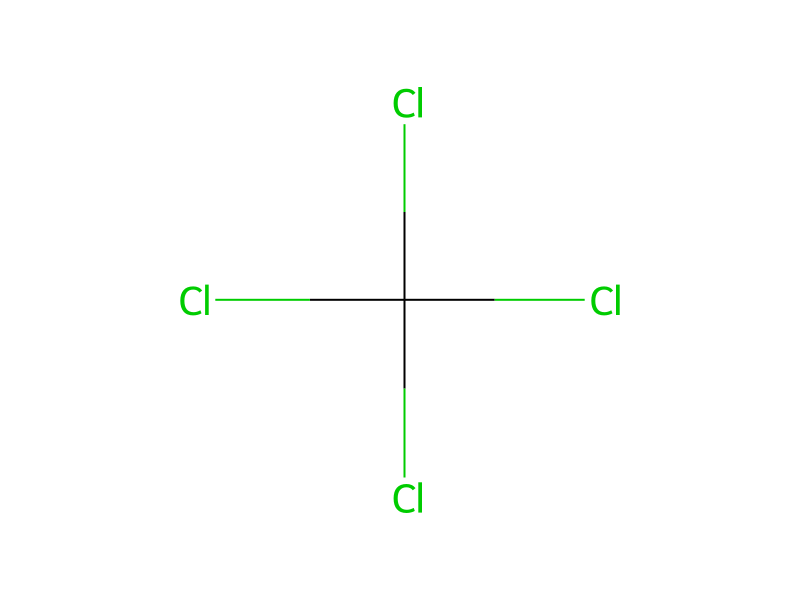
[C:1]([C:7]1[CH:12]=[CH:11][C:10]([CH3:13])=[CH:9][CH:8]=1)(=[O:6])[C:2]([CH3:5])([CH3:4])[CH3:3].[Br:14]N1C(=O)CCC1=O.C(OOC(=O)C1C=CC=CC=1)(=O)C1C=CC=CC=1>C(Cl)(Cl)(Cl)Cl>[Br:14][CH2:13][C:10]1[CH:11]=[CH:12][C:7]([C:1](=[O:6])[C:2]([CH3:5])([CH3:4])[CH3:3])=[CH:8][CH:9]=1Participants


Procedure
To a suspension of 28.5 g. (1.17 g. atoms) magnesium turnings in 150 ml. tetrahydrofuran under a nitrogen atmosphere there is added 10 ml. of 4-bromo toluene (1.17 mole) in 650 ml. dry tetrahydrofuran; the reaction is started and the remainder of the bromo toluene solution is added dropwise at a rate that maintains a moderate reflux. After the addition is complete, the mixture is refluxed for an additional 11/2 hours. The resulting Grignard solution is added dropwise to a cold solution of 128.0 g. pivaloyl chloride (1.06 mole) in 500 ml. dry tetrahydrofuran at a rate that maintains the temperature at 0° to -5° C. The solution is stirred for an additional 11/2 hours at 0° C. and then at room temperature for 18 hours. The mixture is then cooled to 0° C. and hydrolyzed by the addition of 100 ml. 2N hydrochloric acid. The layers are separated and 200 ml. of ether is added to the organic phases which is then washed respectively with 100 ml. 2N hydrochloric acid, 100 ml. 10% sodium bicarbonate solution, and 100 ml. saturated sodium chloride. The resulting layer is dried over anhydrous sodium sulfate, filtered, and the solvent is removed in vacuo to give p-pivaloyl toluene (b.p. 80° to 84° C./0.7 mm, nC21 1.5108). A mixture of 156.3 g. (0.886 mole) of the resulting p-pivaloyl toluene is then added to 157.8 g. (0.886 mole) N-bromosuccinimide, 4.0 g. (0.016 mole) benzoyl peroxide and 150 ml. carbon tetrachloride and heated at reflux for 18 hours. The mixture is cooled and filtered and the resulting oil is distilled in vacuo to give α-bromo-p-pivaloyl toluene (b.p. 124°-132° C/0.7 mm, nD22 1.5546-V.P.C. 96% monobromo 4% -dibromo).
Workup
- additionA mixture of 156.3 g
- temperatureat reflux for 18 hours
- temperatureThe mixture is cooled
- filtrationfiltered
- distillationthe resulting oil is distilled in vacuo
Sources & evidence
- ORD record
- ord-3960e1d53132478998411e016b7754e1
- Source dataset
- uspto-grants-1977_12
- Patent number
- US04061778
Reaction notes
Loading…