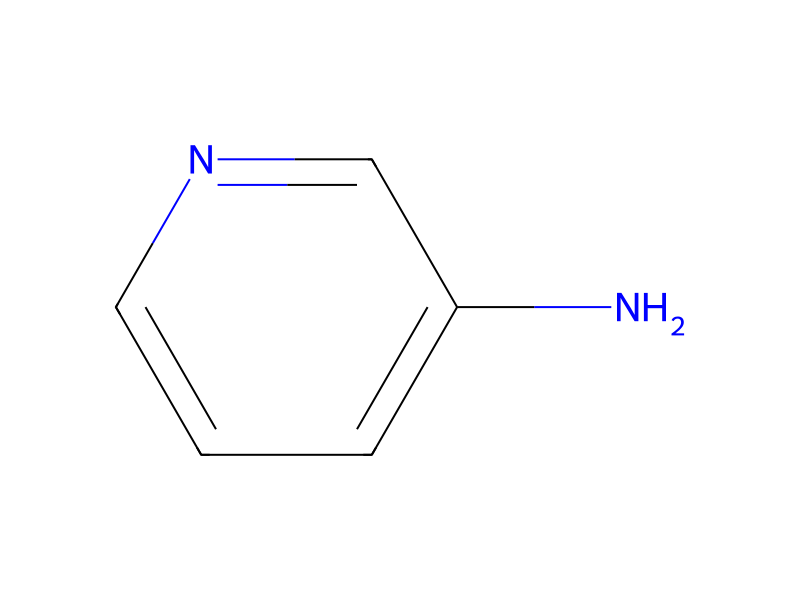
3-Aminopyridine → (S)-3-(pyrid-3-ylimino)-1,5,10,10a-tetrahydrothiazolo[3,4-b]isoquinoline
Reaction equation

[I-].CS[C:4]1[S:5][CH2:6][C@@H:7]2[CH2:16][C:15]3[CH:14]=[CH:13][CH:12]=[CH:11][C:10]=3[CH2:9][N+:8]=12.[NH2:17][C:18]1[CH:19]=[N:20][CH:21]=[CH:22][CH:23]=1>N1C=CC=CC=1>[N:20]1[CH:21]=[CH:22][CH:23]=[C:18]([N:17]=[C:4]2[N:8]3[CH2:9][C:10]4[CH:11]=[CH:12][CH:13]=[CH:14][C:15]=4[CH2:16][C@H:7]3[CH2:6][S:5]2)[CH:19]=1Participants



Procedure
(S)-3-Methylthio-1,5,10,10a-tetrahydrothiazolo[3,4-b]isoquinolinium iodide (36.3 g.) is added, a little at a time, to a solution of 3-aminopyridine (15 g.) in pyridine (1 liter). The suspension gradually passes into solution. After 24 hours at a temperature of about 20° C., the solution is concentrated to dryness under reduced pressure (25 mm. Hg.). The residue is dissolved in a mixture of methylene chloride (250 cc.), 2N sodium hydroxide solution (200 cc.) and water (200 cc.). The organic phase is decanted, dried over magnesium sulphate, filtered and then concentrated under reduced pressure (30 mm. Hg) at 40° C. The residue is recrystallised from acetonitrile (150 cc.) to give (S)-3-(pyrid-3-ylimino)-1,5,10,10a-tetrahydrothiazolo[3,4-b]isoquinoline (22.4 g.) in the form of white crystals which melt at 111° C.
Workup
- concentrationthe solution is concentrated to dryness under reduced pressure (25 mm. Hg.)
- dissolutionThe residue is dissolved in a mixture of methylene chloride (250 cc.), 2N sodium hydroxide solution (200 cc.) and water (200 cc.)
- customThe organic phase is decanted
- dry with materialdried over magnesium sulphate
- filtrationfiltered
- concentrationconcentrated under reduced pressure (30 mm. Hg) at 40° C
- customThe residue is recrystallised from acetonitrile (150 cc.)
Sources & evidence
- ORD record
- ord-c64a5848a61445a4808a88c3fb759e87
- Source dataset
- uspto-grants-1977_12
- Patent number
- US04064247
Reaction notes
Loading…