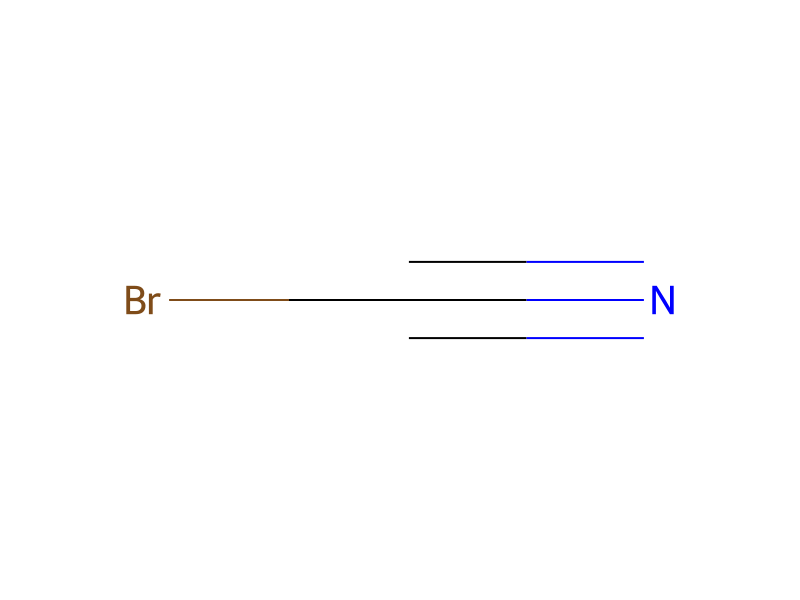
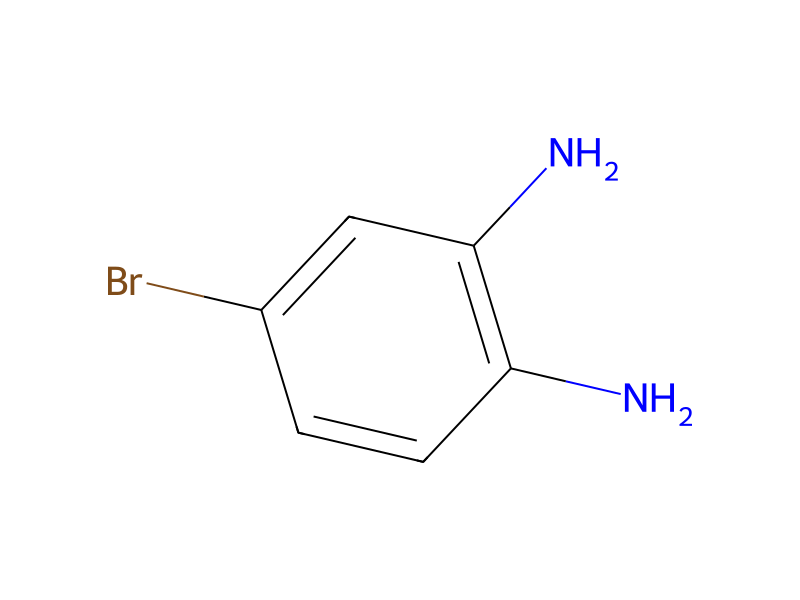
Cyanogen Bromide → 5-Bromo-1H-1,3-benzodiazol-2-amine
Reaction equation

[Br:1][C:2]1[CH:3]=[C:4]([NH2:9])[C:5]([NH2:8])=[CH:6][CH:7]=1.[N:10]#[C:11]Br>CO>[Br:1][C:2]1[CH:7]=[CH:6][C:5]2[N:8]=[C:11]([NH2:10])[NH:9][C:4]=2[CH:3]=1Participants
4
Reactant 2
Product 1

Reagents, catalysts & solvents 1

Procedure
4-bromobenzene-1,2-diamine (1.02 g, 5.45 mmol) was taken into 50% aqueous methanol (25 mL) followed by slow addition of cyanogen bromide (1.73 g, 16.35 mmol) and the mixture was allowed to stir at room temperature over 12 h. The mixture was then concentrated to approximately 50% volume, diluted with water and brought to neutral pH by addition of 2 M aqueous sodium hydroxide. The aqueous mixture was then partitioned with ethyl acetate and the organic solution washed with brine, dried over anhydrous sodium sulfate, filtered and concentrated to give 6-bromo-1H-benzimidazol-2-amine (1.67 g) as a red amorphous residue. MS (EI) for C7H6BrN3: 213 (MH+).
Workup
- concentrationThe mixture was then concentrated to approximately 50% volume
- additiondiluted with water
- additionbrought to neutral pH by addition of 2 M aqueous sodium hydroxide
- customThe aqueous mixture was then partitioned with ethyl acetate
- washthe organic solution washed with brine
- dry with materialdried over anhydrous sodium sulfate
- filtrationfiltered
- concentrationconcentrated
Sources & evidence
- ORD record
- ord-ad7086c6f990416ebd8c47f4fc602900
- Source dataset
- uspto-grants-2014_01
- Patent number
- US08637499B2
Reaction notes
Loading…