Hydrochloric Acid → 1-(8-Quinolyl)-indan-1-ol
Reaction equation

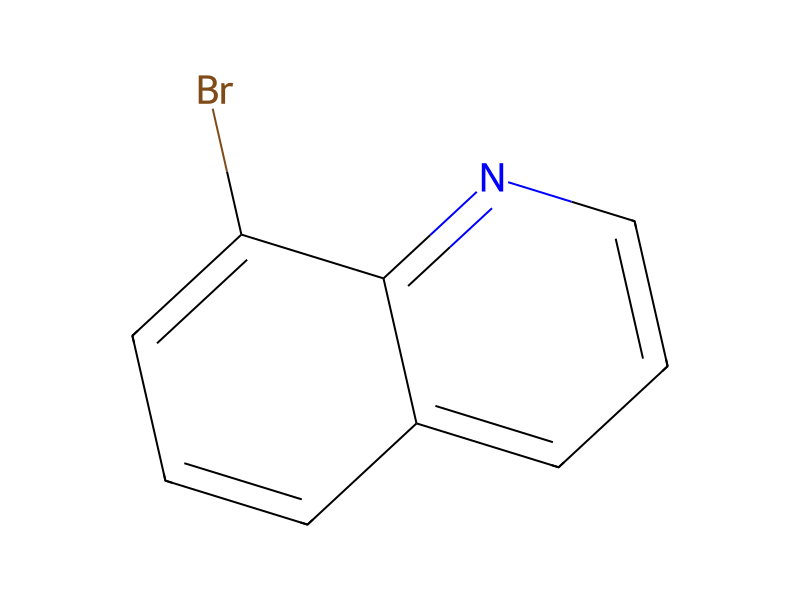
Br[C:2]1[CH:3]=[CH:4][CH:5]=[C:6]2[C:11]=1[N:10]=[CH:9][CH:8]=[CH:7]2.[Li]CCCC.[C:17]1(=[O:26])[C:25]2[C:20](=[CH:21][CH:22]=[CH:23][CH:24]=2)[CH2:19][CH2:18]1.Cl>C1COCC1>[N:10]1[C:11]2[C:6](=[CH:5][CH:4]=[CH:3][C:2]=2[C:17]2([OH:26])[C:25]3[C:20](=[CH:21][CH:22]=[CH:23][CH:24]=3)[CH2:19][CH2:18]2)[CH:7]=[CH:8][CH:9]=1Participants
Reactant 4



Product 1

Reagents, catalysts & solvents 1

Conditions
- Temperature
- -100 °C
Procedure
8-Bromoquinoline (10.4 g, 50 mmol) was introduced into 100 ml of THF, and the mixture was cooled to about −100° C. 20 ml of n-BuLi (2.5 M in hexane, 50 mmol) were added dropwise, during which the internal temperature was kept below −80° C. When the addition was complete, the mixture was stirred at −80° C. for a further 15 minutes, and 6.6 g of 1-indanone (50 mmol), dissolved in 30 ml of THF, were then added dropwise. The reaction mixture was then allowed to warm slowly to room temperature, and was then refluxed for 3 hours. After the mixture had cooled to room temperature, firstly ice and then hydrochloric acid were added to about pH 1, and the mixture was stirred for 30 minutes. The aqueous and organic phases were separated, the aqueous phase was treated with ammonia solution to about pH 9 and extractetd with ether, and the combined organic phases were subsequently evaporated to dryness under reduced pressure. The viscous oil obtained in this way (1-(8-quinolyl)-indan-1-ol (8H2O)) was treated with hydrochloric acid to pH 0, refluxed for 2 hours and subsequently neutralized. After work-up and drying, 6.6 g of 1-(8-quinolyl)indene (55%) were isolated as a colorless solid.
Workup
- customwas kept below −80° C
- additionWhen the addition
- additionwere then added dropwise
- temperatureto warm slowly to room temperature
- temperaturewas then refluxed for 3 hours
- temperatureAfter the mixture had cooled to room temperature
- stirringthe mixture was stirred for 30 minutes
- customThe aqueous and organic phases were separated
- additionthe aqueous phase was treated with ammonia solution to about pH 9 and extractetd with ether
- customthe combined organic phases were subsequently evaporated to dryness under reduced pressure
Sources & evidence
- ORD record
- ord-c5b806c595564815b798cc8f0e10df12
- Source dataset
- uspto-grants-2004_03
- Patent number
- US06699948B2
Reaction notes
Loading…