Ethanol → 3-(Pyridin-4-yl)propanoic acid
Reaction equation
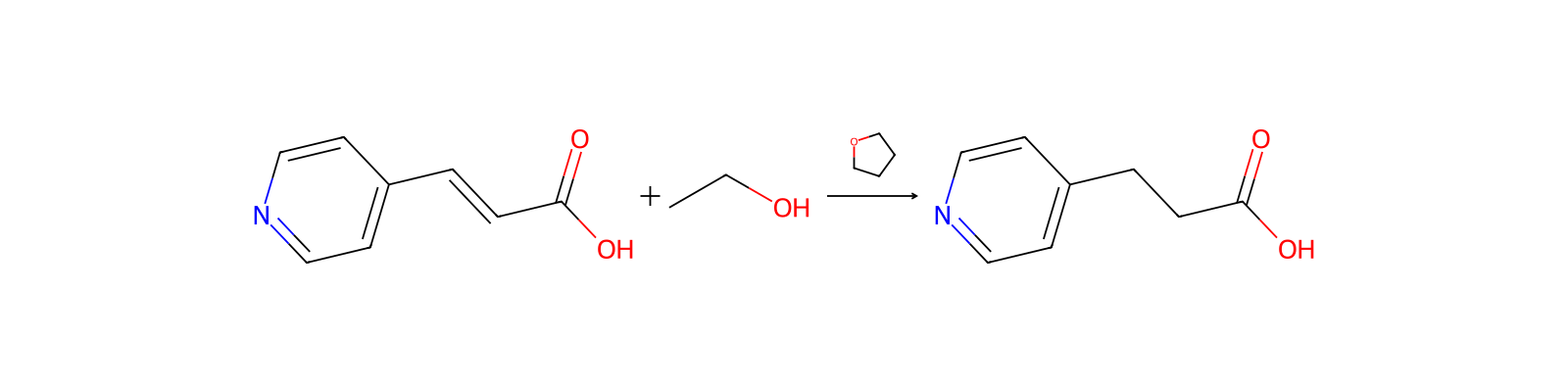
[N:1]1[CH:6]=[CH:5][C:4]([CH:7]=[CH:8][C:9]([OH:11])=[O:10])=[CH:3][CH:2]=1.C(O)C>C1COCC1>[N:1]1[CH:6]=[CH:5][C:4]([CH2:7][CH2:8][C:9]([OH:11])=[O:10])=[CH:3][CH:2]=1Participants
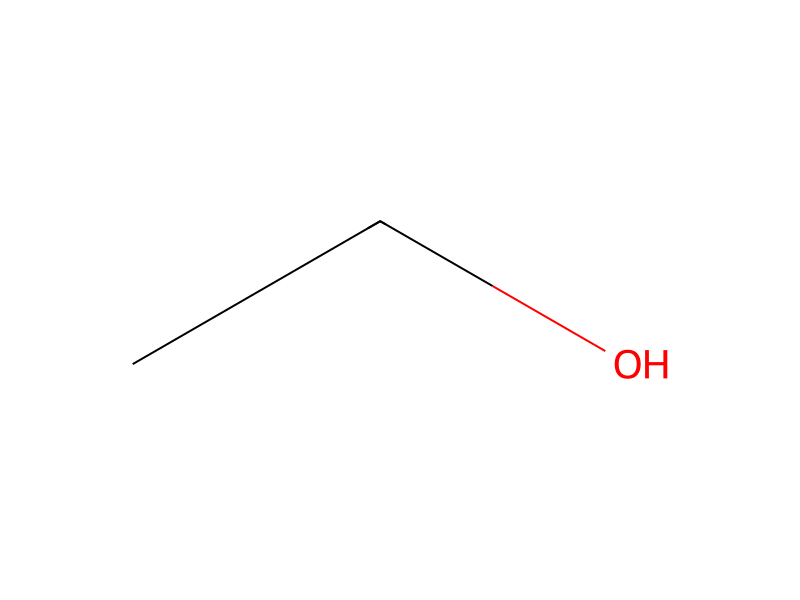
Reactant 2

Product 1

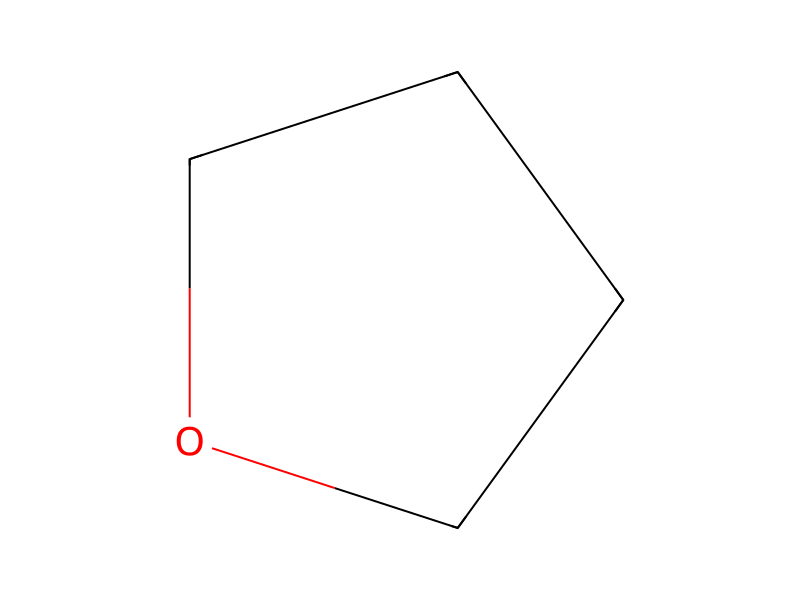
Reagents, catalysts & solvents 1
Procedure
To a solution of 3-(4-pyridyl)-acrylic acid (25.0 g, 168 mmol) in 1:1 ethanol:THF (250 mL) was added 10% Pd(0)/C (2.50 g). The reaction vessel was placed under 110 psi of H2 until 1.0 equivalent of H2 had been consumed as indicated by a pressure drop in the reaction vessel. The mixture was then diluted with 1 L of hot methanol and filtered through celite, rinsing with hot methanol. The liquid obtained was concentrated in vacuo, affording 11.0 g (43% of 3-(4-pyridyl)-propionic acid. This material was dissolved in DMF (300 mL), and to this solution was added the aminochromanol intermediate from Example 1, Step L (12.0 g, 72.5 mmol), HOBT (11.7 g, 87.0 mmol), di-iso-propylethylamine (27.8 mL, 159 mmol) and HBTU (27.5 g, 72.5 mmol). After 2 hours at ambient temperature, the reaction was quenched with 0.5 N aqueous NaHCO3 (500 mL) and diluted with ethyl acetate (1 L). The organic layer was washed with 0.5 N NaHCO3 (300 mL×3), brine (300 mL), dried (MgSO4), and concentrated in vacuo, affording 13.2 g (61%) of the amide as a white solid. A portion of this material (2.27 g, 7.61 mmol) was dissolved in dichloromethane (100 mL), and 2-methoxypropene (3.64 mL, 38 mmol) was added, followed by camphorsulfonic acid (1.20 g, 5.17 mmol). After 3 hours at ambient temperature the reaction was quenched by the addition of 1.4 mL of triethylamine, and concentrated in vacuo. Purification by flash chromatography (3% methanol in ethyl acetate) afforded the title compound as a clear oil. 1H NMR (CDCl3, 400 MHz) 8.55 (d, 2H), 7.58 (s, 1H), 7.26 (m, 3H), 7.00 (d, 1H), 6.84 (t, 1H), 5.81 (s, 1h), 4.88 (s, 1H), 4.40 (d, 2H), 4.18 (m, 3H), 3.02 (m, 3H), 2.70 (m, 1H), 1.62 (s, 3H), 1.30 (s, 1H).
Workup
- customhad been consumed
- additionThe mixture was then diluted with 1 L of hot methanol
- filtrationfiltered through celite
- washrinsing with hot methanol
- customThe liquid obtained
- concentrationwas concentrated in vacuo
Sources & evidence
- ORD record
- ord-0ec7358aa90a479dba72472b62e7ab76
- Source dataset
- uspto-grants-2003_11
- Patent number
- US06642237B1
Reaction notes
Loading…