Methyl benzenesulfonate → 3-Bromo-5-(1-methyl-1,2,3,6-tetrahydropyridin-2-yl)-1-phenyl-1,2-dihydropyridin-2-one
Reaction equation

[Br:1][C:2]1[C:3](=[O:20])[N:4]([C:14]2[CH:19]=[CH:18][CH:17]=[CH:16][CH:15]=2)[CH:5]=[C:6]([C:8]2[CH:13]=[CH:12][CH:11]=[CH:10][N:9]=2)[CH:7]=1.[C:21]1(S(OC)(=O)=O)C=CC=CC=1>C(#N)C>[Br:1][C:2]1[C:3](=[O:20])[N:4]([C:14]2[CH:15]=[CH:16][CH:17]=[CH:18][CH:19]=2)[CH:5]=[C:6]([CH:8]2[CH2:13][CH:12]=[CH:11][CH2:10][N:9]2[CH3:21])[CH:7]=1Participants


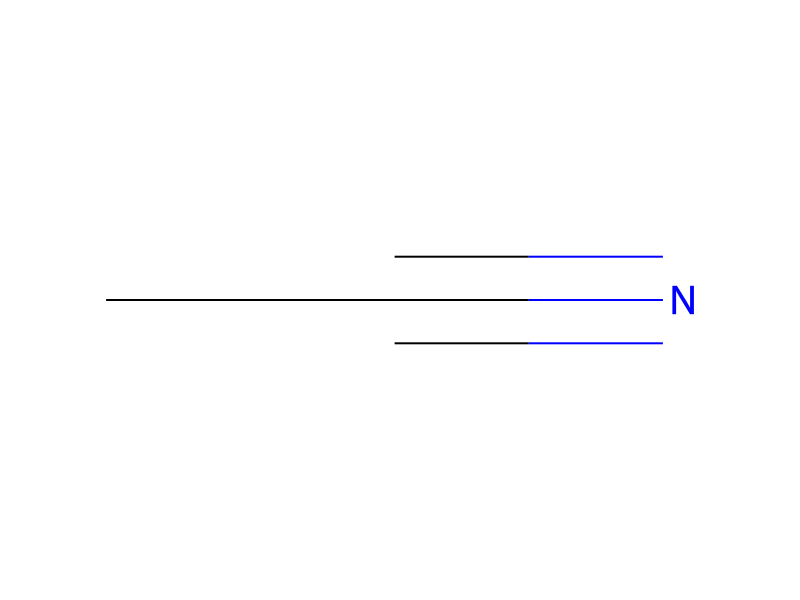
Conditions
- Temperature
- 100 °C
Procedure
99 mg of 3-bromo-5-(2-pyridyl)-1-phenyl-1,2-dihydropyridin-2-one was dissolved in 10 ml of acetonitrile. 2 ml of methyl benzenesulfonate was added thereto, followed by stirring at 100° C. for 2 nights. After cooling to room temperature, the solvent was evaporated. The residue was dissolved in 10 ml of methanol, followed by cooled to 0° C. under stirring. Sodium borohydride was added 5 times at intervals of 5 hours, 1 g for each time, followed by further stirring at 0° C. overnight. Then the solvent was evaporated and a saturated aqueous solution of ammonium chloride was added to the residue, followed by extracting with ethyl acetate. The organic layer was washed with brine and dried over anhydrous magnesium sulfate. The solvent was evaporated, and the residue was purified by silica gel chromatography (hexane/ethyl acetate system), to give 107 mg of 3-bromo-5-(1-methyl-1,2,3,6-tetrahydropyridin-2-yl)-1-phenyl-1,2-dihydropyridin-2-one. The product was dissolved in 10 ml of dimethylformamide. 81 mg of 2-(2-cyanophenyl)-1,3,2-dioxaborinate, 142 mg of cesium carbonate and 7 mg of tetrakistriphenylphosphine palladium were added thereto, followed by stirring at 140° C. for 2 hours. After cooling to room temperature, water was added thereto, followed by extracting with ethyl acetate. The organic layer was washed with brine and dried over anhydrous magnesium sulfate. The solvent was evaporated, and the residue was purified by silica gel chromatography (hexane/ethyl acetate system), to give 41 mg of the title compound.
Workup
- temperatureAfter cooling to room temperature
- customthe solvent was evaporated
- dissolutionThe residue was dissolved in 10 ml of methanol
- temperatureby cooled to 0° C.
- stirringunder stirring
- additionSodium borohydride was added 5 times at intervals of 5 hours, 1 g for each time
- stirringby further stirring at 0° C. overnight
- customThen the solvent was evaporated
- additiona saturated aqueous solution of ammonium chloride was added to the residue
- extractionby extracting with ethyl acetate
- washThe organic layer was washed with brine
- dry with materialdried over anhydrous magnesium sulfate
- customThe solvent was evaporated
- customthe residue was purified by silica gel chromatography (hexane/ethyl acetate system)
Sources & evidence
- ORD record
- ord-05229626ca934bb4bc97bcfcd9d35125
- Source dataset
- uspto-grants-2005_09
- Patent number
- US06949571B2
Reaction notes
Loading…