1,3-Propanediamine → N1-(isothiazolo[5,4-b]pyrazin-3-yl)propane-1,3-diamine
Reaction equation

Br[C:2]1[C:10]2[C:5](=[N:6][CH:7]=[CH:8][N:9]=2)[S:4][N:3]=1.[NH2:11][CH2:12][CH2:13][CH2:14][NH2:15]>CO>[S:4]1[C:5]2=[N:6][CH:7]=[CH:8][N:9]=[C:10]2[C:2]([NH:11][CH2:12][CH2:13][CH2:14][NH2:15])=[N:3]1Participants
Reactant 2
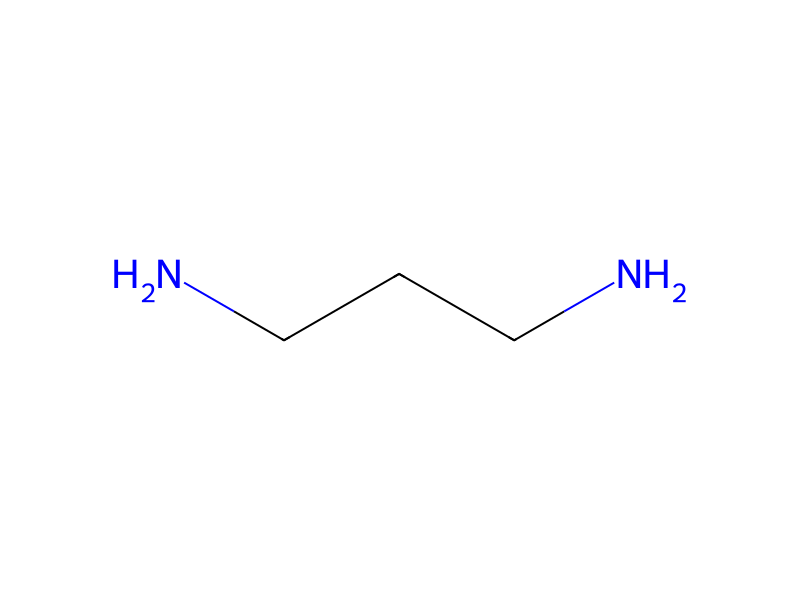

Product 1

Reagents, catalysts & solvents 1

Procedure
To a solution of 3-bromoisothiazolo[5,4-b]pyrazine in methanol (25 mL) was added 1,3-diaminopropane (6 mL). The reaction mixture was stirred at room temperature for 15 min, then heated to 50° C. After 1 h, the starting material was consumed as judged by LC-MS. The reaction mixture was concentrated under reduced pressure and then partitioned between ethyl acetate and brine. The aqueous layer was back-extracted twice with ethyl acetate and once with methylene chloride. The combined organic layers were washed with brine and dried over anhydrous sodium sulfate and filtered. Concentration under reduced pressure gave N1-(isothiazolo[5,4-b]pyrazin-3-yl)propane-1,3-diamine (410 mg) as a yellow solid. 1H NMR (300 MHz, CDCl3-DMSO-d6): 8.62 (d, 1H), 8.54 (d, 1H), 2.66 (m, 4H), 2.49 (br s, 2H), 1.51 ppm (m, 2H). MW=209 confirmed by LC-MS, tr=2.51 min (Method Y) MH+=208-210.
Workup
- temperatureheated to 50° C
- waitAfter 1 h
- customthe starting material was consumed
- concentrationThe reaction mixture was concentrated under reduced pressure
- custompartitioned between ethyl acetate and brine
- extractionThe aqueous layer was back-extracted twice with ethyl acetate and once with methylene chloride
- washThe combined organic layers were washed with brine
- dry with materialdried over anhydrous sodium sulfate
- filtrationfiltered
- concentrationConcentration under reduced pressure
Sources & evidence
- ORD record
- ord-a5ceeb92051349daa8a7ac2f9d8470a1
- Source dataset
- uspto-grants-2010_08
- Patent number
- US07776847B2
Reaction notes
Loading…