2-Phenylethanol → 2-Phenylethyl cyclohexanecarboxylate
Reaction equation

[CH:1]1([C:7]([OH:9])=[O:8])[CH2:6][CH2:5][CH2:4][CH2:3][CH2:2]1.[C:10]1([CH2:16][CH2:17]O)[CH:15]=[CH:14][CH:13]=[CH:12][CH:11]=1>C([O-])(=O)C([O-])=O.[Sn+4].C([O-])(=O)C([O-])=O>[CH:1]1([C:7]([O:9][CH2:17][CH2:16][C:10]2[CH:15]=[CH:14][CH:13]=[CH:12][CH:11]=2)=[O:8])[CH2:6][CH2:5][CH2:4][CH2:3][CH2:2]1Participants
Reactant 2
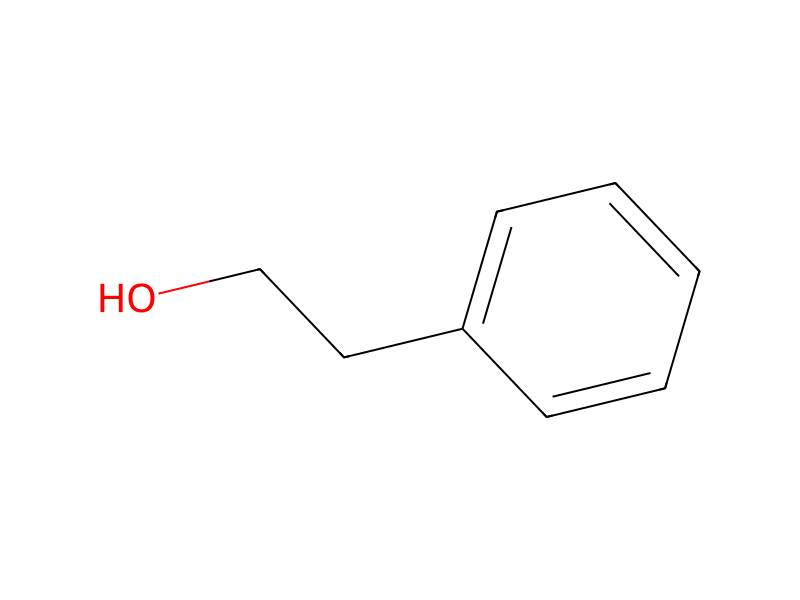

Product 1

Reagents, catalysts & solvents 1

Conditions
- Temperature
- 180 °C
Procedure
A 1-L, 4-neck, round-bottom flask, fitted with a thermometer, mechanical stirrer, nitrogen inlet tube and Liebig condenser/receiving flask, was charged with 320.4 g (2.50 mol, 1.00 equiv) of cyclohexanecarboxylic acid, 335.9 g (2.75 mol, 1.10 equiv) of 2-phenylethanol, and 1.20 g (0.2 wt. %) of tin oxalate (Fascat® 2001). The system was heated gently with slow stirring (<50 rpm) until all the cyclohexanecarboxylic acid was in solution. The air was removed with three cycles of evacuation/nitrogen-fill using a mechanical vacuum pump (50-100 torr). The rate of stirring was increased to ca. 200 rpm, the nitrogen sparge was set at 0.1 scfh, and the reaction mixture was heated to 180° C. After a 1-h hold, 36.7 g of distillate had been collected. The alcohol (9.6 g) was separated and returned to the reaction mixture. The temperature was increased to 190° C. and held for 1 h; an additional 14.0 g of distillate was collected. The alcohol (2.5 g) was separated and returned. The temperature was increased to 200° C. and held for 1 h; an additional 4.9 g of distillate was collected. The alcohol (1.0 g) was separated and returned. The temperature was increased to 210° C. and held for 1 h, and an additional 2.1 g of distillate was collected; 0.3 g of alcohol was separated, but not returned. The temperature was increased to 220° C. and held for 2 h, and an additional 1.3 g of distillate was collected; 0.4 g of alcohol was separated, but not returned. The reaction mixture was cooled to room temperature and sampled for analysis. The acid number was 1.04 mg KOH/g (99.5% conversion). Triisodecylphosphite (0.58 g) was added to the reaction mixture, and the excess 2-phenylethanol (3.9% by GLC) was removed by vacuum distillation at 165-170° C. (10 torr, 0.5 scfh nitrogen sweep) for 1 h. Activated carbon (17.4 g, 3 wt. %) was added, and the mixture was heated at 75-80° C. under vacuum (80 torr, 0.5 scfh nitrogen sweep) for 1 h. The product was cooled to room temperature and filtered through Celite® to afford 470 g (81%) of 2-phenylethyl cyclohexanecarboxylate (99.5% pure by GLC): residual alcohol, 0.06% (GLC); APHA color, 89; acid number, 0.21 mg KOH/g; saponification number, 237 mg KOH/g (theor. 241 mg KOH/g).
Workup
- temperatureThe system was heated gently
- customThe air was removed with three cycles of evacuation/nitrogen-fill
- temperaturewas increased to ca. 200 rpm
- customthe nitrogen sparge
- distillationAfter a 1-h hold, 36.7 g of distillate had been collected
- customThe alcohol (9.6 g) was separated
- temperatureThe temperature was increased to 190° C.
- distillationan additional 14.0 g of distillate was collected
- customThe alcohol (2.5 g) was separated
- temperatureThe temperature was increased to 200° C.
- waitheld for 1 h
- distillationan additional 4.9 g of distillate was collected
- customThe alcohol (1.0 g) was separated
- temperatureThe temperature was increased to 210° C.
- waitheld for 1 h
- distillationan additional 2.1 g of distillate was collected
- custom0.3 g of alcohol was separated
- temperatureThe temperature was increased to 220° C.
- waitheld for 2 h
- distillationan additional 1.3 g of distillate was collected
- custom0.4 g of alcohol was separated
- temperatureThe reaction mixture was cooled to room temperature
- aliquotsampled for analysis
- additionTriisodecylphosphite (0.58 g) was added to the reaction mixture
- customthe excess 2-phenylethanol (3.9% by GLC) was removed by vacuum distillation at 165-170° C. (10 torr, 0.5 scfh nitrogen sweep) for 1 h
- additionActivated carbon (17.4 g, 3 wt. %) was added
- temperaturethe mixture was heated at 75-80° C. under vacuum (80 torr, 0.5 scfh nitrogen sweep) for 1 h
- temperatureThe product was cooled to room temperature
- filtrationfiltered through Celite®
Sources & evidence
- ORD record
- ord-bf3023a3d5544e0bb7365982fd389f2e
- Source dataset
- uspto-grants-2010_08
- Patent number
- US07785573B2
Reaction notes
Loading…