Ethyl Bromide → 4-(2-((Tetrahydro-2H-pyran-2-yl)oxy)ethyl)benzaldehyde
Reaction equation

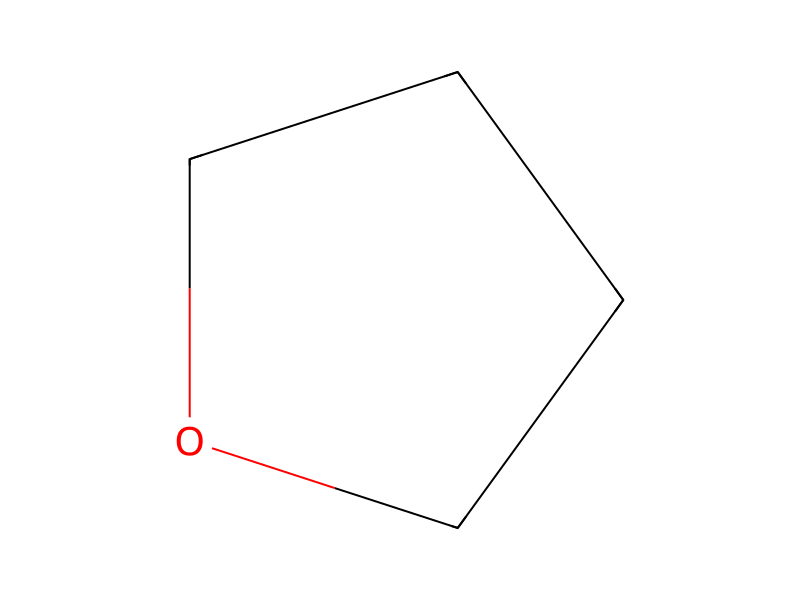
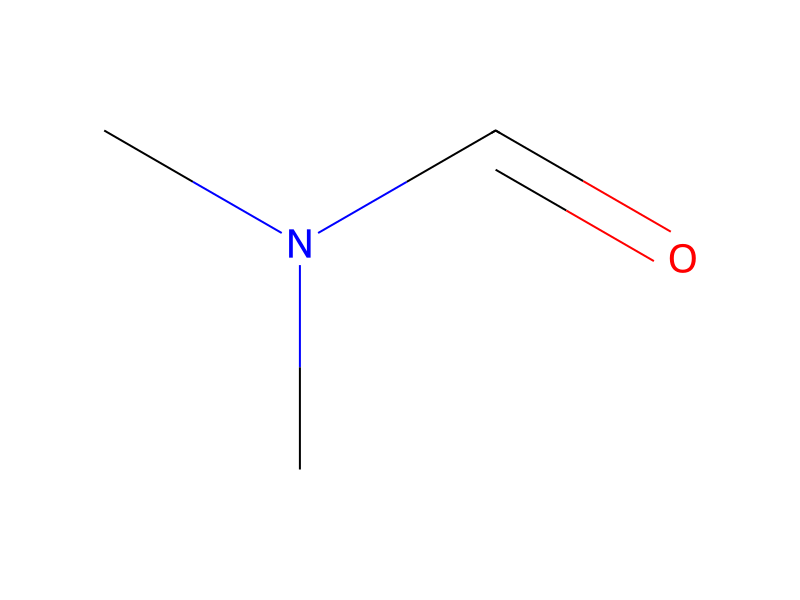
[Mg].Br[C:3]1[CH:17]=[CH:16][C:6]([CH2:7][CH2:8][O:9][CH:10]2[CH2:15][CH2:14][CH2:13][CH2:12][O:11]2)=[CH:5][CH:4]=1.C1C[O:21][CH2:20]C1.C(Br)C>CN(C=O)C>[O:11]1[CH2:12][CH2:13][CH2:14][CH2:15][CH:10]1[O:9][CH2:8][CH2:7][C:6]1[CH:16]=[CH:17][C:3]([CH:20]=[O:21])=[CH:4][CH:5]=1Participants



Conditions
- Temperature
- 85 °C
Procedure
Magnesium turnings (0.97 g, 39.9 mmol) were weighed into a 250 mL 3-neck RB flask which was then suba-sealed (side-arm), connected to a 100 mL pressure-equalising addition funnel (centre-socket), connected to a double-layer coil condenser (side-arm) which in turn was connected to a nitrogen-vacuum manifold and the apparatus purge-filled with nitrogen three times. Separately 2d (9.50 g, 33.3 mmol) was weighed into a 100 mL RB flask which was then attached to a nitrogen-vacuum manifold and purge-filled with nitrogen before THF (anhydrous, 60 mL) was cannula-transferred into the flask forming a colourless solution. This solution was then cannula transferred into the pressure-equalising addition funnel. Ethyl bromide (0.274 mL) was then “dripped” over the magnesium turnings in the reaction flask using a 1.0 mL Hamilton gastight syringe. The 2d/THF solution was then added dropwise to the reaction mixture and after about 5 mL had added the reaction flask was continually heated by means of a silicone heating oil bath (bath T: 85° C.) until reflux started. After the completion of the addition of 2d/THF (about 30-45 minutes) the reflux was maintained by means of the silicone heating oil bath for a period of 75 minutes before the reaction mixture was allowed to cool to room temperature. After this period the reaction mixture consisted of a deep orange solution containing some residual flakes of magnesium. The reaction flask was then surrounded with a water-ice/methanol-water cooling mixture and the reaction mixture chilled for a period of 5 minutes prior to DMF (anhydrous, 3.00 mL) being added to the reaction mixture in a single portion via a 5 mL Hamilton gastight syringe. The reaction mixture in the cooling bath was then stirred whilst being allowed to warm slowly to room temperature overnight. Next day the (melted) cooling bath was removed and the reaction mixture was allowed to stir at room temperature under nitrogen for a further 24 hours. After 24 hours the reaction mixture was quenched by dropwise addition of 60 mL of saturated aqueous NH4Cl, which initially caused the deposition of a dense white precipitate (magnesium hydroxides) which then dissolved as the addition continued. Post quenching the reaction mixture consisted of a lower nearly colourless aqueous layer and an upper deep yellow organic layer together with a few shards of magnesium turning. This mixture was then filtered directly into a 250 mL-separating funnel and the layers partitioned and separated. The aqueous layer was then extracted with 100 mL of Et2O and these extracts combined with the organic layer from the reaction mixture. The organic extracts were then dried over anhydrous MgSO4 for a period of 90 minutes before the drying mixture was filtered and the collected solid washed with 3×25 mL portions of Et2O. The filtrate and washings were then combined and stripped to dryness in vacuo (rotary evaporator) to yield a pale yellow oil. A small aliquot of the crude product was analysed by TLC (silica-gel TLC plates, 20% EtOAc/80% n-hexane elution mixture) against the 2d starting material which indicated that all of the starting material had reacted to form a new highly tailed major spot with an Rf of 0.52 with additional minor spots at Rf values of 0.09 and 0.0 (baseline). The crude product was then pre-loaded onto 11.0 g of Merck 60 (15-40 μm) silica gel purified by dry column flash chromatography: (i) Sinter size: 80 mm diameter/column packed to a depth of 55 mm with Merck and crude product/silica amalgam packed on top of this; (ii) time per fraction: 3.00 minutes; (iii) Fraction size: 100 mL; (iv) Elution gradient: % Volume n-hexane: 100-62% in 2% increments/% Volume EtOAc: 0-38% in 2% increments (20 fractions in total). After elution of the column fractions' 10-17 were analysed by TLC (20% EtOAc/80% n-hexane) which indicated that most of the product was contained within fractions' 11-14 but fractions' 10 and 15 also contained some material (product highly tailed on the column, common property of aldehyde containing compounds) therefore fractions' 10-15 were combined and stripped to dryness in vacuo (rotary evaporator) to yield a pale yellow liquid which was then further dried in vacuo (oil immersion pump) at room temperature for a period of 4 hours. Yield: 5.878 g (75.3%, yellow liquid). 1H NMR (CDCl3) δ 1.40-1.87 (m, 6H, [3×—CH2—]pyran), 2.98 (t, 2H, ArCH2), 3.45 (m, 1H, [OCHaHb-]pyran), 3.70 (q+m, 2H, —OpyranCHaHb— & [OCHaHb-]pyran), 3.97 (q, 1H, —OpyranCHaHb), 4.58 (m, 1H, [—OCHO-]pyran), 7.41 (d, 2H, ArH), 7.82 (d, 2H, ArH), 9.98 (s, 1H, ArCHO).
Workup
- customwas then suba-sealed (side-arm)
- additionconnected to a 100 mL pressure-equalising addition funnel (centre-socket)
- customconnected to a double-layer coil condenser
- additionthe apparatus purge-filled with nitrogen three times
- customforming a colourless solution
- additioncannula transferred into the pressure-equalising addition funnel
- additionafter about 5 mL had added the reaction flask
- temperatureuntil reflux
- temperatureto cool to room temperature
- waitAfter this period the reaction mixture consisted of a deep orange solution
- temperaturethe reaction mixture chilled for a period of 5 minutes
- temperatureto warm slowly to room temperature overnight
- temperatureNext day the (melted) cooling bath
- customwas removed
- stirringto stir at room temperature under nitrogen for a further 24 hours
- customAfter 24 hours the reaction mixture was quenched by dropwise addition of 60 mL of saturated aqueous NH4Cl, which
- dissolutionthen dissolved as the addition
- customPost quenching the reaction mixture
- filtrationThis mixture was then filtered directly into a 250 mL-
- customseparating funnel
- customthe layers partitioned
- customseparated
- extractionThe aqueous layer was then extracted with 100 mL of Et2O
- dry with materialThe organic extracts were then dried over anhydrous MgSO4 for a period of 90 minutes before the drying mixture
- filtrationwas filtered
- washthe collected solid washed with 3×25 mL portions of Et2O
- customstripped to dryness in vacuo (rotary evaporator)
- customto yield a pale yellow oil
- washA small aliquot of the crude product was analysed by TLC (silica-gel TLC plates, 20% EtOAc/80% n-hexane elution mixture) against the 2d
- customhad reacted
- customto form a new highly tailed major spot with an Rf of 0.52 with additional minor spots at Rf values of 0.09 and 0.0 (baseline)
- custompre-loaded onto 11.0 g of Merck 60 (15-40 μm) silica gel purified
- customby dry column flash chromatography
- custom3.00 minutes
- wash(iv) Elution gradient
- washAfter elution of the column fractions' 10-17
- customstripped to dryness in vacuo (rotary evaporator)
- customto yield a pale yellow liquid which
- customwas then further dried in vacuo (oil immersion pump) at room temperature for a period of 4 hours
Sources & evidence
- ORD record
- ord-deb457df1db04d799223b6a9313252e4
- Source dataset
- uspto-grants-2015_08
- Patent number
- US09115063B2
Reaction notes
Loading…