Oxazole → (R)-(1-(4-fluorophenyl)-6-((4-(trifluoromethyl)phenyl)sulfonyl)-4,4a,5,6,7,8-hexahydro-1H-pyrazolo[3,4-g]isoquinolin-4a-yl)(oxazol-2-yl)-(R/S)-methanol
Reaction equation

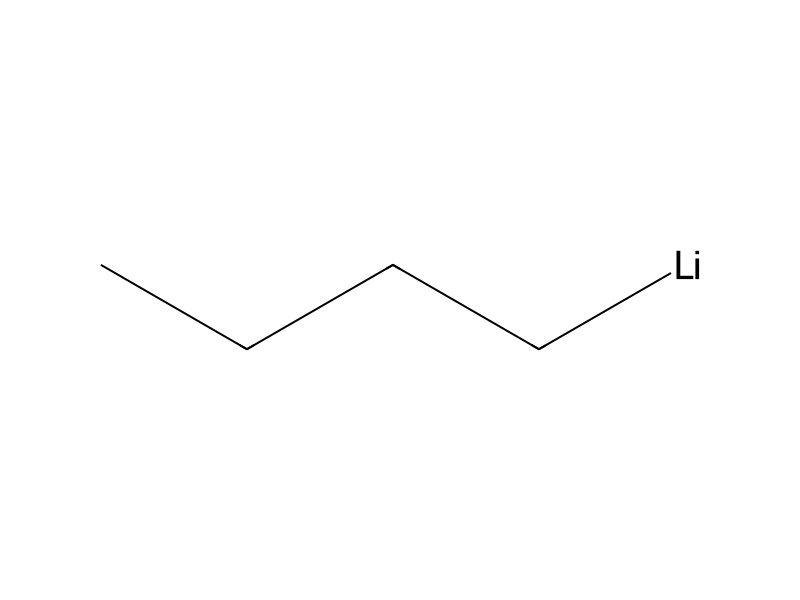
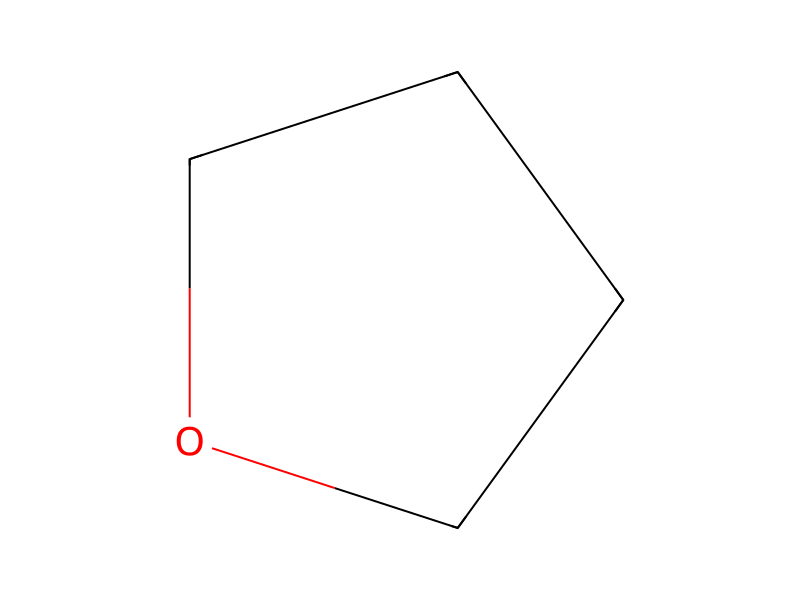
[O:1]1[CH:5]=[CH:4][N:3]=[CH:2]1.B.O1CCCC1.C([Li])CCC.[F:17][C:18]1[CH:23]=[CH:22][C:21]([N:24]2[C:28]3[CH:29]=[C:30]4[C@:35]([CH:37]=[O:38])([CH2:36][C:27]=3[CH:26]=[N:25]2)[CH2:34][N:33]([S:39]([C:42]2[CH:47]=[CH:46][C:45]([C:48]([F:51])([F:50])[F:49])=[CH:44][CH:43]=2)(=[O:41])=[O:40])[CH2:32][CH2:31]4)=[CH:20][CH:19]=1>O1CCCC1.C(O)C.C(O)(=O)C>[F:17][C:18]1[CH:23]=[CH:22][C:21]([N:24]2[C:28]3[CH:29]=[C:30]4[C@:35]([CH:37]([C:2]5[O:1][CH:5]=[CH:4][N:3]=5)[OH:38])([CH2:36][C:27]=3[CH:26]=[N:25]2)[CH2:34][N:33]([S:39]([C:42]2[CH:43]=[CH:44][C:45]([C:48]([F:51])([F:49])[F:50])=[CH:46][CH:47]=2)(=[O:41])=[O:40])[CH2:32][CH2:31]4)=[CH:20][CH:19]=1Participants
Reactant 4


Product 1

Reagents, catalysts & solvents 2

Procedure
To a solution of oxazole (99 μL, 0.5 mmol) in dry tetrahydrofuran (2.5 mL) was added borane-tetrahydrofuran complex (1.0 M in tetrahydrofuran, 1.65 mmol, 1.65 mL) and the mixture was stirred at room temperature for 1 hour. The mixture was cooled to −78° C. and butyl lithium (1.6 M solution in hexanes, 1.20 mL, 1.95 mmol) was added dropwise. The reaction mixture was stirred for 40 minutes at −78° C. A solution of (R)-1-(4-fluorophenyl)-6-((4-(trifluoromethyl)phenyl)sulfonyl)-4,4a,5,6,7,8-hexahydro-1H-pyrazolo[3,4-g]isoquinoline-4a-carbaldehyde (250 mg, 0.5 mmol) in dry tetrahydrofuran (3 mL) was added dropwise and the reaction mixture was stirred at −78° C. for 2 hours. The reaction mixture was warmed to room temperature and stirred for 2 hours. The reaction mixture was poured into ethanol/acetic acid mixture (95:5, v/v; 50 mL) and stirred at room temperature for 18 hours. The solvent was evaporated and the residue was dissolved in ethyl acetate (30 mL). The organic phase was washed with water (20 mL), saturated sodium bicarbonate (2×20 mL) and brine (20 mL). The organic phase was dried over sodium sulfate, the solids were removed by filtration and the filtrate was concentrated under reduced pressure. The residue was purified by column chromatography on silica gel (gradient: 0-4% methanol in dichloromethane) to afford, as a mixture of diastereoisomers, (R)-(1-(4-fluorophenyl)-6-((4-(trifluoromethyl)phenyl)sulfonyl)-4,4a,5,6,7,8-hexahydro-1H-pyrazolo[3,4-g]isoquinolin-4a-yl)(oxazol-2-yl)-(R/S)-methanol as a white foam (136 mg). LCMS (Method A, ESI): RT 3.68 min, m+H=575.0.
Workup
- temperatureThe mixture was cooled to −78° C.
- stirringThe reaction mixture was stirred for 40 minutes at −78° C
- stirringthe reaction mixture was stirred at −78° C. for 2 hours
- temperatureThe reaction mixture was warmed to room temperature
- stirringstirred for 2 hours
- stirring50 mL) and stirred at room temperature for 18 hours
- customThe solvent was evaporated
- dissolutionthe residue was dissolved in ethyl acetate (30 mL)
- washThe organic phase was washed with water (20 mL), saturated sodium bicarbonate (2×20 mL) and brine (20 mL)
- dry with materialThe organic phase was dried over sodium sulfate
- customthe solids were removed by filtration
- concentrationthe filtrate was concentrated under reduced pressure
- customThe residue was purified by column chromatography on silica gel (gradient: 0-4% methanol in dichloromethane)
Sources & evidence
- ORD record
- ord-29255759188240518b8f83e1c2e4ad7e
- Source dataset
- uspto-grants-2014_10
- Patent number
- US08859774B2
Reaction notes
Loading…