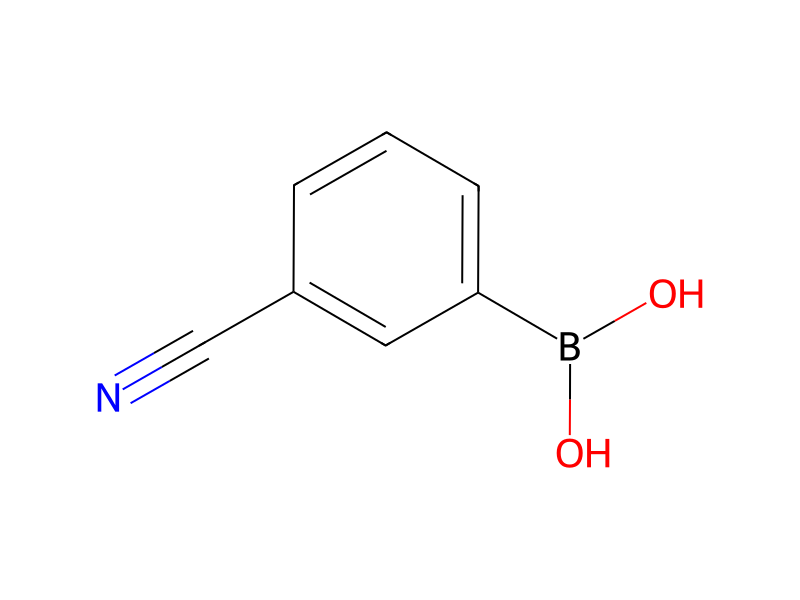
3-Cyanophenylboronic acid → tert-butyl 4-(3-cyanophenyl)-3,6-dihydropyridine-1(2H)-carboxylate
Reaction equation

[C:1]([C:3]1[CH:4]=[C:5](B(O)O)[CH:6]=[CH:7][CH:8]=1)#[N:2].[C:12]([O:16][C:17]([N:19]1[CH2:24][CH:23]=[C:22](OS(C(F)(F)F)(=O)=O)[CH2:21][CH2:20]1)=[O:18])([CH3:15])([CH3:14])[CH3:13]>C(#N)C.C(=O)([O-])[O-].[Na+].[Na+]>[C:12]([O:16][C:17]([N:19]1[CH2:20][CH:21]=[C:22]([C:5]2[CH:6]=[CH:7][CH:8]=[C:3]([C:1]#[N:2])[CH:4]=2)[CH2:23][CH2:24]1)=[O:18])([CH3:15])([CH3:13])[CH3:14]Participants
Reactant 2

Product 1

Reagents, catalysts & solvents 2


Procedure
3-Cyanophenyl boronic acid (1.8 g, 12.2 mmol) and 4-(trifluoromethanesulfonyloxy)-3,6-dihydro-2H-pyridine-1-carboxylic acid tert-butyl ester (5.0 g, 15.2 mmol;) are dissolved in acetonitrile (60 ml) and 0.4 M aqueous sodium carbonate (60 ml). The solution is degassed and treated with palladium tetrakistriphenyl phosphine (0.81 g, 0.7 mmol) at 90° C. for 1 hour. The reaction is cooled, filtered warmed and the filtrate is concentrated to an oil. The oil is extracted with methylene chloride (3×) and the solvent is removed under vacuum. The residue is chromatographed (15% ethyl acetate/hexane) to give the title compound as a white solid (2.7 g, 9.5 mmol). 1H NMR (CDCl3, 300 MHz) δ 7.63 (s, 1H), 7.55 (m, 2H), 7.44 (t, 1H), 6.10 (br, 1H), 4.09 (m, 2H), 3.63 (t, 2H), 2.50 (br, 2H). EI MS M++1: 285.
Workup
- customThe solution is degassed
- temperatureThe reaction is cooled
- filtrationfiltered
- temperaturewarmed
- concentrationthe filtrate is concentrated to an oil
- extractionThe oil is extracted with methylene chloride (3×)
- customthe solvent is removed under vacuum
- customThe residue is chromatographed (15% ethyl acetate/hexane)
Sources & evidence
- ORD record
- ord-a09f6e6a5fff4728ad70661fa982162d
- Source dataset
- uspto-grants-2011_05
- Patent number
- US07947684B2
Reaction notes
Loading…