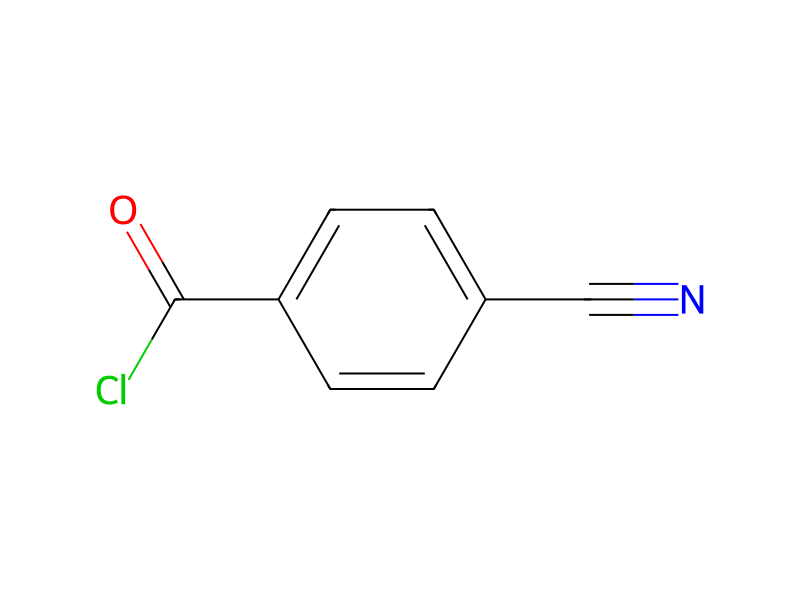
4-Cyanobenzoyl chloride → HCID 57991633, compound
Reaction equation

[F:1][C:2]1[CH:22]=[CH:21][C:5]([CH2:6][C:7]2[S:11][C:10]([NH2:12])=[N:9][C:8]=2[C:13]2[CH:18]=[CH:17][C:16]([O:19][CH3:20])=[CH:15][CH:14]=2)=[CH:4][CH:3]=1.[C:23]([C:25]1[CH:33]=[CH:32][C:28]([C:29](Cl)=[O:30])=[CH:27][CH:26]=1)#[N:24]>>[C:23]([C:25]1[CH:33]=[CH:32][C:28]([C:29]([NH:12][C:10]2[S:11][C:7]([CH2:6][C:5]3[CH:21]=[CH:22][C:2]([F:1])=[CH:3][CH:4]=3)=[C:8]([C:13]3[CH:18]=[CH:17][C:16]([O:19][CH3:20])=[CH:15][CH:14]=3)[N:9]=2)=[O:30])=[CH:27][CH:26]=1)#[N:24]Participants


Procedure
A procedure similar to that in Example 4 was used. 5-(4-fluoro-benzyl)-4-(4-methoxy-phenyl)-thiazol-2-ylamine prepared in Example 13 and p-cyanobenzoyl chloride prepared in the step 1 of Example 12 were used as starting materials, allowed to react at room temperature overnight, followed by post-treatment to obtain a crude product, which was purified by a silica gel column chromatography, and recrystallized with petroleum ether and ethyl acetate to obtain a product as a white solid in a yield of 85.9%, mp: 191-192 └. 1H-NMR (CDCl3, 400 MHz) δ: 3.79 (3H, s, OCH3), 4.18 (2H, s, CH2), 6.73 (2H, d, J=8.96 Hz, ArH), 7.03 (2H, t, 3JFH=3JHH=8.68 Hz, ArH), 7.19 (2H, dd, 3JHH=8.96, 4JFH=5.60 Hz, ArH), 7.24 (2H, d, J=8.96 Hz, ArH), 7.53 (2H, d, J=8.40 Hz, ArH), 7.76 (2H, d, J=8.40 Hz, ArH), 11.74 (1H, br, CONH); EI-MS m/e (%): 443.1 (M, 100), 130.0 (48); HREI-MS Calcd. for C25H18FN3O2S: 443.1104. found: 443.1108. Anal. Calcd. for C25H18FN3O2S: C, 67.71; H, 4.09; N, 9.47. found: C, 67.89; H, 3.97; N, 9.42.
Workup
- customto react at room temperature overnight
- customto obtain a crude product, which
- customwas purified by a silica gel column chromatography
- customrecrystallized with petroleum ether and ethyl acetate
Sources & evidence
- ORD record
- ord-7850a338d7af4d768aad1943641fbed7
- Source dataset
- uspto-grants-2011_11
- Patent number
- US08053581B2
Reaction notes
Loading…