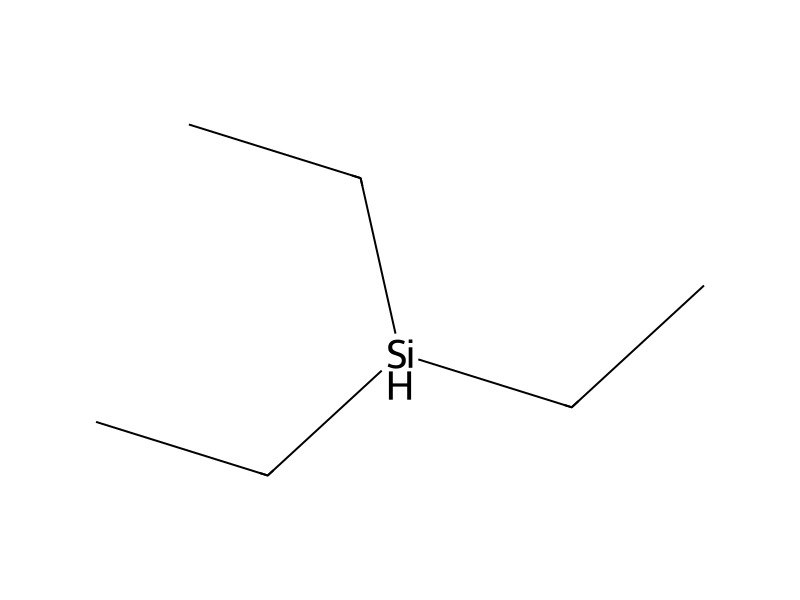
Triethylsilane → HCID 86693062, compound
Reaction equation

[Br:1][C:2]1[CH:7]=[CH:6][C:5]([C:8]2(O)[CH2:11][CH:10]([C:12]([OH:14])=[O:13])[CH2:9]2)=[CH:4][C:3]=1[F:16].C([SiH](CC)CC)C>FC(F)(F)C(O)=O>[Br:1][C:2]1[CH:7]=[CH:6][C:5]([CH:8]2[CH2:11][CH:10]([C:12]([OH:14])=[O:13])[CH2:9]2)=[CH:4][C:3]=1[F:16]Participants
Reactant 2

Product 1

Reagents, catalysts & solvents 1

Procedure
Into a 1000-mL round-bottom flask was placed a solution of 3-(4-bromo-3-fluorophenyl)-3-hydroxycyclobutane-1-carboxylic acid (50 g, 172.95 mmol, 1.00 equiv) in trifluoroacetic acid (500 mL) and triethylsilane (40.1 g, 344.87 mmol, 2.00 equiv). The resulting solution was stirred at room temperature for 4 h and concentrated under vacuum. The resulting solution was diluted with 200 mL of EA and washed with 2×200 mL of saturated aqueous sodium carbonate. The aqueous layers were combined and extracted with 3×500 mL of EA. The pH value of the aqueous layer was adjusted to 4 with hydrogen chloride (1 mol/L). The resulting solution was extracted with 3×500 mL of ethyl acetate. The organic layers were combined, washed with 1×1000 mL of water and 1)(1000 mL of brine, dried over anhydrous sodium sulfate and concentrated under vacuum to afford 35 g (crude) of 3-(4-bromo-3-fluorophenyl)cyclobutane-1-carboxylic acid as a yellow liquid.
Workup
- customInto a 1000-mL round-bottom flask was placed
- concentrationconcentrated under vacuum
- additionThe resulting solution was diluted with 200 mL of EA
- washwashed with 2×200 mL of saturated aqueous sodium carbonate
- extractionextracted with 3×500 mL of EA
- extractionThe resulting solution was extracted with 3×500 mL of ethyl acetate
- washwashed with 1×1000 mL of water and 1)(1000 mL of brine
- dry with materialdried over anhydrous sodium sulfate
- concentrationconcentrated under vacuum
Sources & evidence
- ORD record
- ord-33227d2523894a07a45739b234d33b75
- Source dataset
- uspto-grants-2015_05
- Patent number
- US09034866B2
Reaction notes
Loading…