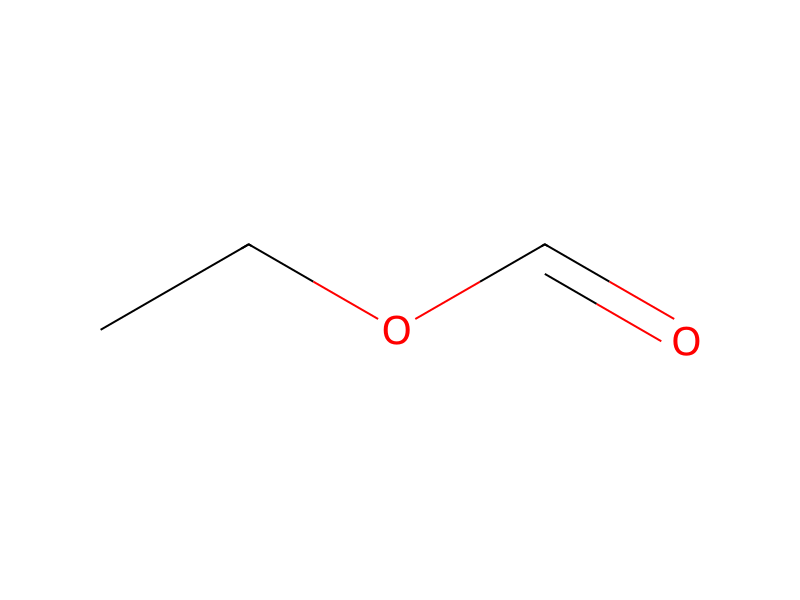
Ethyl formate → 7-Bromo-3,4-dihydroisoquinoline
Reaction equation

Br.BrC1C=CC(CCN)=CC=1.C(OCC)=O.[Br:17][C:18]1[CH:23]=[CH:22][C:21]([CH2:24][CH2:25][NH:26][CH:27]=O)=[CH:20][CH:19]=1.O=P12OP3(OP(OP(O3)(O1)=O)(=O)O2)=O>>[Br:17][C:18]1[CH:23]=[C:22]2[C:21]([CH2:24][CH2:25][N:26]=[CH:27]2)=[CH:20][CH:19]=1Participants


Procedure
The compound of formula II can be made as outlined in Scheme I and as specifically exemplified in Example 1. Referring to Scheme I, 2-(4-bromophenyl)ethylamine hydrobromide is reacted with ethyl formate in the presence of a base to make N-[2-(4-bromophenyl)ethyl]formamide. The fornamide is then treated with phosphorus pentoxide in polyphosphoric acid to cyclize, followed by treatment with hydrogen halide (e.g., HCl) gas to form the hydrohalide salt of 7-bromo-3,4-dihydroisoquinoline hydrohalide. The hydrohalide salt is then reduced to afford 7-bromo-1,2,3,4-tetrahydroisoquinoline. The reduced material is then nitrated by treatment with potassium nitrate in concentrated sulfuric acid and the appropriate fraction separated to yield 7-bromo6-nitro-1,2,3,4-tetrahydroisoquinoline. The nitrated material is then reacted with di-tert-butyl dicarbonate in the presence of a base to block the ring tetrahydroisoquinoline nitrogen, thereby affording 7-bromo-6-nitro-3,4-dihydro-1H-isoquinoline-2-carboxylic acid tert-butyl ester. The ester is then hydrogenated in the presence of palladium-on-calcium carbonate to form the corresponding 6-amino-3,4-dihydro-1H-isoquinoline-2-carboxylic acid ester. The amine is then reacted with 4'-trifluoromethylbiphenyl-2-carboxylic acid to form 6-[4'-trifluoromethylbiphenyl-2-carbonyl)amino]3,4-dihydro-1H-isoquinoline-2-carboxylic acid tert-butyl ester. This product can then be deblocked conventionally to make compound II, 4'-trifluoromethylbiphenyl-2-carboxylic acid (1,2,3,4tetrahydroisoquinolin-6-yl)amide. ##STR6##
Sources & evidence
- ORD record
- ord-6d2afa24823f4c0ba37f15af3193b31f
- Source dataset
- uspto-grants-1999_07
- Patent number
- US05919795
Reaction notes
Loading…