Hydrochloric Acid → Focalin
반응식

[C:1]([CH:4]([CH:6]([C:8]([O-:10])=[O:9])O)O)([O-])=O.[Cr](O[Cr]([O-])(=O)=O)([O-])(=O)=O.[NH+:20]1[CH:25]=[CH:24][CH:23]=[CH:22][CH:21]=1.[NH+]1C=[CH:30][CH:29]=[CH:28][CH:27]=1.[N+](=[CH2:34])=[N-].[ClH:35]>CN(C)C=O>[CH3:34][O:10][C:8]([C@H:6]([C:4]1[CH:30]=[CH:29][CH:28]=[CH:27][CH:1]=1)[C@@H:25]1[NH:20][CH2:21][CH2:22][CH2:23][CH2:24]1)=[O:9].[ClH:35]참가 물질


실험 절차
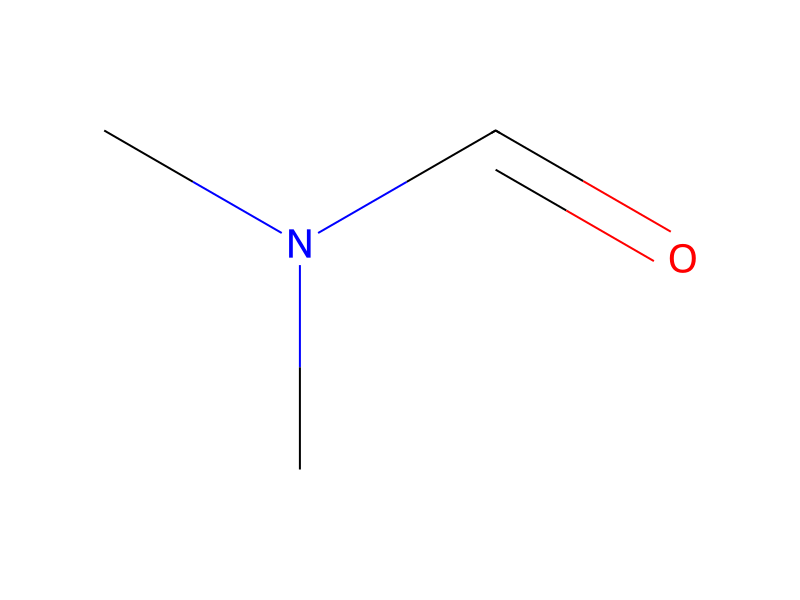
An alternative approach to synthesizing enantiomerically pure d-threo-methylphenidate hydrochloride using an enantiomerically pure starting material, d-pipecolic acid, was reported by Thai et al. in J. Med. Chem. (1998) 41, 591-601. Enantiomerically pure d-pipecolic acid was obtained in 37% yield by recrystallization of the diastereomeric tartrate salt, followed by the separation of the desired amino acid from tartaric acid by ion-exchange chromatography. d-pipecolic acid was protected with a BOC group to afford N—BOC-d-pipecolic acid in 97% yield. The key amino ketone was prepared from N—BOC-d-pipecolic acid in two steps involving its conversion to the N-methoxy-N-methyl amide, followed by a reaction with the amide with phenyllithium. The amino ketone underwent a Wittig olefination with methyltriphenylphosphonium bromide in the presence of potassium tert-butoxide to give the alkene in high yield. The transformation of the obtained alkene to the desired alcohol as a racemic mixture of threo-stereoisomers via a hydroboration/oxidation reaction was critical to introducing the second stereogenic center. Hydroboration with BH3-THF gave a 72:28 mixture of threo and erythro isomers, respectively, from which the threo alcohol was isolated in 64% yield after chromatography. Oxidation of the threo alcohol with pyridinium dichromate (PDC) in dimethylformamide (DMF) followed by esterification of the resulting acid with diazomethane, and N—BOC group deprotection with 3 N methanolic hydrochloric acid furnished d-threo-methylphenidate hydrochloride in 67% yield after recrystallization from a mixture of ethanol and ether.
후처리
- additiona 72:28 mixture of threo and erythro isomers
출처 및 근거
- ORD 기록
- ord-0af506c37be2427bb3a89d3f31b976c2
- 출처 데이터셋
- uspto-grants-2016_01
- 특허 번호
- US09233924B2
반응 노트
불러오는 중…