Nitric Acid → 4-Methoxy-1-nitroacridine
Reaction equation

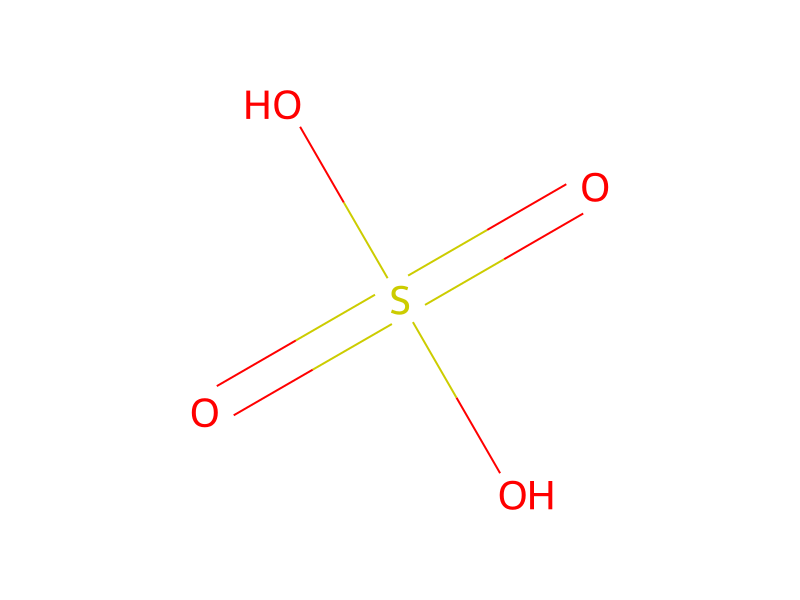
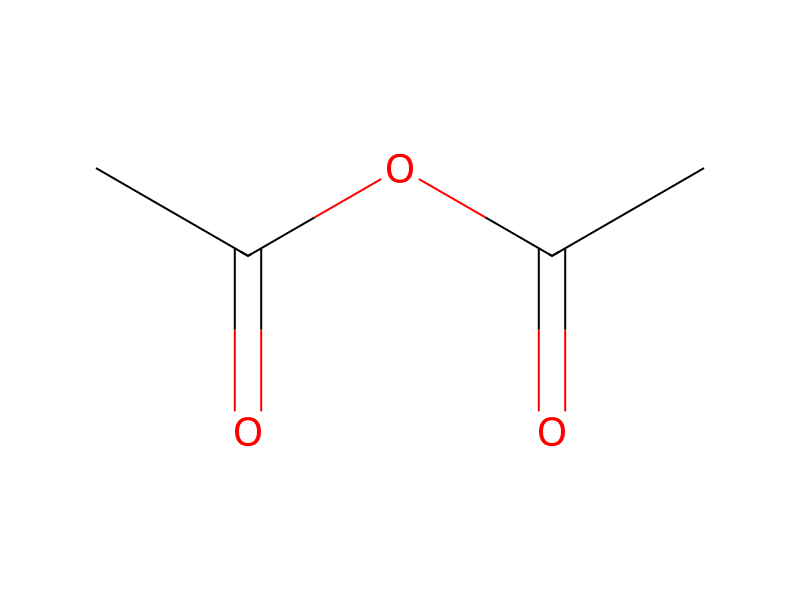
[CH3:1][O:2][C:3]1[C:16]2[C:7](=[CH:8][C:9]3[C:14]([N:15]=2)=[CH:13][CH:12]=[CH:11][CH:10]=3)[CH:6]=[CH:5][CH:4]=1.[N+:17]([O-])([OH:19])=[O:18].S(=O)(=O)(O)O>C(OC(=O)C)(=O)C>[CH3:1][O:2][C:3]1[C:16]2[C:7](=[CH:8][C:9]3[C:14]([N:15]=2)=[CH:13][CH:12]=[CH:11][CH:10]=3)[C:6]([N+:17]([O-:19])=[O:18])=[CH:5][CH:4]=1Participants
Reactant 3


Product 1

Reagents, catalysts & solvents 1
Procedure
4-Methoxyacridine (1.4 g, 6.67 mmole) was dissolved in acetic anhydride (5 ml) and cooled to 0°. Concentrated nitric acid (1 eq, 0.7 ml) was added, followed by concentrated sulphuric acid (1 eq, 0.7 ml). After stirring for 1 hr, the product was filtered and the residue was extracted into methylene chloride and washed with sodium bicarbonate solution. It was then dried and evaporated in vacuo to give 1.2 g (70%) of 4-methoxy-1-nitroacridine. NMR (CDCl3, 90 MHz) δ=4.20, s, 3H; 6.95, d, 9 Hz, 1H; 6.70-8.00, m, 3H; 8.34, d, 9 Hz, 1H; 8.55, d, 9 Hz, 1H; 9.82, s, 1H. The methoxy compound (500 mg) was converted to the 4-hydroxy derivative by heating with KOH (2 ml of an 11M aqueous solution) in DMSO (20 ml). This was tosylated with pyridine and toluenesulfonyl chloride to give the 4-tosyloxy derivative (260 mg, 34%). NMR (CDCl3, 90 MHz) δ 2.2, s, 3H; 7.00, m, 2H, 6.30-6.80, m, 7H; 8.20, d, 9 Hz, 1H; 9.45, s, 1H. The tosyloxy compound (600 mg, 1.5 mmole) was dissolved in acetonitrile (4 ml) and 1,7-diaza-4,10,13-trioxacyclopentadecane (110 mg, 0.5 mmole) were added, followed by 1,8-bis(dimethyl-amino)naphthalene (290 mg, 2 mmole) and the reaction mixture heated under reflux overnight. The reaction mixture was evaporated in vacuo and the residue taken into chloroform and purified by column chromatography (silica gel, ethyl acetate, hexane 1:1) to give the N,N-bis-(1-nitro-4-acridinyl)-diaza[15]-crown-5 as a yellow gum (180 mg, 27%). NMR (CDCl3, 90 MHz) δ 3.40, s, 4H; 3.82, m, 16H; 6.50, d, 9 Hz, 2H; 6.95, d, 9 Hz, 2H; 7.30, t, 9 Hz, 4H; 7.65, d, 9 Hz, 2H; 8.20, d, 9 Hz, 2H; 9.68, s, 2H.
Workup
- temperaturecooled to 0°
- filtrationthe product was filtered
- extractionthe residue was extracted into methylene chloride
- washwashed with sodium bicarbonate solution
- customIt was then dried
- customevaporated in vacuo
Sources & evidence
- ORD record
- ord-fe7670b02d1240588c0d502e3245e542
- Source dataset
- uspto-grants-1999_09
- Patent number
- US05948906
Reaction notes
Loading…