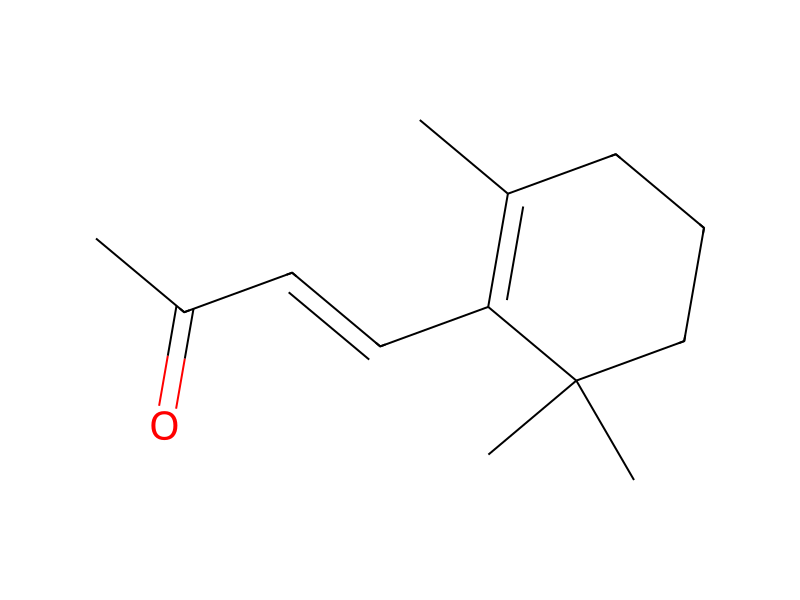
I2-Ionone → 3-(3-Oxobut-1-enyl)-2,4,4-trimethylcyclohex-2-en-1-one
Reaction equation

CC1CCCC(C)(C)C=1/C=C/C(C)=O.[CH3:15][C:16]1[C:21](=[O:22])[CH2:20][CH2:19][C:18]([CH3:24])([CH3:23])[C:17]=1/[CH:25]=[CH:26]/[C:27]([CH3:29])=[O:28]>>[O:28]=[C:27]([CH3:29])[CH:26]=[CH:25][C:17]1[C:18]([CH3:23])([CH3:24])[CH2:19][CH2:20][C:21](=[O:22])[C:16]=1[CH3:15]Participants


Procedure
To a 50-mL 2-neck reaction flask fitted with an additional funnel and a reflux condenser connected to an apparatus similar to that described by Johnson and Schneider [Org. Synth., 30, 18 (1950)] so that the mixture in the flask could be protected from atmospheric moisture, et al. throughout the course of the reaction were added a Teflon-coated spin bar and 1.0 mL of dimethyl sulfoxide (HPLC-grade). After sweeping the system briefly with a stream of nitrogen gas, the flask was heated to a temperature of approximately 100° C. (external oil bath temperature: 100-102° C.). At that point, a solution of 3.81 g (17.7 mmoles) of pyridinium chlorochromate and 1.00 mL (4.91 mmoles) of beta-ionone (both of which reactants were purchased from Aldrich Chemical Co., Milwaukee, Wis.) in 7.0 mL of HPLC-grade dimethyl sulfoxide was added dropwise to the reaction flask over a period of 30 minutes. This mixture was subsequently stirred at 100° C. for 12 hours. After cooling the mixture to room temperature, it was diluted with 50 mL of 2:2:1 (v/v/v) ether:hexane:dichloromethane, 50 g of crushed ice, and 125 mL of ice-cold 1 M aqueous sodium hydroxide. After swirling this mixture for several minutes, it was diluted with 150 mL of 15% (w/v) aqueous sodium chloride and the layers were separated. The organic layer was subsequently washed in successive order with 100 mL of 1:1 (v/v) 1 M aqueous NaOH: 15% (w/v) aqueous NaCl, two times with 50 mL portions of 1:1 (v/v) 2 M aqueous HCl: 15% (w/v) aqueous NaCl, 50 mL of 15% (w/v) aqueous NaCl, and 50 mL of saturated brine. The washed organic layer was then dried over anhydrous magnesium sulfate and subsequently filtered. Removal of the volatile organic solvents by evaporation at reduced pressure afforded 618 mg (61% yield) of the named diketone. The identity and purity of this compound were ascertained by comparison of its IR and proton NMR spectral properties with those previously reported for the same structure by E. Becher, et al., Helv. Chim. Acta, 64, 2419 (1981). For a more economical route to convert beta-ionone to the named diketone (the common name of which is 4-oxo-beta-ionone), see: Japanese patent 81,161,370 (Dec. 11, 1981), which is cited in Chem. Abstracts, 96, 199941t (1982).
Sources & evidence
- ORD record
- ord-9ee6feffe3854173b42057d884f682bc
- Source dataset
- uspto-grants-1999_09
- Patent number
- US05952519
Reaction notes
Loading…