Ammonia → 2,5-Cyclohexadien-1-one, 4-hydroxy-4-(phenylethynyl)-
Reaction equation

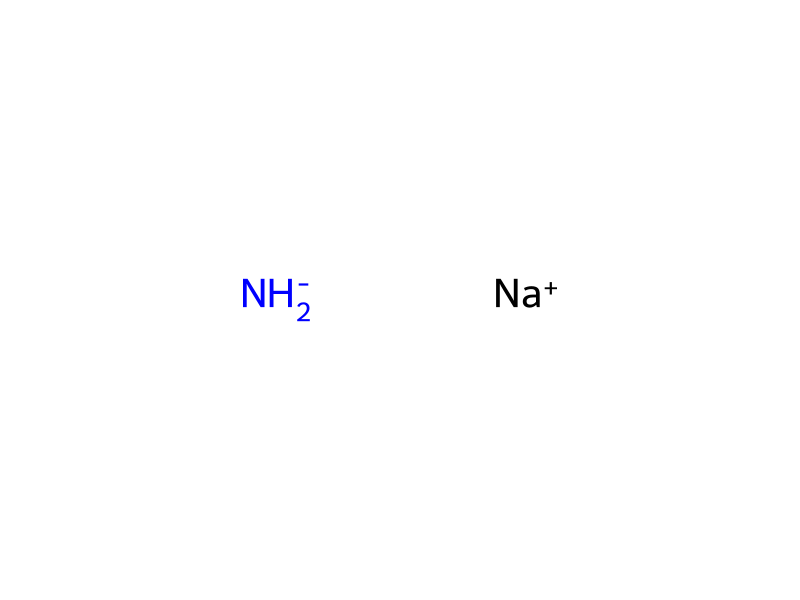
[NH2-].[Na+].[C:3]1([C:9]#[CH:10])[CH:8]=[CH:7][CH:6]=[CH:5][CH:4]=1.N.[C:12]1(=[O:19])[CH:17]=[CH:16][C:15](=[O:18])[CH:14]=[CH:13]1>C1COCC1>[OH:18][C:15]1([C:10]#[C:9][C:3]2[CH:8]=[CH:7][CH:6]=[CH:5][CH:4]=2)[CH:16]=[CH:17][C:12](=[O:19])[CH:13]=[CH:14]1Participants
Reactant 4


Product 1

Reagents, catalysts & solvents 1

Conditions
- Temperature
- -78 °C
Procedure
Sodium amide (0.35 g, 0.009 mole), dry THF (25 mL), and phenylacetylene (0.92 g, 0.009 mole) were placed in a 100 mL, three-necked round-bottomed flask under nitrogen. The reaction was heated at reflux while nitrogen was blown through the flask until ammonia evolution ceased. The reaction slurry was cooled to -78° C., then added to a mixture of benzoquinone (0.97 g, 0.009 mole) in THF (50 mL) at about -108° C. The reaction mixture was allowed to warm to -30° C., then quenched into a saturated solution of ammonium chloride and extracted with ether. The ether extracts were dried over anhydrous sodium sulfate, filtered and concentrated in vacuo. The residue was chromatographed as in Example 3 to yield 0.05 g (2.6%) of the title carbinol.
Workup
- temperatureThe reaction was heated
- temperatureat reflux while nitrogen
- temperatureto warm to -30° C.
- customquenched into a saturated solution of ammonium chloride
- extractionextracted with ether
- dry with materialThe ether extracts were dried over anhydrous sodium sulfate
- filtrationfiltered
- concentrationconcentrated in vacuo
- customThe residue was chromatographed as in Example 3
- customto yield 0.05 g (2.6%) of the title carbinol
Sources & evidence
- ORD record
- ord-2fa8d41e09cc4571bad1e02c790c6dcb
- Source dataset
- uspto-grants-1988_09
- Patent number
- US04772755
Reaction notes
Loading…